“Forget your perfect offering There is a crack in everything That’s how the light gets in.” – Leonard Cohen
“Can I be a rabbi if I can’t sing?” I sobbed to one of my teachers in rabbinical school. I’d struggled for years to find my voice, taking lessons, trying to force myself to make sounds that just wouldn’t come out of my mouth. I practiced relentlessly, but it never seemed to be enough. My teacher was soothing and supportive, pointing out how many strengths I had, and the many gifts I would offer my future communities as a rabbi. And prayer isn’t about having a beautiful voice, after all, she said. It’s about connection.
Similarly, many times, students have confessed to me that they don’t feel comfortable praying because they don’t know how to do it perfectly. They don’t know Hebrew, are not sure about their relationship with God, or they don’t know what they “should” be doing during the silent part of the prayer service. I’m always happy to help students build their prayer skills, but I have to wonder how many times we’ve missed the point because we’re trying to make the perfect offering. Even beyond the world of prayer services, I recognize that many of us have missed opportunities to connect with ourselves or with others in a deeper way because we are afraid to fail.
This week’s Torah portion is Parashat Tzav. Tzav means “command,” and the parsha opens with God telling Moses to command the priests to make offerings. The rest of the text details the long process of making a ritual sacrifice, and consequences for completing the ritual imperfectly. This long list of instructions may seem pedantic. But the language used in the parsha reveals additional meaning. While “tzav” צו means “command” in Hebrew, this word is also related to tzavta צוותא, which means “connect,” or “bond” in Aramaic. “Mitzvah” מצוה, which comes from the same word, means “commandment” and it means “connection.” Similarly, the Hebrew word for sacrifice is “korban,” קָרְבָּן which comes from the root, “karav,” קָרַב, meaning “to draw near.” God commanded us – tzav – to make sacrifices – korbanot – so we could tzavta – connect – and karov – draw near to the Divine Presence. It was all about connection and closeness with something bigger than ourselves.
After the Second Temple was destroyed in 70 CE, we no longer had a place to make sacrifices. The Sages had to design new ways to connect with God, drawing near to the Sacred during a period of distance and exile from everything they knew. The animals the priests offered in sacrifice at the Temple had to be unblemished, but without a Temple or priests, our ancestors understood that our offerings would no longer be perfect, or even uniform. Prayer was the innovation that came from this understanding. In the Temple’s absence, we learned to draw near to the Divine Presence that is alive in everything around us. We don’t need a Temple because our world is the temple. We don’t need priests because everyone can pray.
In Parashat Tzav, we are commanded three different times to never let the fire on the sacrificial altar go out. Without a sacrificial altar at a Temple, the fire that must be tended is an internal one – the spark of the Divine that each of us carries inside. 19th century Polish rabbi, Sefat Emet שפת אמת, wrote that any “distracting thought that enters the heart” during prayer is consumed in that inner fire. “That, in fact, is the true purpose of all those thoughts that rise up within the heart; they are there to be overpowered in the fire of worship. In this way, those distracting thoughts are purified and uplifted.”
Sefat Emet wants us to make our imperfect offerings. My distracting thoughts about my voice are there to fuel the fire inside me. The students’ feelings of uncertainty during prayer are there to do the same – to help them shed light on the reason why they pray, which is connection. I don’t have to sing perfectly in order to pray through song or lead prayer services. I can lead in different ways, using poetry and meditation, or I can partner with a strong vocalist. Most importantly, I’ve learned that I can still sing along with my community, letting the music move me into deeper connection with my community, and with the Divine. This parsha teaches us that we have to keep that light burning.
As we make our offerings on this Shabbat Tzav, if anything is holding you back, I invite you to consider the power of your imperfect praises, blessings, and prayers. Let the light of hope and connection get in. And if you are looking for a place to start, I humbly offer the prayer below – an interpretive version of a prayer we say as part of the daily and Shabbat Amidah. The original prayer asks for a restoration of the Temple, the priests, and the sacrifices. Mine asks instead for acceptance of the words we offer up – wholly imperfect and perfectly holy.
HaMakom, Our prayers are the offering and You are the Temple.
Our words rise to the sky like smoke from a flame, swirling above what is burnt, what is broken.
Holy One of Blessing, please accept them all: the words and wonder, the fear and awe.
Life is light and wood and burning. Every offering we bring before You is a way to draw near, a promise of our love.
Barukh Atah Adonai, mekabel ha’olot Blessed are You, Holy One, Who accepts our offerings.
“Rabbi,” she said, “I don’t believe in coincidences.”
I was strapping my daughter into her stroller for a walk when I received the call. Her name was Dr. Daniela Hermelin, and she was the Chief Medical Officer for ImpactLife Blood Center, an organization that coordinates blood donations. I had reached out to the local chapter in July to schedule a blood drive at Illini Hillel for today, October 12. I figured it would be an easy service program for students after the start of the Jewish new year. At the time, I couldn’t have known that my community would be reeling from the impact of a war and terrorist attacks that began in Israel on October 7th.
Even with the war tearing us apart, I believe the blood inside us unites us more than we are divided by blood spilled on the ground. Dr. Hermelin asked if Hillel was hosting the drive as a response to the war. I told her that I’d planned it months ago and that even though my students were deeply impacted by the war, we had decided to move forward with the blood drive. We could still make a positive impact by giving with our bodies, even with our hearts and minds on Israel and Palestine.
“It’s never the wrong time to do a mitzvah,” I said, and then explained, “a good deed.”
“Yes,” she responded. “I’m Jewish. And I’ve been in contact with Magen David Adom. If they need more blood, we offered to send some from our donors.”
I took a deep breath. Magen David Adom is the Israeli version of the American Red Cross. The organization is responsible for emergency medical care and blood services, and they treat any individual who needs help – regardless of ethnicity, race, or political or religious affiliation.
“I don’t want to make any promises,” Dr. Hermelin continued. “So far Magen David Adom doesn’t need more blood because they have so many donors in Israel. But you can tell your students there’s a chance that their donations today will save the lives of people impacted by this war.” My heart leapt into my throat.
“Rabbi, I don’t believe in coincidences. You didn’t know this would happen, but this is the day you chose to host a drive. If there’s anything I can do to support you and your students, let me know. I’m a Jewish mother. We are in this together.” Together – united by our shared humanity.
I felt tears on my cheeks, my first since the crisis began. All week I’d been in action mode, but my tears and words had been frozen inside me. I’d been texting students late into the night and meeting with students to help them process. I helped students advocate for academic support. As someone who tends toward action and care for others, until this moment, I hadn’t cried yet myself.
I thanked Dr. Hermelin for reaching out and told her I’d pass the message along to students. She promised she would update me on the partnership with Magen David Adom moving forward. “From one Jewish mother to another,” I said, walking my daughter down the street, “thank you.”
This week we read Parashat Bereishit, the very first chapters in the Torah. In Genesis 2:7, we learn that God formed the first human, adam from adamah, earth – “the dust of the ground.” God “breathed into his nostrils the breath of life, and the human became a living being.” The Hebrew word for human, adam, includes the word “dam,” which means blood, and adom, which means red.
The terror attacks and the war in Israel broke in the US on Sunday as we celebrated Simchat Torah, preparing again to read the creation story. All week, blood flooded my newsfeed as I watched, horrified from afar. All week, blood – dam – splattered on the earth – adamah. Blood of b’nei adam, children of the first human. All of them formed – as we learn in this week’s parsha – b’tzelem Elohim – in the image of God. Later in the same Torah portion, after Cain has murdered Abel, God cries out, “Your brother’s blood, dam, cries out to Me from the ground,” adamah.
These words from the parsha have been inside of me all week as I grieved for my student’s brother, an IDF soldier taken hostage, for an acquaintance of mine from Seattle, kidnapped and murdered, for the peace activists and concert-goers. I grieved for the babies, and for the mothers who would never be able to take their daughters on a walk again on a beautiful fall morning. The blood cries out from the earth. The blood cries out from inside of us. The blood that unites us all, b’nei adam, children of Adam, part of God’s marvelous creation.
In the book of Leviticus, Aaron, the High Priest, watches as his sons, Nadav and Avihu, die when they bring a sacrifice to God. A fire erupts and envelops them. There are no reasons cited for their deaths in the Torah, though many scholars have offered suggestions. After Nadav and Avihu die, the Torah says “Vayidom Aharon,” Aaron was silent. Sometimes there are no words for tragic loss. Vayidom comes from the word damam, a word for silence that appears only one other time in the Torah, referring to a stone-like silence – a paralysis.
As a mother who turned away but could not turn away from my newsfeed this week, I understand Aaron’s frozenness, his lack of voice – even though he was the leader who spoke for his brother Moses, when Moses could not speak himself. My own words and tears were frozen inside me all week – damam – a silent stillness – while I watched the dam of b’nei adam spill on the adamah. It was the call from Dr. Hermelin, the Chief Medical Officer of ImpactLife Blood Center, a call that came as I played with my own baby girl, that finally caused my thaw, allowing my tears and words to flow in response. “Rabbi,” she said, “I don’t believe in coincidences.”
I don’t know if I believe in coincidences. But I believe in humans, b’nei adam. I believe in the medical officer mother who reached out to say “thank you” and “you’re not alone.” I believe there is never a wrong time to do a mitzvah, and that we should always give blood when we can. Whether it supports victims of distant war that is close to our hearts, or patients in the hospital down the street, it makes a difference. I believe that we are each designed b’tzelem Elohim, in the image of God, and that our diversity reflects the different ways the Divine manifests on earth. And I believe that even as blood cries out from the land, the blood inside of us unites us. In time, when we are able to break through the damam, the silence and shock, I pray that we remember our shared humanity. May we use our voices to remind others – and ourselves – that we are in this together.
Sermon delivered at Illini Hillel on Yom Kippur – September 24, 2023
Believe or not, I used to think I was strictly an academic; I was working toward a history PhD, I loved studying, I was a strong writer and teacher, and I loved everything about history. But I couldn’t stand the graduate seminars, the posturing of my colleagues and professors, and the unrelenting stream of brutal criticism without a hint of positive feedback. I believed my advisor saw me as a failure, and, unfortunately, I began to agree with her. I was overworked, I’d lost my spark, and I was deeply depressed. I was also determined to keep at it. It was what I had always wanted, after all.
I only gave myself three hours off each week, and it was for Shabbat on Friday night. Every time I showed up at Hillel, one of the undergraduate interns asked how I was doing, and with a sigh of relief, I’d say “I’m so glad it’s Shabbat.” At the end of that year, I was given the “Shabbat Cheerleader” award at Hillel because I was always declaring my love for Shabbat. And I did love it, even when I felt miserable, alone in my work, and out of love with everything. I still have that award, a cardboard cut-out star with glitter around the edges, a reminder that, to paraphrase Achad Ha-Am, Shabbat has kept me more than I’ve ever kept Shabbat. When I thought of my identities, The “Academic” label wasn’t a lie, but it didn’t cover everything. I hadn’t yet internalized poet Walt Whitman’s famous statement: “I am large. I contain multitudes.”
Things began to change for me at the last Shabbat of the Jewish year, on the cusp of my second year in grad school. I was with the local Jewish community at the beach on a beautiful Friday night – the Santa Cruz California fog had cleared, the stars were bright, and the ocean crashed and receded on the shore. Families gathered on blankets around the bonfire as Rabbi Paula Marcus led us in song.
“Return again, return again, return to the land of your soul. Return to who you are, return to where you are, return to what you are, born and reborn again.” It felt like an awakening. I remembered that on Yom Kippur we talk about tshuvah, returning to who we truly are, as the final step of atonement. This means we have endless potential, and it means that everything we need to be our best selves is already inside of us.
There, with the sand and the sea, the song, the stars and the fire, a voice rose inside me, like smoke from a flame. It said “This is not who I am!I am not this miserable person. I am not a sad, cynical academic who fears my teachers and dreads my life every day. I’m not this person who cries on Sunday nights because I don’t want to face the week. This is not who I am!” And just like that, I realized that I had a choice. I didn’t have to get a PhD. There was more to me than being an academic. I promised myself that if I was still unhappy in December, I would consider other options. I went to bed grateful to have discovered this great epiphany – that I had choices. That I was free. ThatI contain multitudes.
We all have stories we tell ourselves about who we are. What stories are you telling yourself today? What stories have you told yourself this month? Until that moment by the ocean, I had been clinging to a single narrative, something I could believe about myself based on internal and external validation: I am a good student. I am an academic. I was sure I was following the best possible path for Heather the Good Student, and it became my entire identity. Everything else about me seemed unworthy of exploration. I couldn’t yet see the value in my empathy, my leadership and community building skills, or my growing passion for Jewish life.
Don’t get me wrong, there’s absolutely nothing wrong with “Good Student” as an identity. I want to celebrate all of you for your hard work as students today, and the work that brought you here. But here’s the thing – by this time, I was no longer shaping my story. My identity had begun to write the story for me. How much are you shaping your own story, and how much is it shaping you? Because my identity was writing the story for me, months after my beach epiphany, when I faced the reality of leaving this part of my story behind, I didn’t know who I was anymore. Without “Good Student,” what – or, rather, who – was left? I had a full-on identity crisis. It really felt like a loss. In addition to new anxiety about the future, I grieved the future I thought I’d have. I grieved the person I believed I’d always been. I didn’t know at the time that this little death would lead to a much bigger life
I’m standing here now as a rabbi and as living proof that identity crises are survivable. As it turned out, “Shabbat Cheerleader” was a more important part of my identity than I had ever realized. And thankfully, I’m not the first person in history to have had an identity crisis. Many characters face identity struggles in our Torah, but today I’m going to focus on one. Joseph – who spent parts of his life in a pit, a prison, and a palace.
A quick recap, for those who haven’t seen Joseph and the Amazing Technicolor Dreamcoat recently: Joseph was the youngest in the family, and he had the power to interpret dreams. He was also his father’s favorite, and his brothers were very jealous of him. His brothers cast him into a pit and sold him into slavery. Joseph’s brothers then lied to their father, Jacob, saying that a wild beast killed Joseph. Joseph worked hard as a slave in the palace and he eventually became a respected lead servant of Potiphar, one of Pharaoh’s advisors, having earned their trust. Then Potiphar’s wife falsely accused him of sexual assault, and Joseph was thrown into prison. As a prisoner, Joseph made a name for himself by interpreting dreams. Finally he was called on to interpret Pharaoh’s own dream. Joseph’s interpretation inspired the Pharaoh to quickly prepare the country in advance for years of drought, preventing widespread famine in the coming season.
Joseph’s family back home suffered during this famine, and his father sent his brothers to ask Egyptian leadership for assistance. By the time his brothers approached him, Joseph was the governor of Egypt, second only to Pharaoh himself, and Pharaoh had given him a new name: Tzofnat Paneach. According to some translations, Joseph’s new name meant “revealer of mysteries.”
This Joseph, this Tzofnat Paneach, whom the brothers entreated on his throne, was quite different from the Joseph who was their father’s favorite son, the Joseph they threw into the pit, and sold into slavery. This Joseph was even different from the Joseph who lived in the Egyptian prison. It’s no surprise that, although Joseph recognized his brothers, his brother’s did not see Joseph on the face of Tzofnat Paneach, the Egyptian governor.
Joseph tested his brothers, accusing the youngest, Benjamin, of stealing a silver cup that Joseph planted in Benjamin’s sack. Upon “discovering” this silver cup, Joseph threatened to enslave Benjamin. Fortunately, the brothers passed the test: Older brother, Judah, offered himself in Benjamin’s place, so that their aging father, Jacob, would not have to grieve the loss of yet another favored child.
When he learned that his father was alive, the Torah says, “v’lo yachol Yosef l’hitapek” – Joseph could not afak – contain – the secret of his identity. He asked everyone to leave besides the brothers, and he began to cry. “Ani Yosef,” “I am Joseph,” he told them. “Ha’od avi chai?”: “Does my father still live?” When he heard about his father, Joseph remembered where he came from – he was not only Tzofnat Paneach, governor of Egypt. He was also Joseph, the Jewish son of Jacob and Rachel, the boy from the pit and the prison, the interpreter of dreams. If his father continued, then so did Joseph. He was still, after all, himself.
His brothers were frightened and could not answer him, worried that their brother would exact revenge. But Joseph was not angry – they passed the test and showed that they had changed. They, also, were not limited in their roles as jealous older brothers.
“Come near me, I pray you, Ani Yosef,” he said again. “I am Joseph, your brother, whom you sold into Egypt.” He explained that they should not worry, saying God sent him to Egypt to ensure their safety during these years of famine. He told his brothers everything that had happened since they sold him into slavery, and Joseph sent them back home with food and other provisions, so the brothers could return with their father and the rest of the family.
“Ani Yosef,” “I am Joseph,” appeared twice within a few lines of this story. Why did he say his name more than once? Maybe the brothers were disbelieving, and Joseph wanted to prove his identity, explaining that he was, in fact, their brother, whom they sold into Egypt. Or maybe it was because Joseph was reclaiming this part of his own identity. It’s significant that Joseph could not afak, he could not contain Joseph, once he learned that his father was alive, even though he rose to power under a new name, Tzofnat Paneach.
It’s also significant that Joseph told his story as one of triumph, in which God had sent him to Egypt to save his family, instead of a story of victimhood, in which his abusive brothers sold him into slavery. Both of these things were parts of Joseph’s truth. Sometimes, trauma doesn’t have a purpose – it just sucks. Part of me wants Joseph to be really angry about what happened to him. And maybe he was. But in telling his story, Joseph had a triple revelation. First, he revealed his identity to his brothers, then he revealed that everything that happened was part of God’s plan, which was his way of making meaning from his trauma. But the resulting third revelation was the most powerful of all: Joseph revealed the truth to himself. After everything that happened, his father was still alive, and he was still Joseph as well as Tzofnat Paneach.
Joseph had multiple defining traumatic experiences, none of which solely defined him. At different points in his story, we see him drawing on his identities as a dream interpreter, a son, a brother, a servant, and a leader. Though trauma was a part of his story, and it always would be, Joseph saw himself in multitudes.
The new year has started, and I invite you to consider: How will you tell the story of your multitudes this year? What parts of yourself can you, like Joseph, no longer afak, no longer contain? Close your eyes for a moment, take a deep breath – and say to yourself, silently. “I am me.” What does that feel like? What identities are you holding? Are any of your identities writing your story for you? Is something external writing your story that shouldn’t be?
Over time I’ve learned to practice drawing on my experiences and identities, leaning into one and then another. I’m a writer, a learner, and a Hillel professional. I’ve been a distance runner, a caffeine addict, a band geek, and a person traumatized by infertility and pregnancy losses. I’ve been a Shabbat cheerleader, a grief guide, a theater person, and a leadership educator. I’ve been a person facing chronic mental and physical illness, I’ve been a camp director, a healer, a college student co-op enthusiast, and a living historian (true story – ask me about shooting Revolutionary war era muskets!). I’ve practiced Conservative and Reform Judaism. I am a Renewal Rabbi. I’m a wife, a sister, a daughter, a mom, a community builder, and an educator. Each of these identities has been a significant part of my story at one time or another. And the most important outcome of my revelation that night on the beach is that I can be all of these things. Even the things that are outside of my control – illness and infertility, for example – do not define my whole self. I get to choose which part of myself I’m leaning into every day.
Two years ago at Yom Kippur I spoke about Simone Biles, celebrating her choice to step back from a successful gymnastics career to focus on her mental health. To recap, by 2020, Simone Biles was considered by many to be the greatest American gymnast with seven Olympic medals and 25 World Championship medals, making her the most decorated gymnast in the history of the Gymnastics World Championships. At the height of her career, during the 2021 Olympics, she withdrew from the finals, citing mental health concerns.
Tonight I want to lift up the newest chapter of her story. Biles went back to gymnastics after a two year hiatus. She returned to this part of herself on her own terms, and she won an eighth National Championship at the end of August, breaking the record of Al Jochim, who won seven titles on national level, the last one in 1933. Biles said the most important thing she did for herself in the last two years was attend to her mental health needs. In a recent interview, Biles said, “There’s so much more in life than gymnastics. I love what I do. At the end of the day, yes, I am a gymnast. I’m really good at what I do. But I won’t be doing gymnastics forever. And there’s still things to look forward to, past gymnastics, where before I never thought so.So, now it’s just a part of what I do. And it doesn’t really define who I am as much anymore.” Biles is learning to honor different parts of her identity, deciding what parts of identity to prioritize, and she is celebrating her multitudes as she writes this next chapter.
We are each made in the image of the Divine. This means that God is One, and God’s Oneness manifests in multitudes. The Divine is alive in everything! God is in the thunder and the wind, flower petals, and yes, even mosquitos. God is in the mountains and the minutiae of daily life. As the Baal Shem Tov, the founder of Hasidism, wrote, “God is garbed in everything. No place is devoid of the Divine.” God is garbed in each of us. God manifests in our multitude of identities, and all of them are holy. If God-language doesn’t work for you, consider a teaching from another one of my rebbes, scientist Neil deGrasse Tyson: “The atoms of our bodies are traceable to stars that manufactured them in their cores and exploded these enriched ingredients across our galaxy, billions of years ago. For this reason, we are biologically connected to every other living thing in the world. We are chemically connected to all molecules on Earth. And we are atomically connected to all atoms in the universe. We are not figuratively, but literally stardust.” Stardust, manifest in multitudes.
When I was on the beach on Shabbat all those years ago, sitting under the stars at a dark time in my life, I could not have imagined that I would be standing here tonight as your rabbi, telling you this story on Kol Nidrei. I left that graduate program, but I still love learning – as a matter of fact, I started looking for a professional development program about three months after I finished rabbinical school. I’m not a professional academic, but the academic in me will always love being a student. We don’t have to be a professional at any activity in order to love it. What do you love to do, even if it’s not part of your life plan? For some of us it might be playing an instrument, or a sport, travel, or cooking. And, because we all have “great multiple futures,” as my friend and mentor, Josh Feldman, says, our passions and past identities sometimes show up as part of our careers or lives in ways we can’t even imagine – being named the “Shabbat cheerleader,” for example. I’m sure the Joseph at the bottom of the pit couldn’t have imagined that he would become Tzofnat Paneach, a powerful leader in Egypt, or that he would forgive his brothers. But even in that position of power, he realized that he was still, after all, his father’s son. After winning her eighth championship following a two-year hiatus, Simone Biles acknowledged that gymnastics is part of who she is, but it no longer defines her. God is One, and yet God – and the stardust that we are made of – manifest in the multitudes of existence.
We all contain multitudes. We are all expansive. We have so many pasts, presents, and futures to explore and inspire us on our journeys of becoming. Which parts of yourself will you return to in this season of returning? How will you honor your own wholeness?
This year and in the years ahead, you will have many opportunities to explore who you are and who you might become. Hold nothing back. “Dare greatly,” as Brene Brown has taught. Don’t let one identity write your story for you. Think about the part of your story you’ve been resisting, and how you might stretch yourself to write it this year. Or let your t’shuvah this Yom Kippur be a return to an identity you’ve abandoned and would like to engage again. Experiment. Play. Be curious and courageous. Repair the world, and do the inner work you need to heal yourself. Embrace the magnificent multitudes of “maybes” that lie within you, and the “great multiple futures” that await you. It’s 5784 and the possibilities are endless. May the stories we tell this year remind us who we are, and celebrate the multitudes contained within us.
Mezuzah (optional – you can do the rest of the ritual without a mezuzah if you don’t have one).
Jar or basket
This ritual should be done right outside the front door to the home.
Facilitator Life is a series of comings and goings, entrances and exits. We stand here now outside the doorway of our new home. Throughout this coming year there will be thousands of leavings and returnings, but only this doorway marks the threshold between the world outside and the world of our hearts.
The blessing inside the mezuzah, the V’ahavta, is a poem about love – You shall love the Source of Life with all your heart, with all your soul, with all your might. This commandment reminds us to enter and exit this home with love in our hearts.
Whatever we encounter on the other side of this door, we choose what comes inside with us, and what we leave on the doorstep. The love shared inside this home can be carried through the doorway as well, a reminder of what awaits us when we return.
To honor this sacred moment, in addition to affixing the mezuzah, we will each write three kavanot – intentions – we’d like to bring to life in our new home. What might we create in this space together? How do we want to feel when we enter and when we exit? What does it mean to each of us when we say “I am coming home?”
Take five minutes to write and reflect individually.
Once everyone has finished, say:
I invite you to share one or more of your blessings/hopes for our new home, and then add it to this jar/basket. We will keep the jar/basket at [a place in your home, perhaps a bookshelf in a central location].
Community shares.
Facilitator:
Thank you, everyone. In the Jewish tradition, HaMakom, The Place, is one of the names of the Divine. May we make this place, our home, holy every day with (list things people offered as blessings), and with laughter, love, and growing.
Affixing the Mezuzah (place scroll in case, recite blessing, then affix):
Traditional: Blessed are You, God, ruler of the universe who has sanctified us with commandments and commanded us to affix the Mezuzah.
Many people have approached me over the years requesting spiritual support for their infertility and pregnancy losses. I am always willing to offer this support when I can. I am posting a collection of my Jewish liturgy and rituals relating to infertility and pregnancy loss here for accessibility – for anyone who needs them. I am also available to teach clergy and other Jewish communal professionals about ways to support those in their communities who are facing infertility. It can be challenging to find a place in the Jewish world without children. But those who are longing for children need Jewish community more than ever. I hope these are helpful. Please feel free to reach out if you have questions or would like to speak more.
Infertility Speaks: An Imagined Support Group for Sarah, Rebecca, Rachel, and Hannah This is a script for an imagined infertility support group for Sarah, Rebecca, Rachel, and Hannah. You might use it as an alternative or in addition to the Torah reading on Rosh Hashanah day 1 (when we read Sarah’s story), or the Haftarah reading on Rosh Hashanah day 2 (when we read Hannah’s story). Or you might use it to open up conversation about this very painful topic with your community when you encounter any of these women’s stories in the Torah. There are suggested debrief questions to share with your community at the end.
Guided meditation for Parashat Terumah based on these sources – written by Rabbi Heather for Illini Hillel students
Plant your feet on the floor and sit in a way that is comfortable for you. Take a deep breath. Now take one more. When you’re ready, close your eyes or soften your gaze. Take another deep breath. Begin to feel your body relax. Your toes. Legs. Hips. Keep breathing. Release any tightness you’re holding in your torso. Your chest. Drop your shoulders. Keep breathing. Release your jaws. See if you can feel your eyes and ears. Relax those too. Take one more deep breath.
Picture yourself in a desert. In Hebrew, it’s called a midbar – it means wilderness as well as desert. Notice the sand – feel its texture beneath your feet [pause] Gaze up at the wide blue sky and the mountains [pause]. Notice the colors of the mountains. Brown, beige, red – what else is there? [pause] Breathe in the stillness. The silence. The emptiness. [longer pause]
Imagine a beloved leader is up on one of the mountains. You followed this leader out of Mitzrayim, the narrow place, and now you are here, in this vast, expansive wilderness. From the constriction of slavery you arrived in open nothingness. What does this nothing sound like? Smell like? [pause] You don’t know where you are going. You don’t know what’s coming next. You are afraid.
When your leader returns, you receive instructions. You are to build a mishkan, a sanctuary. Here in the desert. Here in the nothingness. Here where you’re far from everything you’ve ever known. A place for the Divine to dwell. God does not need this space – “God is garbed in everything. No place is devoid of the Divine.” But we need a space where we can connect with God. A sanctuary in the desert of our souls. What should this sanctuary look like? Imagine its colors and structure. What textures are part of this sanctuary? Take a few moments to explore it.
Now bring your attention back to your body with another deep breath. The rabbinic tradition links the mishkan to the human body. You are a dwelling place for the Divine.
Like your skin that covers and protects you, there are tapestries and wool hangings around the sanctuary. Your sense of touch is one of the first ways you connected with the world as an infant, while your other senses slowly developed. Your skin is a gateway to human intimacy. Imagine slowly dipping your hand into the desert sand. Notice its temperature, its texture. [Pause] Lift a handful of sand on an inhale. And release the sand with an exhale. Notice the sensation of the sand slipping through your fingers. [Pause] Take another deep breath. And when you are ready, you can release them.
There is an incense altar in the sanctuary, connected to your sense of smell. Scent can return memories to us from long ago. Inhale deeply now through your nose, and exhale through your mouth. Is there a scent that feels like a sanctuary to you? [Pause]
There is a menorah in the sanctuary, and a menorah in you – as the menorah sheds light, your mind, your intellect, enlightens your body. Take a deep breath and envision a warm light filling the sanctuary of yourself. Notice the quality of this light. Are there specks of dust that float across? What color is the light? White, yellow, blue, something else? Feel the warmth of this light that brightens even the darkest places, making the desert feel like home. [Pause]
Now place your hand over your heart and see if you can feel its beat. Tap. Bum-bum. Bum-bum. Tap gently with me. Your heart is the innermost part of the sanctuary – the Holy Ark, containing the Tablets of the Covenant. What else does your heart contain? Listen for its wisdom as you continue tapping. [Pause]
Take a deep breath and pause your tapping. You can keep your hand on your heart if you wish, or you can let it rest. [Pause]
Your body is the sanctuary. Your textures and colors, your breath and your skin. God said that all those whose hearts were moved to give, should bring a gift to the sanctuary. Everyone was asked to give according to their ability – no more, and no less. Every gift was perfect. Every gift was accepted. However your body looks or feels, you are a holy sanctuary. You are accepted. You are loved. You are whole. You are a dwelling place for the Divine.
Take another deep breath and we’ll sit with that for a moment. Explore the sanctuary within.[Pause]
Take another deep breath. Notice the ground beneath your feet. The temperature in the room. The sound of your companions breathing beside you. Take a last few deep breaths in this space and when you are ready, slowly, gently – open your eyes.
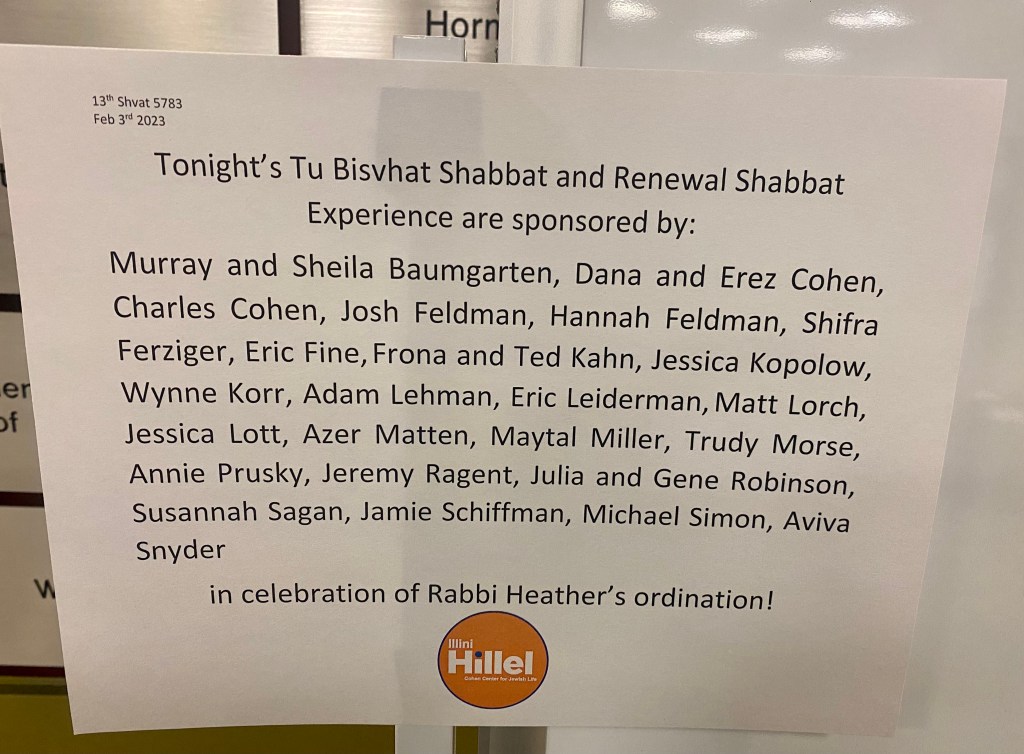
I gave this d’var at Illini Hillel on February 3rd, 2023 at a Renewal Shabbat experience in honor of my January 8th rabbinic ordination. I wanted to share something I learned about leadership during my rabbinical program with my community. This d’var was given on Shabbat Beshelach, two nights before Tu B’Shevat, the new year of the trees.
Where do untold stories go? Do we bury them like sacred texts? Do the stories turn into seeds underground? If the seed splits like the Red Sea, and a stem starts to grow, where does it go if it can’t burst through the soil, if it can’t rise up singing, if it never blooms?
Where do untold stories go? I’ve been asking this question for years in various leadership roles. We talked about it at Davvenen Leadership Training Institute, DLTI – the most formative training program I experienced in rabbinical school. Sometimes leading means we “tell the stories communities need to hear, instead of the stories we want to tell.” The best leaders know how to “hold space instead of taking up space.” As a leader, when I open up, it’s to create openings for others to grow. I am the soil, not the seeds. It’s an honor to bear witness, to share just enough that others are inspired to stretch, crack, and split through the shells of their seeds. It’s a blessing to empower others to grow.
I built a life out of soil and I like to think I’m good at it. I am soil when I train and empower students to lead, when I facilitate grief groups, and when I serve as a mentor. Until DLTI, I thought I made great soil because I am comfortable with the seeds of my own stories – I am comfortable with my vulnerability. However, over time I learned that while I’m open, that doesn’t mean I’m willing to be vulnerable. The stories I share are curated and crafted. I’ve written the stories before sharing them, or I’ve considered the role they play in others’ stories. I share when it’s something a mentee needs to hear, instead of a story I need to tell. That’s a way of being a leader, but it’s not vulnerability.
At DLTI, we took turns leading and then “labbing” prayer services. In labs, our teachers offered feedback on how to make the prayer service more powerful. Transformation occurred every time a prayer leader cracked open their shell, showing a hint of their own stem. We learned to lean into vulnerability in just the right way, to draw on our stories and lead from the heart. Leaders are the soil, but we are also in the soil. And we lead best when we let it show – not a lot, but more than I had in the past.
In a conversation with one of my DLTI teachers, I set a kavanah (intention) that I was going to try this vulnerability thing. I planned to tell a story that had been longing for soil at a Saturday night open mic, a story that truly made me feel vulnerable.
Saturday night arrived, and every presenter who came before me told their own hard story. They split their shells in the soil of our kahal (community) and beautiful, vulnerable stories bloomed all over the sanctuary. However, I noticed that the kahal was worn out from all the emotion – a few people left, and those left in the room were drained. It was time to tell the story the community needed to hear, instead of the story I wanted to tell. So when it was my turn, I shared a story that never fails to make me (and others) laugh. It felt good to lift people up. The tone was right on. Afterward, my teacher congratulated me, knowing I made the decision to share something lighter in lieu of vulnerability: “That was davvenen leadership,” he said. It was, and I was proud.
…until I was sad. Devastated. I figured I was just tired at the end of a long day and a long week. But where do untold stories go? The question was tugging at me. When I felt tears well up during a song circle later that night, I realized that 1am was not the best time to analyze my feelings, and I went to bed. Besides, I thought, these are the kinds of decisions I make all the time as a leader. Surely I’d be fine the next day.
But I wasn’t. A friend noticed, and we walked to a private space where I explained everything. My friend acknowledged that I made the right choice the night before, and then pointed out that this moment was different. She invited me to share the story I needed to tell. I hesitated, but she meant it. I let the seed crack open.
When I finished, I felt lighter. I learned an important lesson about vulnerability that day. I learned I could plan ahead and ask a friend in advance: “If I cannot tell this story tonight, can I tell you another time?” Or as an alternative, I learned to notice my need to share in moments when I can’t, and to honor that need by sharing with a friend later.
This question came up for me again at Hillel last fall. When a friend was in the ICU after an overdose, I wanted a morning prayer minyan for my friend’s healing. Progressive in-person minyanim aren’t regularly accessible here, so I figured I’d find a random one online. When Carly suggested I invite students I am close with to pray with me the next day, I was nervous. Should I be that vulnerable? Was this a story I needed to tell or a story the kahal needed to hear? When is it ok to ask the community I’m leading to show up for me, the leader? I decided to try it, I’m glad I did, and I’m grateful to those who joined me in prayer that day. Leaders need to both support and be supported. Sometimes leaders have to find support outside the community or outside the moment, like I did at DLTI. Other times it’s good to be vulnerable with those you are leading, like I was last fall. It’s hard to know the difference, but I’m learning every day.
We celebrate the leadership of Moses in this parsha – a reluctant leader whose brother Aaron had to help him share his story. Tu b’Shevat is on Monday, celebrating not only trees above ground, but seeds buried in soil, a generative darkness that encourages growth. In honor of this parsha and holiday, I invite you to notice your own opportunities to lead, grow, and lean into vulnerability this week. Every seed wants a chance to grow, and, as I continue to learn, even soil needs soil sometimes. Shabbat Shalom.
Presented at my rabbinic ordination ceremony on January 8, 2023
I became a mom on October 3, and today, I’m becoming a rabbi. “Mom” and “Rabbi” are two pretty big names to earn within three months. While my journey to motherhood included five years of infertility, pregnancy losses, and IVF, my journey to the rabbinate included five years of stumbling through Hebrew, wrestling with God, and finding my voice as a spiritual leader. I learned so much from both journeys. I can’t tell you which was harder. I can tell you that both have been worth it.
I can also tell you that having ALEPH community to support me through both journeys has been a powerful blessing, especially when I felt most isolated and uncertain. I found out I was pregnant at my first Ohalah Shabbaton in 2018. Reb Marcia was reading “Blessing for A New Beginning,” by John O’Donohue, and I teared up thinking about the two new beginnings that were “quietly forming” for me: the beginning of my life as a parent, and the beginning of my rabbinical school journey. I miscarried a few months later.
And since then, these two journeys have been deeply connected. At our last in-person Shabbaton in January 2020, ALEPH friends surrounded me with song and prayer in a private blessing circle for my IVF process. We recorded the songs, and my friends’ voices accompanied me to my doctor appointments. My daughter, Ella, who is watching from home with her daddy right now, came from an embryo transferred 10 days after the 2021 Ohalah Shabbaton. From January to January, from injections to hospital visits, from beginnings to blessings, we have been in it together.
For my ALEPH capstone, I put together a book of my original rituals and blessings. Many of the pieces were written in response to prompts from my teachers – holy homework assignments. And many of them are connected to my experience with infertility. A mikveh ritual for after an IVF miscarriage. A blessing for starting an IVF cycle, which I shared with ALEPH friends on Zoom the night before an egg retrieval.
In moments of pain and in moments of joy, blessings remind us that the world is holy. The Baal Shem Tov taught, “God is garbed in everything! No place is devoid of the Divine.” We do not make something sacred by blessing it. Blessings help us elevate the holiness that already exists. If there was anything holy to be found on my IVF journey, my ALEPH community elevated that holiness through blessings of love, presence, and compassion. I am grateful for the blessing of my daughter, for the blessing of this smicha, and for the beautiful neshamot who blessed us along the way.
As we take the next steps on our journeys, may we all be blessed with communities like the one I found here. May we be surrounded by people who remind us that holiness is pulsing through the universe, as close to us as our own heartbeats. And may we be blessed to be that blessing for others – elevating the Divine Sparks that shine around and within us, and reminding others, every day, that they are not alone. (Amen)
Dvar Torah presented at ALEPH’s ordination weekend Shabbaton on January 7, 2023
“Can I take the place of God?” Joseph surveyed his pleading brothers. His brothers, who threw him into a pit and sold him into slavery all those years ago. Their father, Jacob, was dead now, and his brothers were worried he would pay them back for what they had done.
Joseph said to them, “Al-tirah, ki hatachat Elohim ani?” “Don’t be afraid, for can I take the place of God? Although you intended me harm, God intended it for good, so as to bring about the present result – the survival of many people.” As a leader in Egypt, Joseph saved his people from terrible famine, and he saw God redirect the evil his brothers intended toward this positive outcome. Joseph refused to respond to his brothers’ hateful acts with his own.“And so, don’t fear,” he repeated. “I will sustain you and your children.” The text says he comforted them, and spoke to their hearts.
A flashback: Joseph’s parents, Jacob and Rachel were facing infertility, long before Joseph was born. Rachel, envious of her sister, Leah, who had children, said to Jacob, “Give me children, or I shall die.” Jacob became angry. Vayomer, “Hatachat Elohim anochi asher-mana mimech peri-baten?” He said, “Can I take the place of God, who has denied the fruit of your belly?”
“Can I take the place of God?” The same phrase – hatachat Elohim – in the voices of father and son. While Jacob lashed out, using this phrase in anger, Joseph softened it.
When Jacob said “Can I take the place of God,” he didn’t speak to Rachel. The text de-emphasizes their relationship, saying “Jacob said,” not “Jacob said to Rachel.” We can imagine Jacob throwing up his hands in rage, spitting out the phrase “Can I take the place of God?!” He couldn’t be present in relationship with Rachel. He couldn’t respond to her pain because he was exploding with his own, blaming God for denying fruit in baten, her belly. Notice that he does not use the word rechem, womb, which shares a root with rachamim, compassion, because there was no compassion in his reaction. After this, Rachel gave him her handmaid, Bilhah, who bore two children on Rachel’s behalf. The first child, Dan, means judgment. The second, named Naftali, means struggle. Anger and jealousy begat judgment and struggle. When Rachel finally gave birth, she named her son Yosef, Joseph, meaning “increased.”
After Jacob’s death, Joseph said the same words to his brothers.“Can I take the place of God?” But the text says Vayomer Yosef aleihem – Joseph spoke to them. Unlike Jacob and Rachel, the text emphasizes the relationship. Further, Joseph addressed their feelings first: “Do not be afraid.After all, can I take the place of God?” He comforted them, and spoke to their hearts. He brought in the compassion that was missing from his father’s exclamation.
Like his father, Joseph believed this was all part of God’s plan. In Jacob’s situation, “Can I take the place of God” meant “I’m not God. I don’t decide who can give birth.” In Joseph’s situation, “Can I take the place of God” meant “God sent me here, not you.” Both Joseph and Jacob believed God was responsible for their experience, but Joseph had the advantage of hindsight, and understood the reason.
It is so much easier to make meaning out of trauma once the reason has been revealed and you’ve moved beyond it! Jacob and Rachel were facing infertility when Jacob lashed out in anger – yes, at Rachel, but perhaps also at God and himself. Not knowing how things would turn out, Jacob only knew he could do nothing about his wife’s suffering. I get it. Sometimes I’m angry I can’t change my situation, and sometimes I’m too upset to be compassionate toward myself or others. I’m sure you can think of moments like that too. Maybe you blamed a loved one, God, or yourself. We’ve all been there.
Joseph was in a significant leadership role, like many of us. He rose from the pit to the palace, and made meaning from his pain by acknowledging the blessings that came from it. He was in a position not only to support his family financially, but to see and speak to them with compassion. I’ve found that sometimes, after growing through trauma, we are better able to make space for others in their suffering, and to appreciate the blessings that appeared along the way.
This brings me to one difference in the words Joseph and Jacob used to say the same thing: “Can I take the place of God?” Joseph said “Hatachat Elohim Ani?” Jacob said “Hatachat Elohim Anochi?” Both “Ani” and “Anochi” mean “I.” The Zohar teaches that Anochi is associated with Binah, one of God’s upper sefirot, a part of God that is transcendent and hidden from the world. Ani is associated with Shekhina, the Divine Presence, the aspect of God that is most accessible to us on earth. Jacob used the word Anochi. For him, God was responsible for the infertility – but God and the reason were hidden. Jacob was unable to find meaning in his wife’s pain or his own. For Joseph, who used the world Ani, the Divine and the plan were revealed; Joseph was able to make meaning from it, and could respond to his brothers with kindness.
We can’t expect ourselves – or anyone else – to find meaning, or to find God, in the midst of trauma. But that doesn’t mean we can’t pray or seek the Divine at those times. Some of our favorite Hasidic masters taught us how!
None of us are in the place of God. We have limited control over our outcomes. Sometimes that’s frustrating and sometimes it’s a relief – who wants that responsibility? Either way, when it feels like God or meaning are distant or hidden, we can learn from Jacob’s outrage, and we can remember to treat ourselves and others with compassion instead. And when we have come through our trauma, when we’ve emerged from the pit to find ourselves in the palace, like Joseph, we can remember to appreciate the Divine blessings in our lives. We can speak to the hearts of those who fear, and act in the world from a place of love and compassion.
A Shofar Offering – Shofar’s Cry: Sarah and Hagar Speak This is an interpretive Torah experience for Rosh Hashanah, incorporating Hagar’s story from the Torah reading on the first day of Rosh Hashanah, and the Akedah, which we read on the second day. This is designed to be read aloud by two people, each taking one of the parts. It would work well on Zoom as well as in person. Please feel free to use it with attribution.
A Haftarah Offering – Hearing in our Hearts: Hannah’s Story In Tosefta Brachot, the rabbis said, “Hannah spoke in her heart,” meaning that her lips moved, but sound did not escape them. This poem is for those who know the words that were on Hannah’s heart, and for those who need to hear them to understand.
Afternoon learning offering – Infertility Speaks: An Imagined Support Group for Sarah, Rebecca, Rachel, and Hannah This is a script for an imagined infertility support group for Sarah, Rebecca, Rachel, and Hannah. You might use it as an alternative or in addition to the Torah reading on Rosh Hashanah day 1 (when we read Sarah’s story), or the Haftarah reading on Rosh Hashanah day 2 (when we read Hannah’s story). Or you might use it to open up conversation about this very painful topic with your community when you encounter any of these women’s stories in the Torah. There are suggested debrief questions to share with your community at the end.
Yom Kippur liturgical offering – Held in the Brokenness: A Prayer for Forgiveness This is a prayer for repeat mistakes – the ones we come back to over and over, the ones we find ourselves thinking about on each Yom Kippur.
Yom Kippur liturgical offering – Unknowable A prayer about God in search of us, with a reference to God asking for our forgiveness on Yom Kippur
Gun violence prayer – Mourners Kaddish for Mass Murder This is for anyone speaking about gun violence on the High Holidays this year