Contagious Courage: 5787

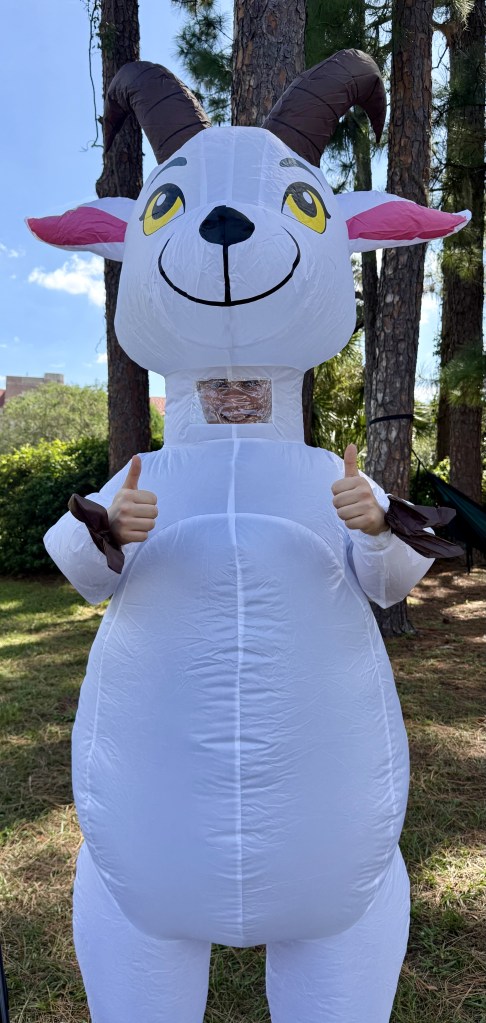
On Thursday, I stood out on Landis with a giant goat. More accurately, it was with my coworkers, Sam and Emma, who took turns wearing a giant inflatable goat costume. As people walked by, I called out, “Would you like to confess anonymously to this goat? He’s a really good listener!” Some people stopped, took pictures, laughed. Others said “No thank you,” or “I’m running late to class.” “Next time then!” I called out after them.

Several people however, did stop and write their sins on slips of paper. When they came to the table with a friend, both friends participated. “I lied to my best friend.” “I used AI on an exam.” “Excessive drinking.” When people saw others had stopped, they stopped too, and shared their confessions with an inflatable goat. It took courage for them to open up in that way – to do something silly and raw and real. They were open to experimenting with communal release, in public, on a busy Thursday afternoon.

Communal release is part of our holiday tradition. In the Torah, on the first Yom Kippur, the High Priest sacrificed one goat, and put his hands on another. He sent that second goat off into the wilderness, carrying the sins of the whole community. The original scapegoat. Thanks to Sam and Emma for carrying our sins back through campus wilderness.

It doesn’t have to just be sins. On Friday night, we had another opportunity for our community to open up, share, and try something unique. Yom Kippur is about reflecting on ways we missed the mark and the mistakes we’ve made, so we invited people to tell their epic fail stories. With enthusiasm and encouragement from a student leader, Rya, who recruited friends, and shared first, others felt more comfortable sharing their fail stories. And we all had a great time laughing about it together. In both of these scenarios – the campus goat adventure and our epic fail storytelling program – it took one person’s enthusiasm and openness to trying something different to spark the participation of those who followed. It turns out we are all influencers, and our actions are contagious.

Much like these two activities, our Yom Kippur service is designed to recreate this space for communal release. Prayer was an innovative, brand-new, experimental response to the inconceivable disaster of losing the Second Temple. Without a Temple or a High Priest to sacrifice a goat on our behalf, we now voice our transgressions as a community through prayers like Ashamnu and Al Chet. These prayers are spoken in the plural – a kind of contagion through ritual, designed to spread atonement through communal action and speech.

We all remember contagions and how they work, right? During lockdown, many of us learned far more about it than we’d ever planned to. And these days, it’s coming back to me, as my daughter’s preschool sends home notices about diseases traveling through her class, with reminders to wash hands. Those pandemic years taught us how vulnerable we are to contagion – that what’s inside of me touches what’s inside of you. That the health of one person can change the health of the world. We truly are all inter-breathing. And while that’s terrifying in the face of illness, it also reminds me how intimately connected we are – by our breath, by our bodies, by the Oneness of the world.

This intimacy means we have the power to infect one another, to spread both physical and spiritual diseases. But that’s not the only option. My friend and mentor, Lee Kravetz, who is a marriage and family therapist, science journalist, and author in the Bay Area, wrote a book about social contagion, the spreading of behaviors, thoughts and emotions: “Whether it’s mirroring someone’s posture or mimicking someone else’s speech patterns, we are all driven by unconscious motivations triggered by our environment.”

Social contagion theory teaches us that behaviors are infectious. Emotions are viral. Even thoughts are catch-able. How we interact with individuals impacts not only how they interact with us – but also how they interact with others, with themselves, and with the world around them. We have the ability to influence others with something as minor as a smile, or eye contact, the colors we wear, the tone of our voice, the images we post on social media. And the most remarkable thing about them? Social contagion, like physical contagion, is often completely unconscious. We pick up on cues from the world around us all the time without even noticing what it was that shifted our mood or colored our experience. More important, I find, is that we are inadvertently influencing others’ thoughts, feelings, and behaviors, as well — and that includes positive cues, like courage, happiness, laughter, and benevolence.

As we enter a new year, I wonder what it would look like if we leaned into that power. How might we learn to spread the opposite of disease? Can we spread resilience instead? Or wonder? If one person tells a story, others are more likely to share their own. If one person is brave enough to hand their confession to an inflatable goat, others in their friend group will do the same. It’s not cringe if we’re all in it together, right? What would it look like to dedicate this year to spreading a contagion of courage or curiosity?

Jewish sources include many examples of social contagion. Perhaps unsurprisingly, a lot of them are stories in which social contagion spreads for the worst – even in biblical times, bad ideas quickly went viral. Consider the story of the golden calf in the book of Exodus. The Israelites arrived at Mt. Sinai after many years of wandering in the desert, after God freed them from slavery. Moses went up the mountain to receive the Torah from God, and said that he would return in 40 days. The first emotion to spread was uncertainty. According to medieval commentator, Rashi, there was some confusion about the timing – would Moses come back on the sixteenth of Tammuz or the seventeenth? Did those 40 days include the day that Moses went up the mountain? When would Moses return?

The next emotion that went viral was fear. Commentators disagree about which influencer started spreading it, but soon, just about everyone was terrified that Moses would not return, believing instead that that God abandoned them to die in the desert. Some commentators say that Satan – yes, contrary to popular belief, Satan does appear in Jewish texts, but that’s a dvar for another day – Satan exacerbated the situation by showing the people an image of Moses, dead on the mountain, that was so real, the Israelites could reach out and touch it. Satan was an influencer who must have had access to great AI, right? Have you ever fallen into an anxiety spiral where the story in your head is more real than what’s in front of you? Did your fear come from a seed sewn by someone else? Many of us know what that feels like.

You know what happens next – even Aaron, Moses’s brother, who truly was an influencer, participated in building and worshipping a golden calf, a false idol. The Israelites had just come from enslavement in Egypt, where idol worship had been the norm. It makes sense that they would turn to something familiar at a time of uncertainty and fear. Raise your hand and if you’ve turned to a familiar but unhealthy coping mechanism in a moment of uncertainty. Me too. These are our golden calves.

Moses was angry that the Israelites had given up on God, who brought them out of Egypt. But he understood, and he pled to God on the Israelites’ behalf, an act of compassion in his moment of hopelessness and rage. Thankfully, God heard Moses’s plea, and decided to punish the Israelites with a plague instead of something worse. Moses returned to the mountain and received the Torah for a second time. When he came back down, he brought a new set of tablets with him. Our ancestral calendar tells us that this occurred on 10th of Tishrei – which is today. We commemorate God’s forgiveness for the golden calf incident each year on Yom Kippur.

When social contagion spreads, it’s hard not to get swept up in the current. But not everyone does. Even in the story of the golden calf, the Torah noted that women refused to give their jewelry to Aaron to be melted down for the calf’s construction. And according to a midrash (a story about the Torah, which I like to call “Torah fanfiction”), the tribe of Levites also did not give in. The midrash also says that Miriam’s son, Chur, denounced those who were spreading fear – and he paid for it with his life. The angry and terrified crowd murdered him for standing up for what he believed in. It’s hard and sometimes dangerous to share a dissenting view when a social contagion spreads within a negative and reinforcing echo chamber.

What about positive examples of social contagion from our tradition? Two took place at the Sea of Reeds, more commonly known as the Red Sea. A midrash teaches that when the Israelites stood before the Red Sea, with Pharaoh’s army behind them, one man took the first steps into the water. The man was given the name Nachshon, which comes from nachshol, “of the sea.” Nachshon faced the water, and the future, with bravery, and his courage was contagious. The others followed, and the sea split.

After the Israelites made it to the other side and the army drowned in the waters behind them, Moses and Miriam each began to sing the song of the sea. Rashi says that Miriam thought to pack her timbrel as they were leaving Egypt because she believed so strongly in the coming redemption. When they began to sing, others joined Moses and Miriam in this joyful prayer of thanks to God.This is an example of a social contagion that started with one voice, and spread to many. And it’s a contagion of gratitude that spans the generations. This prayer is among the oldest lines of poetic verse in the Torah and they’re part of our daily liturgy. Mi Chamocha, ba’eilim Adonai? Who is like You, among the mighty, Adonai?

A final moment to share, also from Exodus, takes place in the Torah portion we read the week after the incident with the golden calf. In Parshat Vayakhel, God tells the Israelites to build a mishkan, a sanctuary for God. “Everyone whose heart so moves him shall bring gifts for the Lord – gold, or silver, wool or linen, wood or oil, spices or stones, anything to make the Sanctuary more glorious for God,” said Moses. The Israelites, moved by their hearts, brought all kinds of golden objects, colorful wools, silver, copper, and acacia wood. They worked together to make the Sanctuary sacred for God. They eventually brought so many gifts that Moses had to ask them to stop. I love this contagion of giving. And I love the Israelites for how human they were. Of course they yearned deeply to give to the Holy One, to give so much that they had to be asked to stop – right after so many of them spread and gave in to the contagion of fear that led to the building of the golden calf.

I’m sure many of us can think of contemporary social contagions, both negative and positive. Today I’m going to consider just one example from the 2021 Olympics. When celebrated Olympic gymnast, Simone Biles, decided to withdraw from the 2021 individual all-around competition to protect her mental health, her decision set a wave in motion. “I say put mental health first,” Biles said. “Because if you don’t, then you’re not going to enjoy your sport and you’re not going to succeed as much as you want to. So it’s OK sometimes to even sit out the big competitions to focus on yourself, because it shows how strong of a competitor and person that you really are — rather than just battle through it.” We’re just going to sit with that for a moment. Such a powerful statement about what matters most. Afterward, although a few commentators accused Biles of being a “quitter,” Biles’ decision to prioritize her mental health was generally widely praised and credited with starting a wider conversation about the role of mental health in sports. Other gymnasts relayed their own stories of struggle as a result of her sharing. Biles sent a message to all of us about the power of prioritizing health over performance. Before she withdrew from the competition, the website formerly known as Twitter celebrated the gymnast’s excellence in her sport by creating a Simone Biles emoji that appeared whenever someone used the #SimoneBiles. After she withdrew, people continued to use that emoji, along with another hashtag: #mentalhealthfirst. Simone Biles taught us all that this is what excellence looks like.

The ideas we share, the emotions we express, the stories we tell ourselves and others, all have the power to spread. Will we spread fear and distrust this year, building more false idols? Or will we spread something different, building a sanctuary of courage, curiosity, and healing with our words, our choices, and our actions?
I want to clarify that I’m not encouraging anyone to spread toxic positivity – to “just be positive” in the face of suffering. Pretending that things are ok, when they’re not, is another form of idol worship at a time when the truth demands to be seen. Let’s be honest about the threats of our world, but let’s think about how we respond to them. Another dear friend and mentor of mine, Josh Feldman, says that “Our daily experiences are a laboratory for the invention of the future.” When we are in a lab, trying to create the next great invention, sometimes the experiment goes wrong. The data we collect from each experiment, even the failed ones, help us decide what to try next. We are not here to deny the darkness. We are not here to ignore the facts. We are here to decide what to do with them.

The great 19th century Ukrainian rabbi, Rebbe Nahman of Breslov taught “Kol Ha’Olam Kulo, Gesher Tzar Me’od,” the whole world is a very narrow bridge. And we have been misquoting the second part of his teaching for years. In song and story, we say “lo lifached klal,” which means “the most important thing is not to fear at all.” The whole world is a very narrow bridge and the most important thing is not to fear. But here’s the thing. In Nahman’s teaching, he says “v’hayikar lo l’hitpached klal.” Hebrew grammar nerds, do you know the difference? The most important thing is not to make yourself afraid. Nahman used a reflexive hitpael verb. It’s not about NOT being afraid at all. It’s about not making ourselves more afraid. It’s about self-awareness, recognizing that fear, naming it, and responding appropriately. It’s about crossing the bridge while we are afraid, leaning into our curiosity and courage, so we can find out what is on the other side.

What if the Israelites had approached their fear with curiosity and honesty while Moses was on the mountain receiving the Torah? “Wow,” one might have said to the other. “I’m really scared right now. I’m not sure when Moses is coming back and I’m having a hard time trusting that we will be safe with God in the future.” That’s a truth worth sharing. “I’m afraid too,” the other might have responded. “Thank you for telling me. This is all really new for me, and idol worship used to feel so comforting. I’m grateful to know I’m not alone.” Vulnerable sharing, supporting one another, and speaking from your own experience, are also contagious behaviors. That might have been a better response to the facts of their fear.

The new year has begun and there’s still a lot of darkness around us. From the effects of climate change to gun violence, to wars erupting in the world and the wars within and between us. We know now that the health of one person can change the health of the world. Social contagion theory teaches, and our Torah shows us, that the hope, courage, voice, and generosity of one person can change the world too.

So I have a question for all of you. What will you spread this year? How will you respond to the darkness? And how will you model what you want to see in your community when you show up as part of it?

This year, spreading curiosity, wonder, or resilience may be a small act of bravery for you, an attempt to plot a better course, even when you feel the current pulling in another direction. Maybe it feels like a radical act, taking a bold step into the sea of your uncertainty, like Nachshon, or bringing the timbrel with you, like Miriam, because some part of you believes redemption is possible. Maybe you’ll put your mental health first and inspire others to do the same, like Simone Biles. Maybe you’ll cross the bridge while you’re afraid. Maybe yours will be the voice that encourages others to join the song.

Author and researcher, Brene Brown, says to “Dare greatly,” teaching that “Vulnerability is the birthplace of innovation, creativity and change.”

So, tell me, influencers – How will you dare? What will you be spreading this year? Call it out. 

Thank you everyone. May we carry these messages in our hearts and into the world, and may we be blessed with the courage to bring them to life.
Empty, Open, Receiving: Wilderness Lessons from Shavuot

This post appeared in another format on the Hillel International blog on May 20, 2026

“May I be empty
and open to receive the light
May I be empty
and open to receive   

May I be full 
and open to receive the light
May I be full 
and open to receive”

Shavuot celebrates a time of receiving. After a long period of wandering in the vast, empty desert, the Israelites arrived at Mt. Sinai to receive the Torah. This was the great revelation after our liberation. It was the moment of our becoming a people. 

There are many beautiful commentaries that explore how Torah was given and received, and who was there to receive it.  Midrash Tanchuma says that the Torah was received in the wilderness because “Just as the wilderness is ownerless, available to all, so too the words of Torah are ownerless, available to all.” Midrash Shemot Rabbah teaches that “Not only those who were in the wilderness stood at Sinai, but also the souls of all future generations.” Shemot Rabbah also says that God’s “voice went forth and divided into seventy voices, in seventy languages, so that each and every person would hear according to their capacity.” 19th century Hasidic master, Sefat Emet, took this a step further: “The voice was for each person according to their capacity…And so within each and every person there is an aspect of the giving of the Torah…for the utterance is heard both outside and within.” Sefat Emet also wrote that the Torah was both given once, and that its giving is ongoing in the present. 

Together, the text and commentaries teach that we were all there, together in that ownerless wilderness, receiving a message that was both personal and communal, a message that belonged not only to one person or even one group of people – but to everyone. Each time we interpret, innovate, or uncover a message from our ancestral tradition or from the torah within, we become part of the great unfolding story of our people’s revelation at Sinai. 

I’ve been reflecting recently with graduating seniors who are facing their ownerless wilderness – the uncertainty of life after college. A memory from one of my own times of wandering, as well as these teachings about Shavuot, have been a helpful framework for them as they prepare for their next steps. 

In June 2008, I had just finished a master’s degree in history at UC Santa Cruz. I had planned on pursuing a PhD and becoming an academic historian, but throughout my time in the program, it became clear that this wasn’t the right path for me.  But I didn’t know what else I could do instead, and I was terrified in the uncertainty of this wilderness.  My story was ownerless and wide open. I felt lost as I frantically applied for jobs. To make matters worse, it was 2008, and the country was in its own desert: an economic recession. 

At the same time, a beloved rabbi was preparing to leave Santa Cruz Hillel, where I had been an involved participant throughout undergrad and graduate school. I felt honored when a committee asked me to join them in a hiring process for the new staff member. I cared about the future of our Hillel, and I figured that it would help to see the other side of a hiring process while I applied for jobs. Then, after we had interviewed a couple of candidates, one of the people on that committee turned to me and asked, “Heather, why haven’t you applied for this position?” It was a Sinai moment. 

I had never considered working for Hillel, but the more I thought about it, the better it felt. I didn’t know what to do with my life, so why not give back to an organization that had given me so much?  Hillel had always been there for me, a reliable, loving space, no matter what happened in the rest of my life, and I was excited about the opportunity to create that space for others. When I look back, I realize that Hillel was there for me in that moment as well, a path forward in the wilderness of my job search and identity crisis. Like so many in our ancestral tradition – including Moses when he encountered God in the burning bush – it wasn’t just that I happened to be in the wilderness. I had to be in that vast unknown before the path forward was revealed. I am grateful every day that I was open to receiving this message that guided me into my future. I never would have predicted it, but 18 years later, I’m still working for Hillel, and I’m a rabbi. 

This story has become part of my own torah, a moment I return to whenever I’m facing another wilderness, or when I’m speaking with a student who is facing theirs. When we are in the ownerless wilderness, it can be tempting to narrow our vision, to focus on the familiar because the unknown is so scary. But Shavuot and the commentaries on this holiday teach us that we are all at Sinai,  receiving the Divine voice according to our own capacity. Sometimes it arrives in the voice of a friend or mentor, who sees something in us that we couldn’t see in ourselves. 

Shavuot celebrates our receiving, but that moment at Sinai was not only a moment.  As Reb Zalman Schachter-Shalomi (z’l), taught, the divine broadcast is eternal; “the question is whether we have our receivers turned on and tuned to the right frequency.”  The Torah is still being given. We are still receiving – and creating! – Torah. It’s all a matter of how attuned we are, how open we are, to receive what’s coming through. What might you receive if you make yourself open, free, and ownerless like the desert? What is the torah, the wisdom of your heart, that reveals itself to you when you are ready to truly listen? 

The Kabbalists taught that we should read “midbar,” wilderness, as “midaber” – “to speak.” To tell. To create worlds with our words. Revelation is not only about what we receive, it’s about how we respond. What we do with what we receive. How many times have you ignored or tried to brush off some piece of advice, some internal, deep knowing? What would change if you not only noticed, but acted meaningfully in response? 

You are most likely in your own wilderness right now, and with Shavuot approaching, I encourage you to tune in to the Divine broadcast. Notice who is standing with you at Sinai, and open yourself to receiving whatever message comes through. Torah belongs to all of us, and the Divine voice is all around you and inside of you. What is the message that is meant for you? How will you respond when you receive it? 

Threadnody

Threnody (n): a song, poem, or musical piece composed as a formal lamentation or memorial for the dead

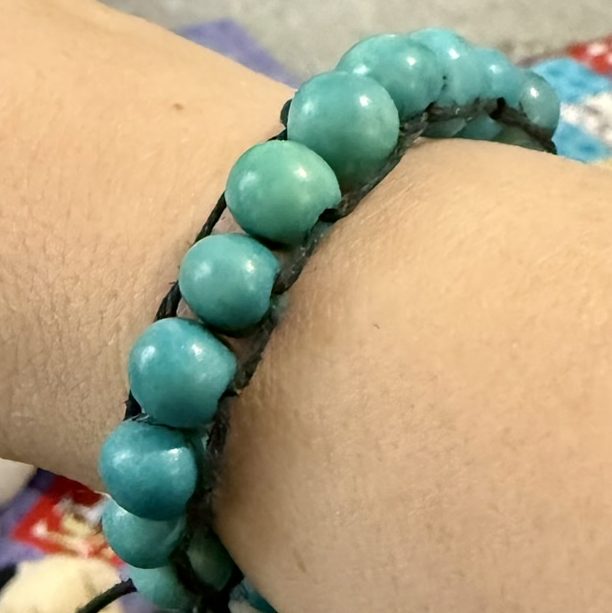
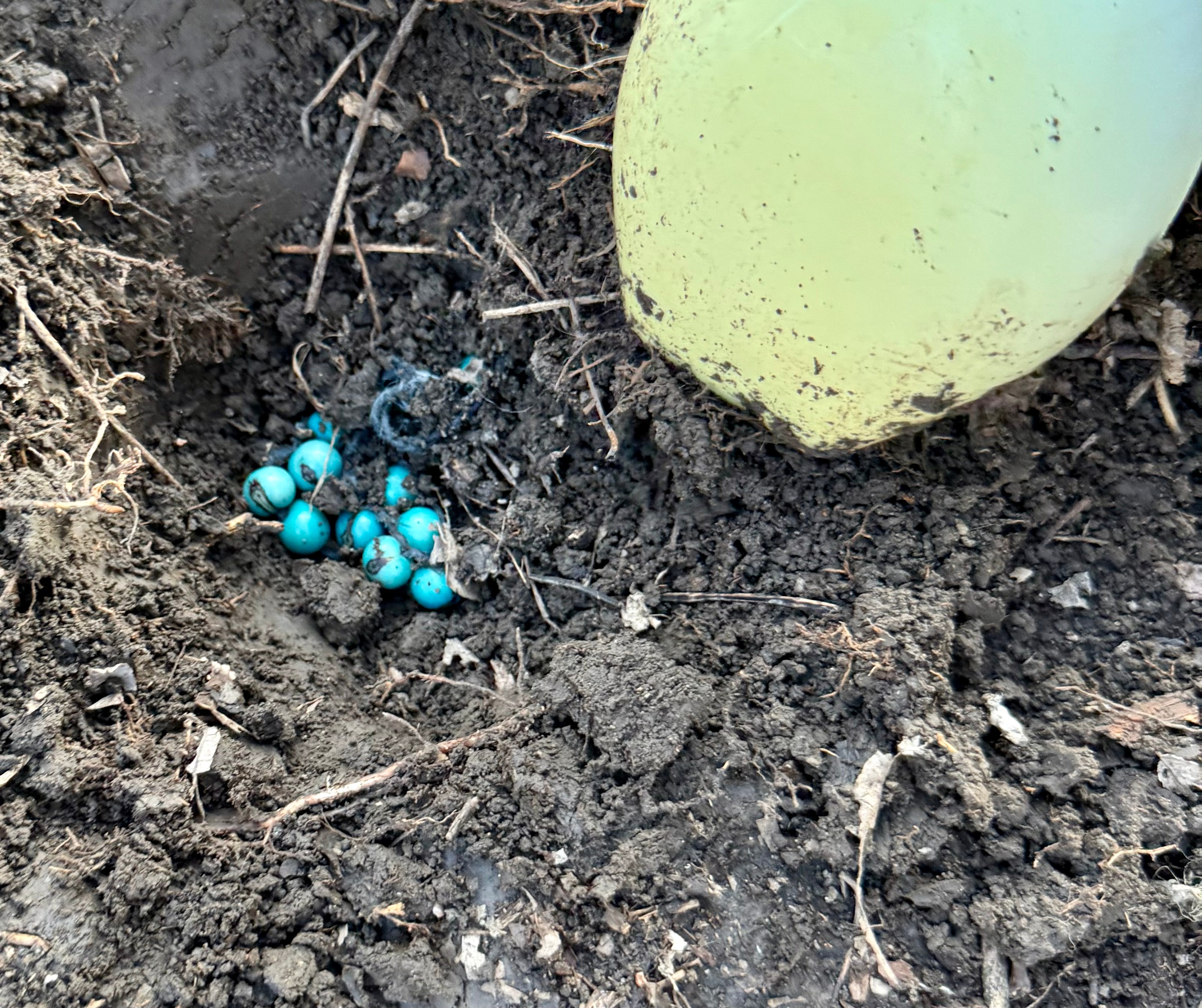
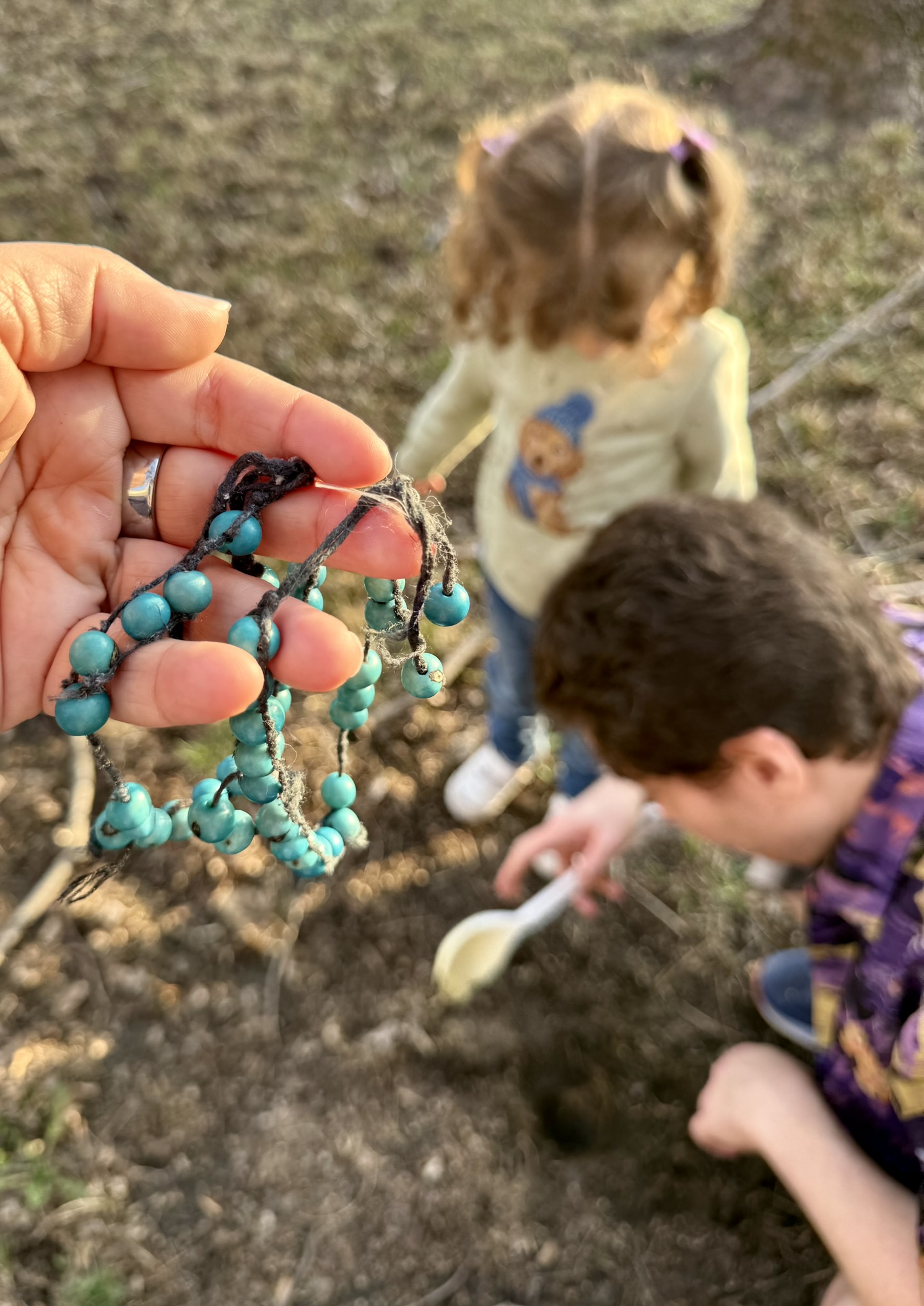
On Tuesday, Joseph, Ella and I buried this bracelet in the backyard. 

The bracelet had been with me for almost a year. On my wrist. In my backpack. My purse. It came with me to Kallah in Baltimore over the summer. It came with me to California for three visits and then a fourth when I officiated my grandfather’s funeral. It went to three different states when I officiated weddings in August, October, and January.

I bought the bracelet not long after we lost our last embryo on March 10, 2025. With that embryo, we also lost our last chance to become biological parents to a second child. I was still carrying the weight of the two pregnancies we lost before our miracle Ella, as well as the two losses that followed her. Even as I delighted in Ella every day, I grieved for the future I envisioned for us as a family of four. At the same time, my parents were preparing for their move to Florida. Realizing they are aging, I grieved anew that it took us so long to have a child and that we live too far away for frequent visits. I grieved for the time we lost and the time we won’t have. I grieved the end of my childhood, young adulthood, and the vision I’d had for my future. 

I had trouble speaking about this litany of grief because I also have so much to be grateful for. I know that grief does not undermine gratitude – it actually expands our capacity for it.  But it was still hard for me to name this weight, padlocks dangling heavy on the gates of my heart. 

If anyone else had come to me with this problem, I would have designed a ritual for them, some way to externalize the feeling, acknowledge and validate it. I would have invited them into ritual to honor the memory of what had been lost, and to support their steps into the future. But as our sages taught, in a famous Talmud passage, “A prisoner cannot free themself from prison.” In the story, Rabbi Yohanan, who had the power to heal others from sickness, could not heal himself. He needed a friend to help, and so did I (Talmud Bavli, Brachot 5). It was Reb Irwin who suggested a bracelet made of biodegradable materials. Something that I could keep for a year and then bury. I’d made similar suggestions to others coping with miscarriages – carry a rock for a week, a month, or as long as you carried the pregnancy, and then bury it. In the absence of a body, a casket, or a funeral, it’s helpful to hold a physical item, return it to the earth, and say goodbye. The loss of this embryo seemed to carry all the previous losses inside of it, a set of faceless Russian nesting dolls. With all of those layers, it felt like a year was the right amount of time to carry the bracelet. 

The bracelet I selected was made of turquoise acai seeds and black cotton thread. When it arrived, I counted 22 beads. One for each letter of the Hebrew alphabet. In Jewish tradition, 22 is a number that represents creation and completion. The mystics teach that these letters were the building blocks of the universe. In Bereishit, God created 22 things within the six days of creation, and rested when the work was complete. And in gematria, Hebrew numerology, the number 22 = יחד yachad, which means “together.” 

Despite my intent to wear it daily (and the mystical meaning I was rapidly assigning to acai seeds on a string), the bracelet itself was not the sturdiest. The woven structure fell apart within two weeks. I bought a second one. After all, if I wanted this item to stay with me for the duration of a year, I needed something durable, something that could hold itself together. The second one fell apart as quickly as the first, and I found myself asking my friend Bekah to help me stitch the beads back in line at ALEPH’s Kallah over the summer. Bekah is a Kohenet, artist and ritual guide; I told her why the bracelet was important to me, and asked for suggestions. How could I keep it from falling apart? 

I spent a lot of time rethreading the beads in the art room during breaks at Kallah. I tied and retied them, but no matter how I tried, I couldn’t get the beads to line up as they had before. Bekah noticed, and she reflected my behavior back to me – my singular focus on stringing the beads in a specific way. And I realized that for years, I had been trying to build my life the same way. No matter how hard I try, I just can’t control the future. I can pick the colors, string the beads, line everything up, create something beautiful – but sometimes, the thread breaks, the colors fade, the last embryo fails to attach. Sometimes, I am left with something less than what I’d envisioned, and more beautiful in its authenticity. I am left with the life I have, and the best thing I can do is wrap it around my wrist, and wear it with love. 

I kept both of the broken bracelets, carried them through my own wilderness, like the broken Tablets of the Covenant the Israelites carried, along with the whole ones, in their traveling sanctuary (Talmud Bavli, Bava Batra 14b). I kept one bracelet within my eyesight in my office, and kept the other in my backpack or purse. These artifacts of my grief made the losses visible, even if they were only visible to me. 

This past Tuesday was March 10, 2026. One year had passed since the day we learned about our last embryo. It was time for burial. Since I had two bracelets, I decided to keep one as a reminder of what I learned in the art room at Kallah. I brought the other out to the yard behind the house we’ve been renting in Urbana for the last four years. I moved into this house mid-miscarriage, and it’s the house we brought Ella home to when she was born. It’s the last home we ever shared with Gulliver. 

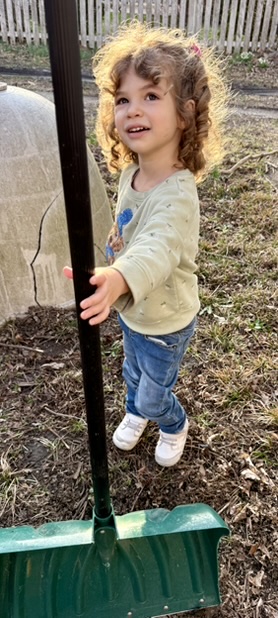
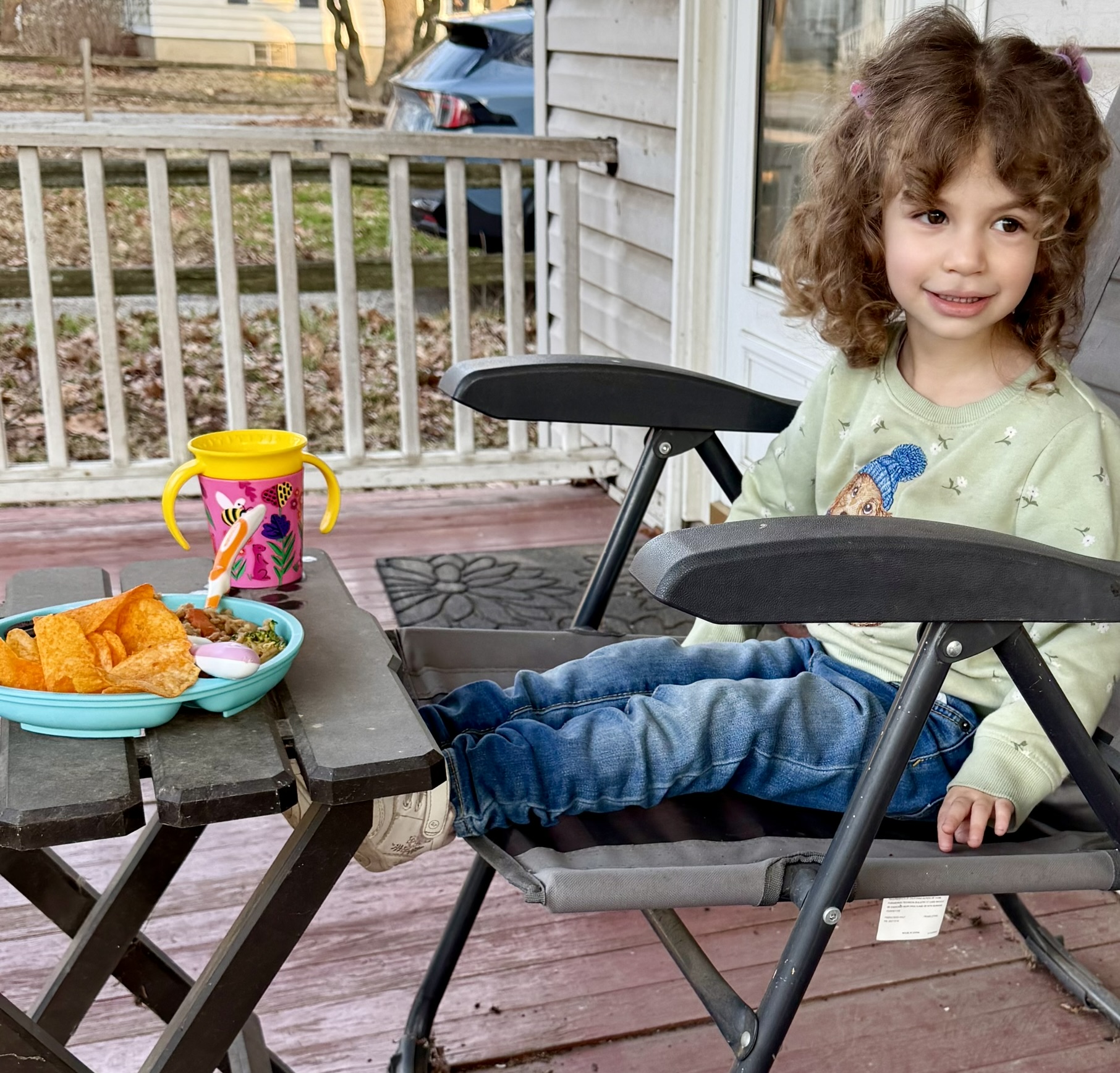
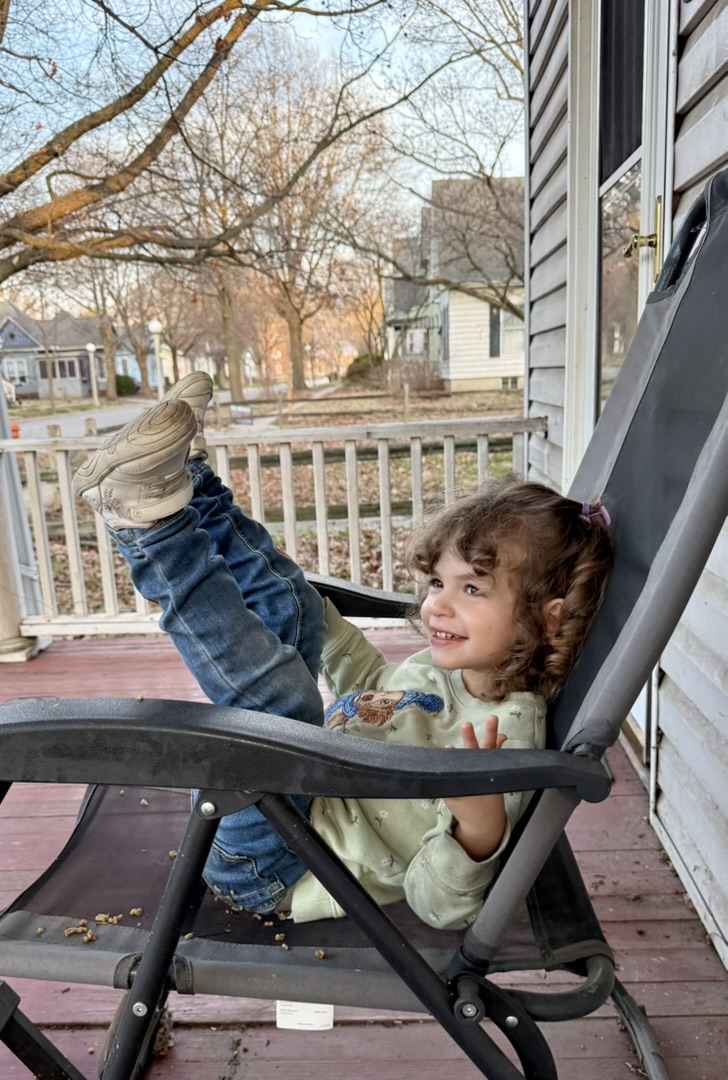
It was a beautiful spring day. Ella was wearing her favorite sweatshirt, the one my mom made for her with a dog embroidered on the front. We didn’t have a gardening trowel, but the earth was soft enough that we could dig a small hole with a snow shovel and soup ladle. “Today we are outside in the yard!” Ella chattered, telling us about the trees, the grass, and the wildflowers. She was excited to help us dig, “like a doggie!” I didn’t feel the need to say a blessing of any kind, or to name out loud what we were doing and why. It was beautiful to just be yachad – together – returning these 22 seeds to the earth. Ella asked if we could eat dinner outside afterward, so we sat together on the porch, enjoying the evening. 

One year after a traditional burial, Jews do an unveiling ceremony. The headstone is covered until that time, and at a ceremony around the one year anniversary, the veil is lifted. This was a different kind of loss, and I was burying, not unveiling. But something lifted for me that night as we sat on the porch together after burying the bracelet. For a few moments, there were no veils separating the life I am living from the life I had envisioned. I tied my daughter’s laughter with string, wrapped it twice around my heart, and I knew, in that moment, that we are everything we need. 

A Brush with Death

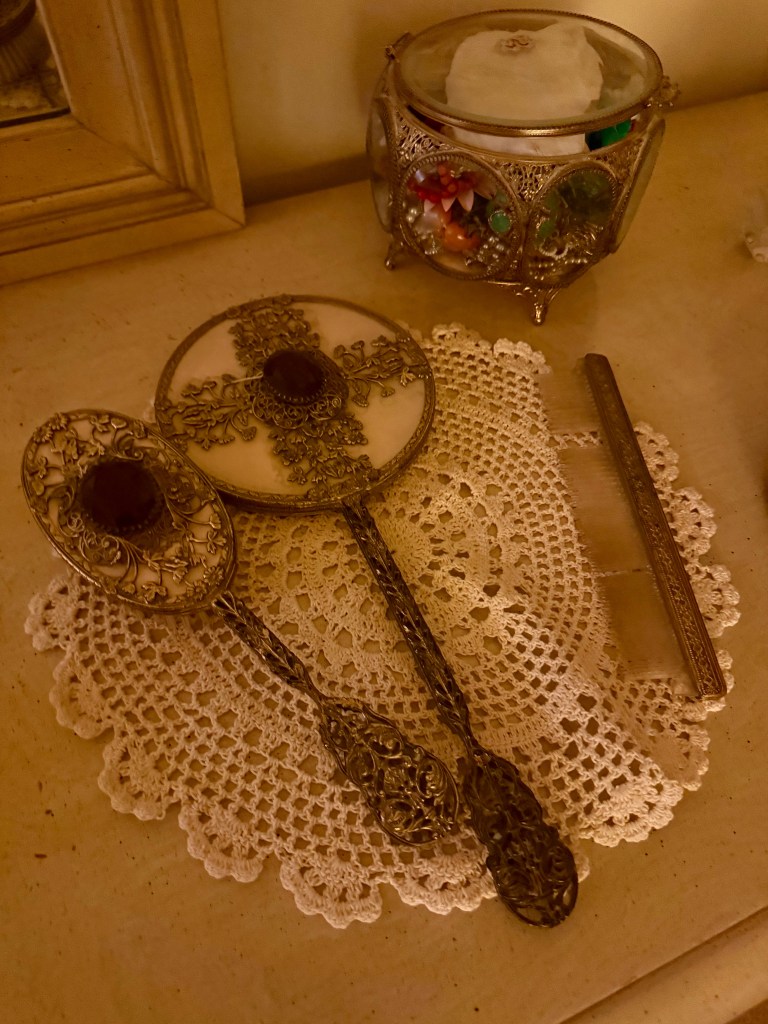
For as long as I can remember, this hairbrush, mirror, and lace doily have lived on the bedroom dresser in my grandparents’ bedroom. I remember playing with them as a little girl – marveling at how something as simple as a hairbrush could be made ornate. I don’t recall my grandmother ever using them. But I knew they were hers. I associated them with her. And they belonged on my grandparents’ bedroom dresser, next to the framed photo of my whole family at my bat mitzvah, and facing the large painted portraits of my mom and my two uncles when they were children, hanging on the wall over my grandparents’ bed.

I don’t know what I will do with the hairbrush and the mirror, but I couldn’t bear the thought of letting them go. As if leaving them in the donation box meant giving away the part of me was who believed everything my grandmother touched was beautiful because she had touched it. I added them to my pile on the bed in my mom’s childhood bedroom, along with two of grandmother’s paintings, a couple of photo albums, and a needlepoint she made. I remember looking at the needlepoint as I fell asleep while my grandmother sang Brahms lullaby in Yiddish.

The hairbrush and mirror look out of place next to these handmade treasures, and next to the menorah – the metal dark with age – that my mom and her brothers grew up lighting for Chanukah. We lit that menorah together with my grandfather during our visit and I am so glad we were there to do that. I am so glad Ella repeated the words after me, while my grandfather beamed beside her. I never expected that I’d be taking this menorah – or the paintings or needlepoint or the hairbrush and mirror – home with me, just over a week later.

I went to my grandfather’s CD tower and pulled out an album from clarinetist, Acker Bilk. When I picked up the clarinet in band in fifth grade, my grandfather introduced me to his “Stranger on the Shore,” and we loved to listen to it together – plaintive, longing, wistful. He and I were supposed to dance to that song at my wedding but my grandmother was tired and needed to get home before the DJ got around to playing it. Now the song was echoing in my heart as I walked through my grandparents’ house – full of things, but empty of them.

My grandparents’ house was our second home when I was growing up. They only lived about 25 minutes from us, and we were there every Sunday for dinner. After I left for college, every time I came home to visit my parents, we also had Sunday dinner with my grandparents. My mom dutifully shared photos of each Sunday meal in our family group chat, so I felt connected to those gatherings even when I lived far away. As a child, I didn’t realize how rare it was to have no true “extended” family, because there were no extensions – we saw each other every week, so everyone was immediate. Everything was always. My grandparents’ house was the other home I came home to, even after my grandmother died in 2015. We all still miss her, but I loved that I could feel her comforting presence so strongly when I visited. Everything she touched, like the brush and the mirror, was right where she left it.

I said goodbye to my own childhood home three times, but when I left after winter break, I was not prepared to say goodbye to this one. My parents were supposed to move away and sell the house over the summer, so I visited and said goodbye to their house in May, walking through it with my phone, taking photos and videos. I narrated favorite memories associated with every corner, floorboard, and cabinet. My parents ended up pushing the move back, and I was grateful to have one more Thanksgiving and winter break in the house.

Joseph, Ella, and I were in Southern California, visiting our homes, and our families in them, from December 20th-December 28th this year. We spent time with my grandfather on 21st and 25th. My grandfather had just received a good report from his primary care physician. At the age of 95, he still lived independently and read voraciously. Driven by lifelong intellectual curiosity and a zest for learning, my grandfather led three discussion groups in his 90s, for other octo and nonagenarians. When I was in college, my Grampie was the only person besides my thesis advisor to have read my entire undergraduate senior thesis – which was a serious undertaking, because that thing was over 100 pages on the American Revolution. I remember when he handed it back to me – with typos marked in red! Typos my thesis advisor herself had missed. I was so touched that he’d read the whole thing and with such attention to detail. He also read my masters thesis, and, I believe, most, if not all, of my rabbinic capstone.

In the living room of their house, the book my grandparents made for me, of all the poetry I wrote between the ages of 6 and 13, was at the center of their coffee table. They called it “Voyage of the Imagination,” and they had presented it to me for my bat mitzvah. It’s one of the most cherished gifts I’ve ever received – not just the book itself, but their relentless belief in my words, in my story, and in me. My grandfather believed I had something to say, something precious to offer – and whether it was an elementary poem in rhyming couplets, an academic thesis, or a high holiday drash, he wanted to hear it, read it, mark it up with a red pen and hand it back to me with one thousand questions. Grampie’s great-granddaughters – who called him “Double,” for double-grandparent – were the light of his life, and having Ella there to visit, chatting, playing, and singing, clearly made his whole month. I had no reason to think it was the last time. But I guess no one ever really does.

The day we flew back to Illinois, my grandfather wasn’t doing well. He’d had a couple of on and off health issues in the last year – but he was in his 90s, and that happens. A nagging feeling tugged at my heart but I shrugged it off. My grandfather had bounced back so many times that we barely worried. He went into the hospital and my mom kept us updated on his progress. My mom told me that Grampie had decided that if he wasn’t getting better, he was at peace and ready to join my grandmother. This was his decision. I was sure he would recover.

On December 31st, I woke up feeling nauseous. I assumed it was nothing and went to work. Then my mom messaged me. My grandfather was on hospice. Not long after that, he was gone, and I discovered I had food poisoning. I went home to look at flights. The funeral would be on January 2nd, and I would be officiating.

I wrote the eulogy in the airport on January 1st. My grandfather had been an aviation pioneer – involved in the early years of commercial air travel – and even as I sat there, queasy and grieving, it felt like an appropriate place to write something beautiful for him. And I did write something beautiful. I wrote a beautiful eulogy and designed a beautiful funeral. I officiated a beautiful service on January 2nd, after spending the night awake and writhing with stomach pain. It was an honor to his memory and a love letter to his legacy. I didn’t cry until I was in my grandparents’ house for the last time, realizing that these things – from the hairbrush to the Sunday dinner table – would no longer be there, waiting for me to come home to them.

I know that a table isn’t the people who sat around that table together, but my memories are wrapped around the table legs. My memories are laughing with my grandfather in the living room, falling asleep to my grandmother’s voice, running their fingers over her hairbrush. My memories’ hands are sweaty and struggling to turn the doorknob of my parents’ house after high school cross-country practice. They are tucking a letter for the tooth fairy under the pillow in my childhood bedroom – after I swallowed my first tooth, I wrote the letter asking the tooth fairy if I could have the prize anyway (she conceded). My memories are following baby Ella as she crawls down the hallway toward the den. My memories are sharing an indoor picnic in that den, sitting on a blanket in front of the fireplace and listening to the rain fall outside. My rituals of return brought me back to the same two homes my entire life. I miss my grandparents. I will miss these places too. It feels like my childhood and young adulthood chapters are closing as my family tries to close these two houses.

But thankfully, memories cannot be sold. Thankfully, I am a ritual artist, and we are creating new ones. Ella FaceTimes with my parents each morning. It’s not Sunday dinner, but it is meaningful. My parents are moving, but their new home will become the house Ella remembers. My grandfather died, but I think of him when I listen to “Stranger on the Shore,” and when I ask too many questions. My grandmother is gone, but I hear her voice when Ella listens to Brahms Lullaby as she falls asleep.

The goodbyes pile up in the inbox of my heart, and I can only mark “unread” for so long before I need to respond. So, here I am, in a coffee shop in Central Illinois, writing back – to my grandparents, to my houses, and to the parts of me that still live there. More goodbyes are needed, but I only have capacity to respond to a few at a time, and I am starting with these. “I am sorry for the delayed response, beloveds. I promise I haven’t forgotten. I promise I will always remember.”

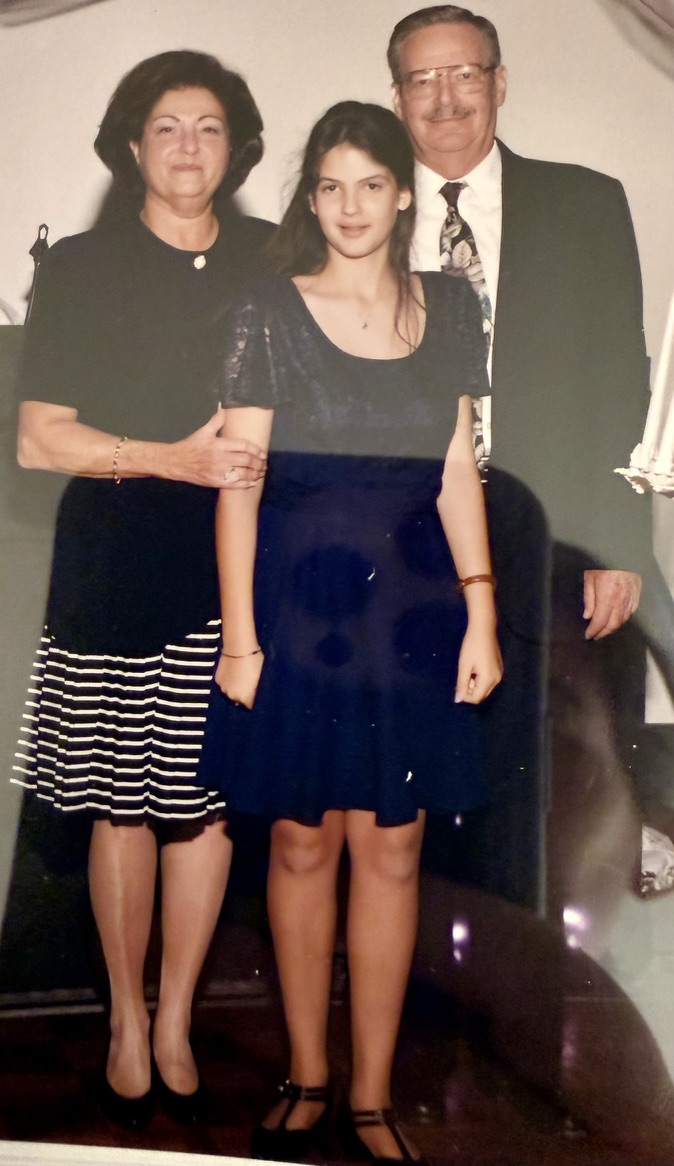
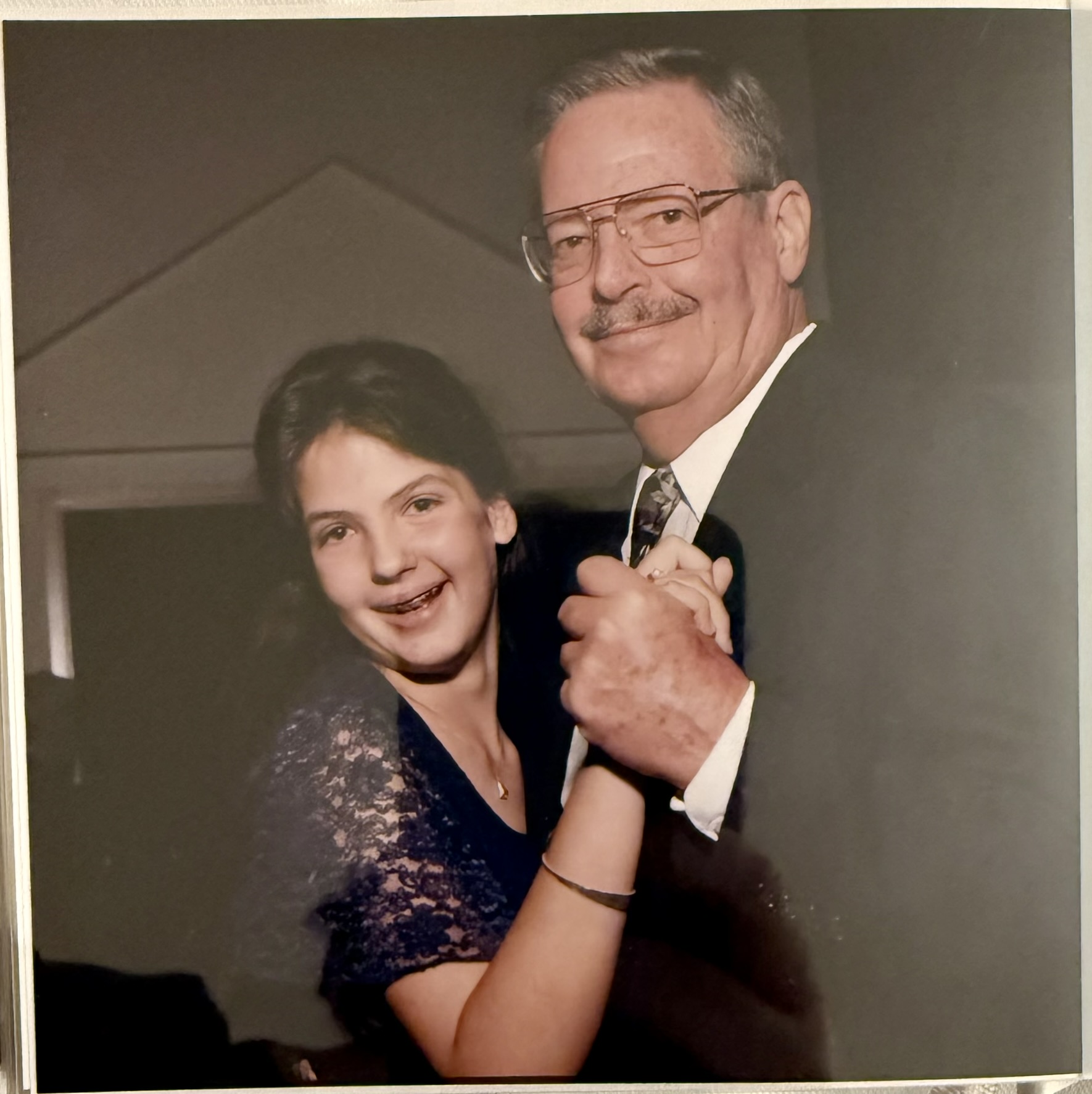
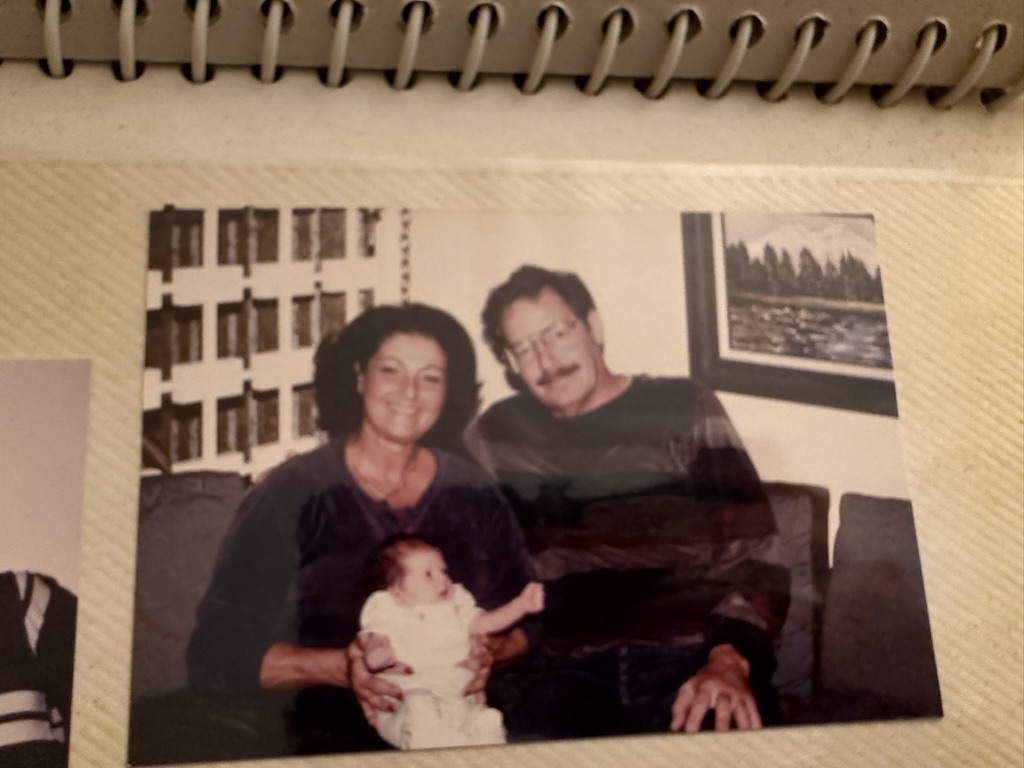
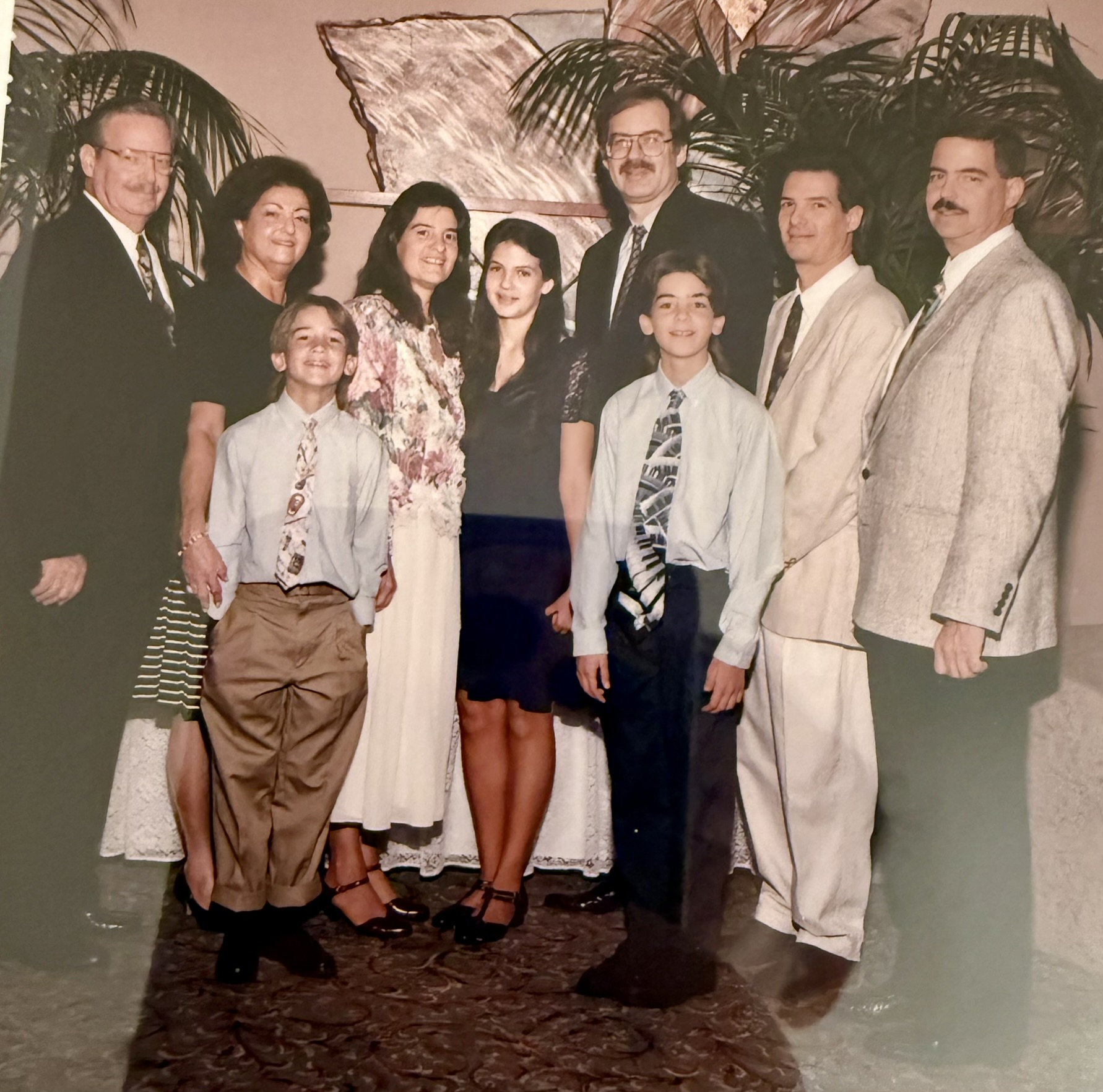
Three of these photos are from my Bat Mitzvah (Dec. 7, 1996). One of these photos was taken not long after I was born (Dec. 1983) on the couch in my grandparents’ house. All of these photos were in an album at my grandparents’ house, along with many other cherished memories. May theirs always be for blessing.

Wisdom from the Wilderness

There’s a name for what we’re experiencing . That feeling of having our hearts broken so repeatedly by the news cycle. Flash floods, fires, mass shootings, wars within us, wars between us, and wars in the world. Wars that make us question who we really are as a people. One day you’re worrying about climate change, the next it’s a group project, AI taking over, what you’re going to do with your life, the next pandemic, your situationship, economic collapse, or drama within your friendgroup. There’s never enough time to process one crisis before another begins. Even when the crisis is no longer acute, there’s a pit in our collective stomach, and it’s not just because we’re Jews with stomach problems. There’s anxiety pulsing through our communities as we wonder what will happen next. The feeling is called “existential whiplash.”  An instagram post from a mental health service called Spring Health says that “existential whiplash” is the emotional strain of trying to keep up with daily life while everything around us feels uncertain or overwhelming. 

Our ancestors knew a thing or two about this feeling, and what it’s like to yearn for stability, while knowing that change is going to keep coming. They survived slavery, escaped Egypt, and crossed the Red Sea. They had a dramatic experience at Mt. Sinai. They reached the Promised Land.  In between these major events, they wandered in the desert – trying to live amid existential whiplash, just like us. The Hebrew word for desert is “midbar.” It also means “wilderness.” The word  midbar appears approximately 270 times in the Torah. It represents uncertainty, wandering, a feeling of lostness in a world churning  with change. 

We’ve spent a lot of time here too, bamidbar – in our own spiritual wilderness. Believe it or not, 2020 was only five years ago. It’s been a long five years, and it’s been utterly exhausting. But all that intergenerational trauma we’ve acquired – going all the way back to our ancestors in the midbar – comes with intergenerational resilience. We are still here.  Still moving forward. We’re even still complaining about it, much like our ancestors in the desert.  

Tonight, I’m going to share 7 lessons for our spiritual wilderness based on our ancestral experience, as well as a few lessons based on the literal wilderness. Some of our most powerful spiritual technologies mirror the interdependent systems of the natural world. In the wilderness, we have an opportunity to learn from that which is wild, around and within us. We will see what our ancestors and the natural world can teach us about the resilience we have right now – and the ways we can build it for the future.  

7 Lessons from the Wilderness 

Lesson 1: Build sanctuaries. “V’asu li mikdash, v’shohanti b’tocham” – God says. “Make for Me a sanctuary, that I may dwell within them.” The mishkan – the communal, portable sanctuary in the desert – was elaborate. Five Torah portions in Exodus discuss the building of this space, sometimes in excruciating detail. The mishkan teaches us that at times of uncertainty, we should build something beautiful. We should pour our energy into creating, especially co-creating something that will serve the community. 

What sanctuaries have you built in our wilderness? What does your mishkan look like? Your mishkan might be your dorm room, a friend’s car, or your favorite coffee shop. It might be the arboretum or another outdoor space where you feel at peace. When you can’t change the whole world, you can still create something beautiful. Something safe. Something meaningful to you and those around you. 

The commentators point out that “v’shohanti b’tocham,” means “that I may dwell within them.” Yes, we must build physical sanctuaries, and we do – and on another level, the text may be referring to the people themselves. “Make for Me a sanctuary that I may dwell within them,” the people. The mishkan, the dwelling place for the Divine – is within every one of us.  

This means you can both build and be a sanctuary – for yourself and others. When have you been a sanctuary for someone you care about this year? When have you been your own? What does it look like to know there is a safe and sacred space within you, one you can always return to? The ultimate mishkan – traveling temple – goes wherever you go, and is there for you no matter what. This is the first lesson of the wilderness: In times of existential whiplash, build sanctuaries. 

There are many examples of collaborative building in the wild that can be instructive for us. Bees build hives and make honey through a process called festooning.. These “festoons” create structural support and regulate the temperature of the hive. Within the hive, there are worker bees who build honeycomb, nurse bees caring for the young, and scout bees who search for optimal hive collections. Each bee contributes to the structure that enables the hive to thrive. 

This leads me to lessons 2 and 3. Lesson 2 is Everyone has something to offer. God instructed every person to bring gifts to the sanctuary, telling Moses, “You shall accept gifts for Me from every person whose heart is so moved.”  Everyone was asked to give from their heart, and every gift was accepted.  

What can you do to sustain yourself and your community?  Are you an expert problem solver? Someone with powerful listening skills? Are you creative? Are you the person who can always make your friends laugh? Think about what you can give, and give it with love. It might be exactly what your community needs. Lesson 2. Everyone has something to offer. 

Like bees, when we contribute our skills and strengths to our community, we also benefit from the skills of others. This creates a more capable community that allows people to flourish – even or especially in the wilderness. This is where lesson three comes in. Ask for help. In the mishkan, Kohanim were the priests, who made sacrifices on behalf of themselves and their communities. The Levi’im played music and managed the practical aspects of Temple worship. There were also specific roles for individuals. Miriam was the one who could always find water. Betzalel was an artist who designed that first mishkan. 

Lessons 2 and 3 are connected. If everyone has something to offer, you can help others – and others are here to help you, like the bees in their hive. We all have different skills to share. Who, in your wilderness, can you turn to for help? Who can you reach out to when you experience existential whiplash?  When your well has run dry, find a Miriam who can help you locate a new source of lifegiving water. If you can’t serve God by leading song, find yourself some Levites who can. 

Hasidic master Sefat Emet wrote, “Each one gave their own offering,  but they were all joined together by the Mishkan, and became one. Only then did they merit the Divine Presence.” Each person had something unique and precious to offer – but they could not experience the Divine Presence until they shared these offerings. We became a people united not by what we took, what we achieved, or what we conquered. We became a people united by what we gave to one another.

Ecosystems are interdependent. Beavers create habitats, and those habitats are shared with other life forms. Recent research suggests that trees of the same species are communal, and will form alliances with trees of other species. Some claim that forest trees live in cooperative, interdependent relationships, maintained by communication similar to an insect colony. We are both of and in the wilderness. No one can make it through the wilderness alone and fortunately, we don’t have to. Third lesson from the wilderness: Ask for help. 

One Jewish practice that speaks to lessons 2 and 3 is the act of praying with a minyan – ten people. Mourner’s Kaddish is one prayer we only say when we have a minyan. We show up to support the mourners so they can say this prayer during their time of vulnerability and grief. In my prayer services, we count the Jews who are in the building, not just the ones who are in our service, because we are here together for the same reason. We are here because we know we are interdependent, because it strengthens the community, and because we believe in showing up. 

In April, there was a 5.2 magnitude earthquake in Southern California. A livecam from the San Diego Zoo showed all the adult elephants making a protective circle around the two youngest elephants. This behavior is a natural instinct to protect the most vulnerable. An elephant minyan. I think about it when we pray Mourner’s Kaddish together. We can’t protect anyone from grief. But there is so much power in showing up, like the elephants – it makes the grief just a little more bearable, a little less lonely. 

When there’s existential whiplash, make the minyan.  When others ask for help, it’s ok to not always have the right words. Sometimes, showing up is the help. When people are vulnerable, when things are uncertain, when the ground itself feels shaky – count your people, leave no one behind, show up, and be counted yourself. 

Lesson 4: Practice mindful awareness – be present and look around. Our ancestors often found what they needed in the wilderness when they least expected it.

Jacob ran into the wilderness after deceiving his brother and his father. He fell asleep with his head on a rock, and he dreamed of a ladder with angels ascending and descending. Jacob awakened, saying “Mah norah hamokom hazeh!” God was in this place, and I didn’t know it. 

Moses was also bamidar when he saw a bush, burning, but not consumed in the fire. He had run away from Pharaoh’s land, struggling with his conflicting identities as a master in Pharaoh’s palace and a Hebrew, like those Pharaoh enslaved. God spoke to Moses from the burning bush, saying, “Take off your shoes. The place where you are standing is holy ground.”  It was existential whiplash. 

Moses and Jacob were in the wilderness – physically, emotionally, and spiritually – when they received these messages. The Israelites were in the wilderness when we received the Torah at Mt. Sinai. Midrash Rabbah Numbers 1:1 teaches that this was because the Israelites had to be “free and ownerless like the desert” in order to receive it.  The lesson is to be aware of your surroundings. God was in that place. The ground itself was vibrating with holiness. That which appears empty is full of potential. Make yourself free and ownerless like the desert. That which appears mundane may actually be sacred.  Lesson 4.  When facing existential whiplash, practice mindful awareness.  You never know what the wilderness of our moment might reveal.  

Lesson 5 is to forgive. Yom Kippur is the anniversary of the day God forgave the Israelites for one of the greatest sins of all-time – building and worshipping a golden calf. Moses went up Mt. Sinai to receive the Torah from God. The Israelites were afraid and uncertain as they waited. We’ve all been there. We turn to unhealthy coping mechanisms in the wilderness of the unknown, just like our ancestors did.  Even Aaron, Moses’s brother, a leader in the community, took part, inciting the group to not just build, but worship the false idol. 

We have all worshipped false idols in the last year. We have doomscrolled through the desert, worshipping headlines, statements, and trends, arguing in comments instead of taking responsibility for our errors. Your leaders, like Aaron, have also committed this sin. But the story of the golden calf and God’s forgiveness of our ancestors remind us how important it is to forgive, even if it means forgiving idolatry. 

Individuals can’t be perfect, communities can’t be perfect, and the world can’t be perfect.  Ecosystems can’t be perfect either –  even a slight shift in one element can create significant and damaging change across the system. Without grace for the flaws of individuals, communities, or the world, we lose interest in showing up to help each other. We instead cut ourselves and others out. Our communities suffer as a result, much like our ecosystems when something is missing. 

On Yom Kippur, we pray for God to forgive us, as God forgave us for the golden calf. But the only thing we can really do is forgive each other and ourselves. Adonai, Adonai, El Rachum v’Chanun, we chant, listing God’s 13 attributes of mercy – God, God, compassionate and merciful. Can we be compassionate with one another? Can we have mercy on ourselves? Can you forgive yourself for your own idolatry? Can you forgive your community? The world? Can you forgive God? It’s a tall ask. It’s not always possible and it’s not even always the right thing to do. But most of the time, it is – and we must try. Lesson 5. Forgiveness. 

Lesson 6 is to make space for grief. Miriam, Aaron, and Moses – all great leaders – eventually die in the wilderness, before the Promised Land. We’ll focus on Moses and Aaron first. Regarding Aaron’s death, the Torah says “All the house of Israel bewailed Aaron thirty days.” Regarding Moses’s death, we read, “The Israelites bewailed Moses in the steppes of Moab for thirty days.”  To this day, shloshim – 30 days – is one of the mourning periods after a death in Jewish tradition.  With their deaths, Aaron and Moses taught us how to grieve. 

Elephants revisit the remains of deceased herd members, touching and examining the bones, or standing vigil for extended periods. Some cry and refuse to eat after losing a companion. Dolphin mothers may carry their dead calves for periods of time, and other pod members may assist in carrying the body or guarding it. 

Loss happens in the wilderness. In ours, it may seem like everyone is grieving, all the time. But announcements of anguish for suffering communities does not reflect a full grieving process. Existential whiplash leads to “statement culture.” Everyone feels the need to say something about the most recent bad news. It’s often necessary, but it keeps real grief itself at a distance. We need to pause. We need to wail, like the Israelites cried for Moses and Aaron. We need to reflect and remember, like elephants revisiting their herd members’ bones. Make space to mourn. That’s lesson 6.  

Lesson 7 is to practice trust. God appeared to the Israelites as a pillar of cloud by day and a pillar of fire by night. The pillars  were with them at all times, reminding the Israelites that they were safe. That’s right. They had an emotional support pillar-of-cloud.  Still, as a people traumatized by a history of enslavement, it took them a long time to trust their safety, their leaders, and God. Even when the Israelites were on the verge of the Promised Land, they believed false risk reports, and acted out from a place of fear. They had to wait another 40 years before going into the land as a result.  Nonetheless, the pillars of cloud and  fire stayed with them; a Divine Presence. A reminder that they could learn to trust. 

When you are hypervigilant, or overly attuned to risk – what is your pillar? What shows you that you are safe, that you can trust the process, that you will be cared for, no matter how the future unfolds? Can you trust yourself? Your leaders? Your community? Lesson 7 is to “practice trust” because in times of emotional whiplash, it really does take practice. But our ancestors learned how. And so can we. 

I want to share one case study from the wilderness that shows what happens when we miss the mark in each of these lessons.  When Miriam died in the wilderness, “The community was without water, and they joined against Moses and Aaron. The people quarreled with Moses, saying, “Why have you brought God’s congregation into this wilderness for us and our livestock to die there? Why did you make us leave Egypt to bring us to this wretched place, a place with no grain or figs or vines or pomegranates? There is not even water to drink!”

Miriam was the one who made wells of water appear in the desert, so their concern about water was understandable – but by now, they had been bamidbar for a long time. God had provided what they needed, from manna to eat, to the Torah herself.  By whining for the Egypt they left behind, the Israelites abandoned the sanctuaries they built together.  With mindful awareness, the Israelites might have made space for Moses and Aaron to grieve for their sister. Instead, they panicked, quarreled, and cried for water. Ultimately, God told Moses to speak to a rock, and water would pour from it. In Moses’s rage, he hit the rock instead. 

It’s so relatable. The communal experience of water anxiety. The personal loss. The competing needs, everyone yelling over everyone else. And all of it happening all at once. It was existential whiplash. Instead of grieving, he had to make it stop. He had to fix it. Can anyone relate? Me too. With awareness, Moses might have said “I hear your concern for water. God will provide. Give me a few minutes to myself before I ask God for help.” Instead, he lashed out, hitting the rock in his rage. 

We are living in a wilderness, experiencing profound existential whiplash. The Israel / Palestine crisis, the climate catastrophe, rising antisemitism, lack of access to health care – the list goes on.  While the issues themselves may be new to us, the experience of wilderness is, for lack of a better term – precedented. We have been afraid and uncertain before. We know what happens when we act from a place of fear, building false idols that don’t really protect us. We know what happens when we jump into fixer-mode, without first making space for grief.  We are interdependent, like so many animals in the wilderness. When just a couple of wolves can’t trust the others, it threatens the health of the whole pack. 

We also know what it’s like to build and to be a sanctuary, for each other and for ourselves. We know how to make a minyan, how to lean on each other, and we know how to make offerings that come from the heart.  We know that every bee’s role is urgently needed for the health of the hive. We know how to see the sacred where we least expect it to find it. We can lessen the pain of existential whiplash by looking to the midbar – the wildernesses of our past, the wild world around us, and the wildernesses within, to discover what we need to thrive.  

To recap: 

Lesson 1. Build Sanctuaries. 

Lesson 2. Everyone has something to offer. 

Lesson 3. Ask for help. 

Lesson 4. Practice mindful awareness.

Lesson 5. Forgive. 

Lesson 6. Grieve. 

Lesson 7. Trust. 


A midrash teaches that midbar, wilderness, is linked to the word “midaber,” which means speech. We can use our speech, our words, to teach one another these lessons when we’ve forgotten. We can use them to write down our stories, so we can return to them in the next wilderness. We can use them to remind ourselves that our ancestors passed down their grit (along with all that anxiety and the stomach problems), and that we are stronger for it. We are always in the wilderness and there are always sanctuaries and we keep trying and learning and becoming. There are words for what we are experiencing – existential whiplash. And there’s a term for the antidote – it’s what happens when we learn from everything behind us, around us, and within us. It’s resilience.

Strength and Song


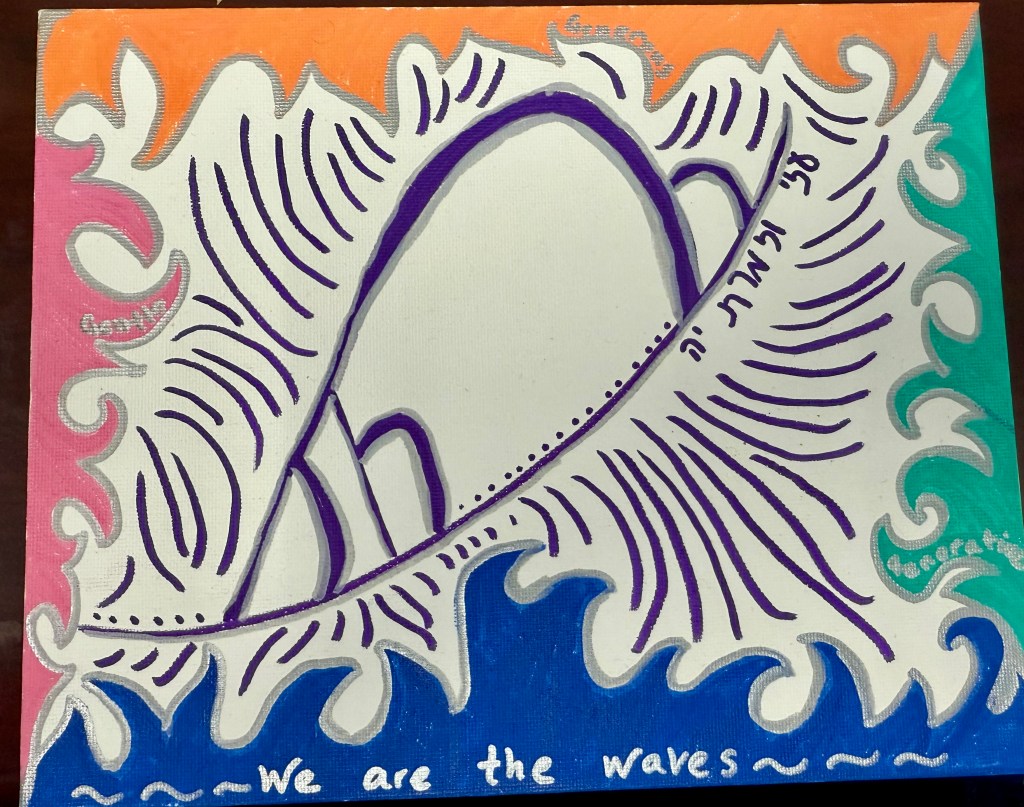
עָזִּי וְזִמְרָת יָ וַיְהִי לִי לִישׁוּעָה
Ozi v’zimrat Yah
Vayehi li lishua

My strength (Ozi) and God’s song (Zimrat Yah) will be my salvation.

This prayer-song was my anthem for my final embryo transfer. Offered to me as medicine from my soul sisters on the Sunday of the Ohalah Shabbaton in January, I listened to recordings of my beloved friends singing me this song as I drove to doctors appointments and before most of my injections.

Ozi v’zimrat Yah. My strength and God’s song. We never know how the song will unfold. When I surrender to its music and I focus on my own strength, the parts of my life – and the parts of IVF – that I can control, it helps ease my passage through the dissonance I encounter along the way.

IVF – really, all pregnancy and birth, but especially IVF – are part miracle, part medicine. My strength and God’s song. Hope and hormones. Prayer, practicing trust, and doing everything we possibly can to make it work.

We did everything we could to make our final embryo transfer work on February 27th. And still, on March 10th, we found out the embryo didn’t even attach this time. I was not pregnant.
I’m not pregnant.

For a long time I felt guilty about even wanting or praying for another child, and I felt guilty asking my friends for support while I was trying. I leaned on community so heavily in my journey to Ella. Part of me felt like “I already got my miracle. Who am I to ask for another?” But we had always wanted two. That was our intention. Before the first miscarriage. Before infertility. Before the endo diagnosis. Before IVF. We dreamed of being a family of four. I wasn’t willing to give up on that, not while I still had remaining embryos. Even after my challenging pregnancy and birth experience with Ella, I wanted her to have a sibling. And knowing that we only had XY embryos left – we were really excited about the possibility of a baby brother.

But we miscarried the embryo we transferred in September and this final embryo didn’t attach. And we won’t be doing further medical intervention. The time for egg retrievals is behind us. It costs a fortune. My egg quality wasn’t great during all those retrievals and it’s certainly not better now. My body reacts so badly to the progesterone injections that doing this again with a donor egg isn’t an option either. After this transfer, I battled another infection at one of my injection sites. It was cellulitis – the same thing that landed me in the hospital in 2021. I caught it early this time and got antibiotics as soon as I knew. I am glad I listened to my body and went to the doctor instead of waiting longer.

While I battled the infection, Gulliver, our beloved 13-year-old labradoodle, got very sick. In just five days, we went from thinking we might gain a family member – to facing the very real possibility of losing one. I didn’t have capacity to reflect on the embryo loss while we were deciding if we should put Gulliver through the operation. Would they operate and find cancer, discovering that he had no chance at survival anyhow? Would they remove the spleen and find a benign tumor, prolonging his until-now happy and healthy life? Once again, we were standing at the crossroads of medicine and miracles. Our strength and God’s song. A doctor we trusted and an outcome we couldn’t. Just enough information to tell us we had a choice, but not enough to know if we had a decent chance. How would the song unfold this time?

We are so relieved that our sweet boy is healthy after all. We know Gulliver is a senior dog and we aren’t in denial about that. But for now, he is cancer-free, which means that he and Ella can make more happy memories together in the time he has. They shared a piece of pizza on Saturday, and it felt sacred.

It has been over seven years since my first pregnancy, and over five years since we started pursuing IVF. Seven years of trial and error. An endometriosis diagnosis. Countless ultrasounds, blood tests, laparoscopies, injections, miscarriages, tears, and everything else. At the same time – rabbinical school, a cross-country move for a rabbinic position, a child born, ordination received, and growing into my roles as rabbi and mother. Ozi. My strength. It took so much strength to get through it all. Looking back, realizing again how unlikely it was for IVF to work even once for someone like me, I’m so, so grateful that it did.

Ozi v’zimrat Yah
Vayehi li lishua
My strength and God’s song will be my salvation.

I have no regrets about the decisions we made. I am grateful that IVF – part medicine and part miracle – brought Ella into our lives, even while I grieve for the ones it couldn’t. We surrender what we can’t control, and do our best with what we can. We don’t know how the song will unfold, but this process has taught me that in the face of dissonance, the best thing I can do is continue, with all my strength, to sing along.

*Read more about Kohenet Bekah Starr’s art and teachings here

Witnessing: Yom Kippur Sermon, 5785

When I was regularly facilitating children’s grief groups and volunteering at grief and cancer camps, I had a recurring dream. In the dream, I was facilitating a grief group, much like the ones I led in waking life. The crucial difference is that the dream grief group was a grief group for the dead. My job in that dream was two-fold: to witness the dead as they grieved the lives and loved ones they left behind, and to support the dead through this transition, to help them integrate their new reality. These dreams were never scary. They were tender. Loving. We even laughed together, just like we did in my grief groups for the living.

Almost always, the deceased parents of the children I worked with in waking life showed up in my dream grief groups. I recognized them immediately when they walked in, because their living children had shown me pictures of them at candlelight memorials and in popsicle stick photo frame activities. I’d heard so many stories about these deceased parents from their living children, whose grief I witnessed in waking life. One teen described her late mother as feisty and smart. She was a brilliant scientist who always wore bright red lipstick. When that deceased mother came to my dream grief group, she appeared just as her daughter described her, red lipstick and all. 

My unconscious mind fabricated grief groups for the dead based entirely on stories shared by their living children – memories, quirks, inside jokes, and even the tough moments – the ones that emerged late at night at grief camp. “My last conversation with her was an argument. It was so stupid.” “I was so angry at him for the drug use. What if he didn’t know I loved him?” In my dream grief groups, the deceased parents and I fondly remembered their children together. Their parents were always so proud of them. 

The dream groups were intimate. Personal. Powerful. It was my mind’s gentle way to witness my own witnessing – to make sense of the countless stories of loss I carried with me over my decade working with these children. 

Grief group facilitation taught me a lot about the power of witnessing – or, as my friend Rabbi Irwin Keller says – “with-nessing.” With grief, there is no problem-solving, no solution. Nothing can be done to change the situation. Witnessing and being-with are the greatest gifts we can offer. 

The Shema, the most central statement in Jewish liturgy, is a proclamation of our witnessing. In the Torah, the last letters of the word “Shema,” which means “Hear,” and the word “Echad,” which means “One,” are written in larger script than the rest of the text. These letters are Ayin and Dalet. Together, they spell “witness.” The Shema is a call to witness the Oneness of the Divine Presence as it unfolds in the world. In other words, even God needs to feel seen. 

For a number of reasons, I stopped facilitating children’s grief groups after I moved to Champaign-Urbana. The dreams stopped coming at regular intervals, and then they stopped entirely. I was focused on life in a different way, so I stopped dreaming about the dead.

After October 7, 2023, I was sure the dreams would return. I was grief counseling full time, even when we didn’t call it grief counseling. I facilitated groups. I witnessed the pain of countless students, friends, and colleagues. But the dreams didn’t come.

Until September 1st. Since that night when six hostages were murdered, those hostages and others who died on and after October 7th have been visiting my dream grief groups. Like the parents of the children I used to work with, I know the faces and stories of the dead from the living people who loved them. I’ve met musicians, tattoo artist, Shani Louk (z’l), and children who were murdered in their kibbutz bedrooms. I met Carmel Gat (z’l), who was a mindfulness meditation and yoga instructor. In my dream grief groups, she leads some gentle movement for the group each time we meet. The murder of those six unlocked the part of my dream life that processes my grief, and the grief of those I witness – by helping the dead process theirs.

Yom Kippur has a lot to teach us about death, grief, and witnessing. Jewish tradition considers Yom Kippur to be a “dress rehearsal” for our own deaths: We refrain from eating and drinking, washing and pleasure, and some people wear white, evoking the image of shrouds. I’ll talk about that tomorrow morning. Yom Kippur invites us to witness the grief of others, as we experience our own grief at the Yizkor – memorial – service. 

There’s also a Yom Kippur afternoon service that is not often included in Reform spaces, but its message is an important one for this year. It’s called Eyleh Ezkerah – “These I remember,” based on lines that we repeat throughout the service: “Eyleh Ezkerah v’nafshi alai eshp’khah, al koroteinu ha-marot einai zoglot dimah” – “These I remember, and nafshi – my soul – melts with sorrow. For the bitter course of our history, tears pour from my eyes.” The service tells the stories of generations of Jews who were murdered for being Jewish – from Rome to Mainz during the First Crusade to the Spanish Inquisition. “These we remember,” we say again, and again. None of us personally knew rabbinic greats like Rabbi Akiva and Rabbi Shimon ben Gamliel – but we remember them based on the stories of others. The Eyleh Ezkerah service offers a way for us to use ritual and memory to witness the dead, and to create meaning for the living.   

Earlier this week, on the anniversary of the October 7th massacre, students and staff worked together to implement a student vision – a memorial museum. Far from a static walk-through museum with statistics and political analysis, the experience lifted up the stories of actual people – soldiers, people who lived and died in the kibbutzim, and people who witnessed the murder of their loved ones at the Nova festival. First-person testimonials were the fabric of this experience. We felt the presence of those who died on the 7th through the powerful stories and memories of those who loved them. 

And each of us who walked through the museum was a witness. A witness to the stories. A witness to others walking beside us. A witness to our own grief – grief we may have forgotten during an intense year of political argument and analysis. Eyleh Ezkerah. These we remember. Late at night on October 8th, when we cleaned up and put away the museum pieces, it felt like uncovering the mirrors in a home after shiva. That night, more of the dead from October 7th and beyond attended my dream grief group than ever before. 

In my Erev Rosh Hashanah sermon, just 10 days ago, I said that I don’t know what to say about October 7th, and it’s still true. But that’s because there’s nothing we can say that will change what happened. 

It turns out that, once again, it’s not about saying something

Listening is greater than speaking.
Presence is greater than power.
Witnessing is sometimes the most precious gift we can offer.

Surrounded by death, witnessing says “I am here. We are alive. We are together. You are not alone.” 

In my dreams, no one, living or dead, is grieving alone. 

We are all witnessing each other. 

And we are comforted.

Hovering: Rosh HaShanah 5785

Wow. What a year. I have to be honest, friends. I don’t know what to say about it. I don’t know what to say about the year we are leaving behind. I don’t know what to say about where we are now – with rockets flying in multiple directions, slogans screaming across Instagram, countless lives lost and relationships shattered since October 7th. I don’t know what to say about where we are going in this new year when there’s no resolution in sight. We eat apples dipped in honey, illustrating our hopes for a sweet new year. But it can be really hard to think or talk about sweetness when we are tasting bitterness at the same time. 

The beauty of Jewish holidays is that they are both commemorative and experiential. We are asked to remember something that happened in the past – AND we experience it in real time. At Passover we are told that we ourselves are coming out of slavery. Rosh Hashanah is a time when we both remember and experience renewal, rebirth, and creation. When God began creating the world, 5785 days ago in Jewish time, the earth was tohu vavohu, chaos and void. And choshech, darkness, was on the face of the deep. And Ruach Elohim, the spirit of God, m’rachefet, hovered on the face of the water.

What was God feeling in that moment, hovering over the darkness? Was God afraid of the void? Anxious amid the chaos? What did it take for God to find the courage to say “yehi or,” “Let there be light?”

We, too, have known darkness this year. We have also faced the depths. And right now, we, too, are hovering – m’rachefet – between darkness and whatever comes next. What is it like living in this hovering uncertainty? What will it take for us to risk looking forward at all, let alone looking forward with something like hope? I don’t know. But I do know we have examples in our tradition of other moments like this one, and we can learn from our ancestors. 

Our ancestors shared an experience of darkness, chaos, and confusion at Mt. Sinai, waiting for Moses to bring Torah down from the mountaintop. When Moses ascended Mt. Sinai, the Israelites didn’t know when he would return, and they were terrified. In their fear and anxiety, hovering beneath the mountain, they turned to a destructive but familiar coping mechanism, like so many of us have in those uncertain moments – they built a golden calf, a false idol. 

How many of us have turned to an unhealthy habit in moments of anxiety in the last year? Me too.

Moses came down from the mountain with the commandments on two luchot, two stone tablets, and when he saw the golden calf, he was so furious that he shattered them. Moses climbed the mountain again. Even though he was angry at the Israelites, he pleaded with God on their behalf. And God forgave them on the 10th of Tishrei – a day that we now experience and commemorate each year: Yom Kippur. Then Moses descended with new luchot. 

A midrash – which is Torah fanfiction – on this Torah portion tells us how our tradition treats the brokenness we experience in times of darkness and hovering. When Moses came down from Mt. Sinai the second time, with new tablets, the Israelites kept the broken ones. They placed the broken luchot, along with the new ones, in the holy ark.

Why keep this symbol of our own fear, this casualty of rage, this set of broken laws? Because brokenness and wholeness live side by side in the world and in our hearts. Because we had to be in the wilderness, hovering, waiting, lost and afraid, worshiping a false god before we could worship our One God from a place of trust. We kept the broken tablets because learning is part of becoming. We kept them alongside the new ones, because brokenness itself is holy. The broken tablets, carried along with the whole ones in the Aron HaKodesh, the holy ark, represent the resilience that carried us through the rest of the uncertain wilderness.

Rabbi Harold Kushner (z’l) raised an important point about this story “…The saga of the golden calf, God’s anger at the people, Moses’ intervention and God’s forgiveness raise an interesting question: When something breaks, something that was precious to us, is it ever possible to put it together again so that it’s as good as new?” 

So much shattering occurred over the last year. Trust was broken. Relationships ruptured. Communities crumbled. October 7th splintered us again and again. How can we repair? Is it even possible to build ourselves up again so that we and our communities are as good as new?

Rabbi Kushner continued, “It would be nice to believe that a God of second chances would make that possible, but the reality seems to be no, you can’t. If it’s broken and repaired, it will never be the same. The crack will always show. But what a God of second chances does is make it possible that you will end up with something in its place that will be even stronger and better than the original.” 

What would it look like for us to build something better? And what examples can our textual tradition offer for guidance? 

After God hovered in darkness, over the face of the water, God said “yehi or” “let there be light,” and went about the work of creating the world for us. When we finished hovering in the darkness at the foot of the mountain with the golden calf, we went about the work of creating a Mishkan for God, an elaborate and collaborative traveling sanctuary. Each person contributed something of their own to the creation of the Mishkan. The sages consider the golden calf incident to be one of the darkest moments of our history – despairing, leaderless, and chaotic. Our ancestors came through that darkness and said “yehi or,” “Let there be light.” And they created a mishkan. 

The truth is that there is always darkness, brokenness, and loss. And – we can always say yehi or – while we hover within the tohu vavohu, within the chaos. Kohelet says “To everything there is a season, a time for joy and a time to weep.” In his poem, “Kohelet Wasn’t Right,” Israeli poet, Yehuda Amichai responds that no, these are not separate times. “In the days when each hour collides with the next,” he says, “we have no choice but to cry and to laugh with the same eyes, to mourn and dance at the same time.” We have to carry the broken tablets with the whole ones. We have to create light while the darkness swirls around us. When false idols have made us forget that we are One, we have to build a mishkan together. 

Does it sound impossible? That’s ok. It won’t happen perfectly, or all at once. Creation didn’t happen just one time – creation is always unfolding, all around and within us. 40 days and nights passed before Moses came back down the mountain with the new tablets after seeing the golden calf. It took time for the Israelites to return to the mishkan. Healing is a long and by no means linear process. We may continue hovering – m’rachefet –  over the depths for awhile.

In the meantime, we have ancestral tools, handed down in our hearts and in our liturgy, that can help us make incremental change. One of these tools is selichot – forgiveness. Rabbi Kushner wrote that “The crack in the first set of tablets was the loss of the dream of perfection. Now the challenge facing you is… can you replace that dream of perfection…with a more realistic one… that will make allowance for human frailty? … Can you give yourself and those around you permission to be human…? On Yom Kippur, so many years ago, God forgave the people who built the golden calf. He forgave us for being human beings, with hopes that we would learn to forgive each other as well.” 

Can you forgive yourself for the moments when the darkness was unbearable, the moments when the shattered pieces of your heart cut so deeply you couldn’t see the whole ones beside you, the moments when hovering was the only option because you couldn’t find light amid the chaos? Can you forgive your community for the moments when we failed to hold you in the way you needed to be held? Can you forgive God for God’s imperfect world? 18th century Ukrainian rabbi, Rebbe Nachman of Breslov, taught that Moses was able to find the nekuda tovah – the good point, the Divine Spark – in the Israelites when he pleaded with God on their behalf on top of the mountain. Nachman teaches that this is what allowed the Israelites to move from building the golden calf to building the mishkan – all it took was one person seeing the good inside of them. Forgiveness is another way to say “yehi or.” Let there be light. 

5784 had darkness, chaos, confusion, and grief. We have been at the foot of the mountain with the golden calf.  At this exact moment, when we remember and experience the story of creation, we are m’rachefet – hovering – on the face of the depths. How can we say “yehi or,” like God, when God created from darkness? How can we say “yehi or,” like our ancestors who contributed to the mishkan after contributing to a golden calf? How can we build new tablets – while we hold onto the broken ones? We have looked at an ancestral tool, but we can and should draw on personal experience as well. 

Take a deep breath. Think back on some of your own, personal, darkest moments from this last year. What are the qualities you already had inside you, what are the roots you returned to, what did you discover that was grounding, replenishing, and brought you a little more light? What did you try? What was helpful for you?

Even in this dark year, you were able to find “yehi or” moments. Looking back on our year at Hillel, I can also see examples of times when we said “let there be light” as a community, not in spite of, or even because of, the chaos – but because it is what we do. It’s part of who we are. 

Yes, there was rupture within our community. And, over the twenty-five Bagel Brunches we shared on Sunday mornings, we ate 1,250 bagels in total. There’s an ongoing hostage crisis and war in the Middle East. There was anger, distrust, and antisemitism on campus. There was also Matzo Ball, a festive Hollywood themed semi-formal at Joe’s at the beginning of spring semester. We were anxious and uncertain, but we also celebrated Purim with 300 of our besties at the seventh annual Purim drag show. The news cycle was relentless and depressing. And we played a lot of Dungeons and Dragons. We said “yehi or” when we piloted a wellness-themed Jewish Learning Fellowship, where students shared from their hearts and deepened their relationships. We said “yehi or” when we welcomed the angels, and each other, by singing Shalom Aleichem together before each Shabbat meal. With the darkness – light. With the brokenness – creation. With the hovering – a mishkan, a gathering space for sacred community. 

Contemporary scholar of kabbalah, Dr. Melila Hellner-Eshed, writes that “An envelope of bitterness encases the divine sweetness,” yet we can “reach the sweet, divine essence hidden within the layers of the world’s bitterness.” So we will dip our apples and our challah in honey for a sweet near year. We will practice forgiving ourselves and each other for our imperfections. We will rebuild relationships and repair our community. It won’t be the same as before, but it will be stronger. We will honor our brokenness and our wholeness. We will turn away from false idols and we will work together to create a better world. We will say “yehi or.” Say it with me: “Yehi or.” Let there be light. 

Shared with gratitude to Rabbi Bluth and Josh Feldman for helping me figure out what to say in a year when none of us really know what to say. Your friendship and mentorship means the world to me.

Lag B’Omer 5784

Today is Lag B’Omer, the 33rd day of the 49 between Passover (liberation) and Shavuot (revelation) on the Jewish calendar. The Omer is a time of mourning for the deaths of 24,000 of Rabbi Akiva’s students, possibly due to a plague, or due to the Bar Kokhba revolt. On Lag B’Omer, we learn, the plague lifted, or perhaps there was a pause in the fighting. Either way, the deaths stopped.

Lag B’Omer is also the yahrzeit (anniversary of death) for the great mystic, Rabbi Shimon Bar Yochai. Before he died on this day, he told his students that today should be a “day of joy” for them – a day of happy remembering, of lifting up the sparks of his teachings.

Today, in recognition of these historical events, Lag B’Omer is a day when the mourning practices of the Omer period either pause, or stops completely, depending on communal tradition. It interrupts our grief. Lag b’Omer is a day that is often celebrated with bonfires, music, friends and family, and time spent outside.

For the last eight months, my communities and many others have been mourning. Without going into specifics, I will share that nothing has been the same for any of us since 10/7. I’ve been a Jewish communal professional for 15 years, and have spent 10 of those years on campus. This was by far the most challenging. My colleagues and I have been grief-tending, listening, supporting, and teaching students how to be in community with those whose opinions are different from their own. It’s been important work…and it’s been exhausting work. It has been all-consuming.

But today is Lag B’Omer, and so we interrupt our grieving. We emerge from the caves of our pain, as Rabbi Shimon Bar Yochai and his son emerged from their cave after 12 years. We remember that celebration is holy. We remember that we can hold multiple truths, multiple feelings, exploring the paradox of joy and sorrow, love and loss. We gather at bonfires. We sing if we can. We try to lift up the sparks.

I am in Los Angeles to officiate a wedding today. The marriage canopy is open – it has no walls, so the love of the couple can spread throughout the world. According to mystical traditions, the love and marriage of the couple has the power to change the very fabric of the cosmos.

So, today, wherever you are, whatever you believe, I hope you can feel it. I hope you feel the love that is pulsing through universe. I hope you stop even if it’s just for a moment, and allow that love to interrupt your grief. It has been hard for a long time and the hard times are not over. But just for today, join me. Go outside if you can. Build a bonfire in your heart. Take a deep breath, close your eyes, and say “thank you.”

Happy Lag B’Omer, beloveds. May we all find a way today to celebrate the love that surrounds us.

The Narrows and the Expanse

Min ha’meitzar karati Yah
Anani ba’merchav Yah

From the narrow place I cried out to God;
God answered me with an open expanse.

These words from Psalm 118 have been on my heart this year as I’ve prepared for Passover. Every year, we relive the Exodus, saying that we ourselves were slaves in Mitzrayim – a Hebrew word that means both “Egypt” and “Narrow Place.”  This year, we are all trying to make sense of slavery and freedom in a post October 7th world. Each of us has our own meitzar (narrow place) to escape, and our own merchav (expanse) to explore. We have our individual enslavements, our personal Pharaohs and seas to be crossed. But like the Exodus, the war in Israel is being experienced collectively as well as individually.  We all need to find our way from our communal meitzar to the merchav, and we need to do it together. 

For the Hebrew slaves, the narrowness – the meitzar – was Egypt under Pharaoh. The Haggadah tells us that Pharaoh forced the slaves into hard labor. But the subjugation went far beyond the physical. When Moses told the Hebrews that God would free them from slavery, they could not hear Moses in their suffering – literally, according to the text, due to kotzer ruach, shortness of breath, or spirit.  Their spirit had shrunken until they couldn’t grasp the idea of freedom. Netivot Shalom, a 20th century Hasidic rabbi, wrote that “Israel was subjugated in total. They had no independence, even in thought.” The Hebrews “became like breath caught in the throat, subsumed in Pharaoh completely, body and spirit.”  In the narrowness, they could not hear, think or speak for themselves. A numbing silence came from deep trauma, their thoughts swallowed on the inside before they could name them, even to themselves or each other. The Zohar calls this a “galut ha’dibbur,” an exile of speech. 

The path to freedom opened when the Hebrews opened their own mouths and spoke. Exodus 2:23-24 lists four types of outcry: The Hebrews anach, (sighed), za’ak (called out), shav’ah (cried for help),and n’akah (groaned). The beginning of redemption was their own awareness. After generations of feeling and thinking only what Pharaoh told them to, the Hebrews recognized their own suffering. The next step was to call out. At first, they groaned before they could speak. It may have been unintelligible, but the pain and their voices were their own. “When they left Egypt, they went from subjugation to everlasting redemption and received anew the aspect of speech,” writes Netivot Shalom. “Peh-Sach can be interpreted as shorthand for peh (mouth) that sach (speaks). This is the essence of the holiday of Pesach.” They went from slaves that couldn’t think, feel, or speak for themselves, to human beings with awareness of their own pain, and voices that could tell their story. 

After the Hebrews crossed the Sea of Reeds, they found themselves in their merchav – the wilderness.  And they were terrified. We joke about it, but it’s true – after singing at the Sea, the Hebrews immediately used their newfound voices to complain. They complained in Egypt they’d had cucumbers, onions, and melons. Would they starve to death in the desert? What would become of them in this wasteland? These complaints were about physical needs, but they spoke to an underlying spiritual question. Enslaved in Egypt, they’d known what to expect. The Hebrews knew who they were, understood their roles, knew where their meals would come from, and when. There was security in the structure. 

Today, sometimes our structures confine and define us as strongly as Pharaoh. Our polarized political discourse is the most constrictive structure I’ve witnessed and experienced since October 7th. This meitzar is one of certainty, and obsession with our own correctness. In this suffocating narrowness, we categorize people, things, and actions into good or bad, right or wrong. People are forced to be on the side of Israel or Palestine, the side of peace or war. We are enslaved to the echo chambers we created, narrow spaces that limit our perspectives. Students who don’t fall clearly on one “side” or the other have shared that they, like our ancestors under Pharaoh’s rule, can’t speak. They don’t want to ask questions because they are afraid they will be alienated from friends and communities they hold dear. The Passover seder is all about asking questions, but we have become experts at silencing voices that question the Pharaoh. It’s so easy to unfollow or unfriend, to curate a meitzar where we feel secure – and sometimes we may need to! Like the narrow place that enslaved our ancestors, this meitzar has its benefits – it’s predictable, expected, understood. But at what cost?

If our meitzar is a place where we are constricted by certainty, the merchav – the expanse – is uncertainty, a wilderness of not-knowing. We are free when it is safe to be unsure of our stance, and we are open to engaging with different viewpoints. In the merchav, Pharaoh no longer dictates what we believe. Once again, the beginning of our redemption is our own awareness – an awareness that there’s something outside the narrow confines of our own perspectives. We have learned to speak – this time, with people outside the echo chamber. And perhaps more importantly, we’ve learned to listen.  In this expanse, we can be expansive. We can hear one another, acknowledge complexities, and hold multiple truths. 

No longer trapped in the narrowness of what iswe are able to imagine what could be. In this merchav, students who are unsure about their views on Israel and Palestine are welcome to voice their questions without being forced to choose a side. In this merchav that we create, two students who completely disagree with each other sit down for coffee, hear each other’s stories, and learn why each of them cares so deeply about this cause. Neither one convinces the other – and neither one expects to change the other’s mind. They leave the conversation richer because they understand one another better than before they entered this merchav together. 

The possibilities are exciting and terrifying, much like the merchav the Hebrews encountered. It’s scary to hear the voices of those who disagree, when our beliefs feel fundamental to who we are. Will we lose ourselves in the process? Will we forget where we came from? No we will not, because, as the seder reminds us: Avadim hayinu, ata b’nei chorin. Once we were slaves, now we are free. 

As we approach Passover this year, I invite you to use the seder as an opportunity to truly reflect on the meitzar and the merchav. Throughout the week, consider: Have you made a Pharaoh of your opinions? Are you 100% correct, or is that Pharaoh telling you what to think? When you feel the urge to retreat to the security of the meitzar, remind yourself of the consequences. Passover is an opportunity to reflect on what we believe, how we formed our beliefs, and how those beliefs may be forming us. This year, the Peh – Sach, the mouth that speaks, must be one that asks questions, as we always have in our seders. The Haggadah reminds us that we cannot return to Pharaoh. We must free each other, and we must do it together.