September

Another piece of older writing, but one that returns to me every fall, with the leaves, new students and the new year. New writing will be here soon, I promise!

The reason it’s so hard to tell this story is because it’s a story I don’t want to tell. I want to talk about everything around it until the space where this story lives is a tiny white dot, surrounded by circling black sentences. Every time I add another layer of writing, the white dot grows more visceral, and its silence, louder. I’ve written about goodbyes, graduations, new homes, and final resting places. I’ve called them “rituals,” hoping to lessen the finality of endings. Rituals are predictable; life itself is not so patterned.

It was September, and everything was beginning. September brings autumn breezes and new books. Old friends reunite with excited cries, while new students grow younger every year. When I was a child, I rose at five in the morning, even though my first day of second grade would not begin until eight. I couldn’t wait to see what second grade would bring, and this was the start of it all. In college, September still brought the familiar rush of excitement and nerves, and a fresh sense of purpose…which always faded by midterms. Longing for September’s optimism soon became part of the ritual as well.

In September 2005, I had just returned from a National Historical Park on the East Coast, where I worked as a historical re-enactor for three months. I barely had time to recover from my colonial adventure before my senior year of college began. That September, I began writing my history undergraduate senior thesis, after eighteen months of research. I wrote my first few blurbs as a new intern for the Santa Cruz Good Times, a local weekly newspaper, and I discovered that I loved writing literature features. I studied for the GRE’s, enrolled in my last two literature courses, and I began applying to history graduate programs. Everything felt enormous as I prepared to finish college, and took my first steps toward the unimaginable territory of graduate school.

Then, on September 20, my friend Randy died. He was 25 years old, and he had graduated in June with a degree in politics. I remember his bright orange “party shirt,” and sharing cold drinks on his porch. I remember that everyone sat up straighter when he started coming to Kresge Student Parliament meetings. By his senior year, Randy was the Parliament chair, and I was the secretary. I gave him Robert’s Rules of Order for his birthday. He made me feel like I was the most important person in the world. Randy had worked on Ryan Coonerty’s mayoral campaign for the city of Santa Cruz. He was going to go far.

When I found out that he had died, there was a scream that started in my stomach.

The only poem I wrote that school year was about his funeral. I wrote it without meaning to, sitting at my desk in the Good Times office in September, waiting to hear back from a possible interviewee. I called the poem “Twenty-five,” and when I went outside to get some coffee, I read it to my mom over the phone. Meanwhile, leaves scattered on Pacific Avenue, and students huddled together in coffee shops. Somehow, it was still September.

The day after his funeral, I tried to read Clouds by Aristophanes. It was inconceivable. I asked for my first extension on a paper in my fourth year of college, because I was so overwhelmed with grad school applications, the GRE’s, my burgeoning thesis project, and Randy’s absence, which made everything else seem trivial. How could the leaves fall?

On September 20, 2006, I was a busy new graduate student.  I spent the entire day reading, and trying not to think about anything. But in the middle of the night, I blew a tire right in front of his old house, and I heard him say “Sweet pea, if you don’t slow down, you’re going to blow a tire too.” I stumbled out of the car and cried “I know, I have to slow down, I’m sorry! I love you! I miss you!” It was the one-year anniversary of his death. I hadn’t forgotten. I was just tired of remembering.

Each September, I start another year working at a university Hillel. Autumn arrives with its familiar markers – leaves and books, new students to meet, High Holy Day services to plan. My sense of memory is stronger than my sense of present – the past is vibrant, finished, and contained, while the moment is gray and intangible. Rituals provide an imagined structure, the illusion that I can order the present because I can count on new students. I can rely on September.

In 2005, Randy’s death disrupted autumn. Familiar rituals seemed insignificant, cruel in the face of shattering change. But over the last few years, I’ve learned that life is not ritual, and that rituals change based on life. I never wanted September to mark an ending, but I didn’t get to make that choice. I can, however, choose the way I want to remember, now that Randy is part of the autumn landscape. Like books, like leaves. Like new beginnings.

Photo taken on Thesis Day, December 12, 2005
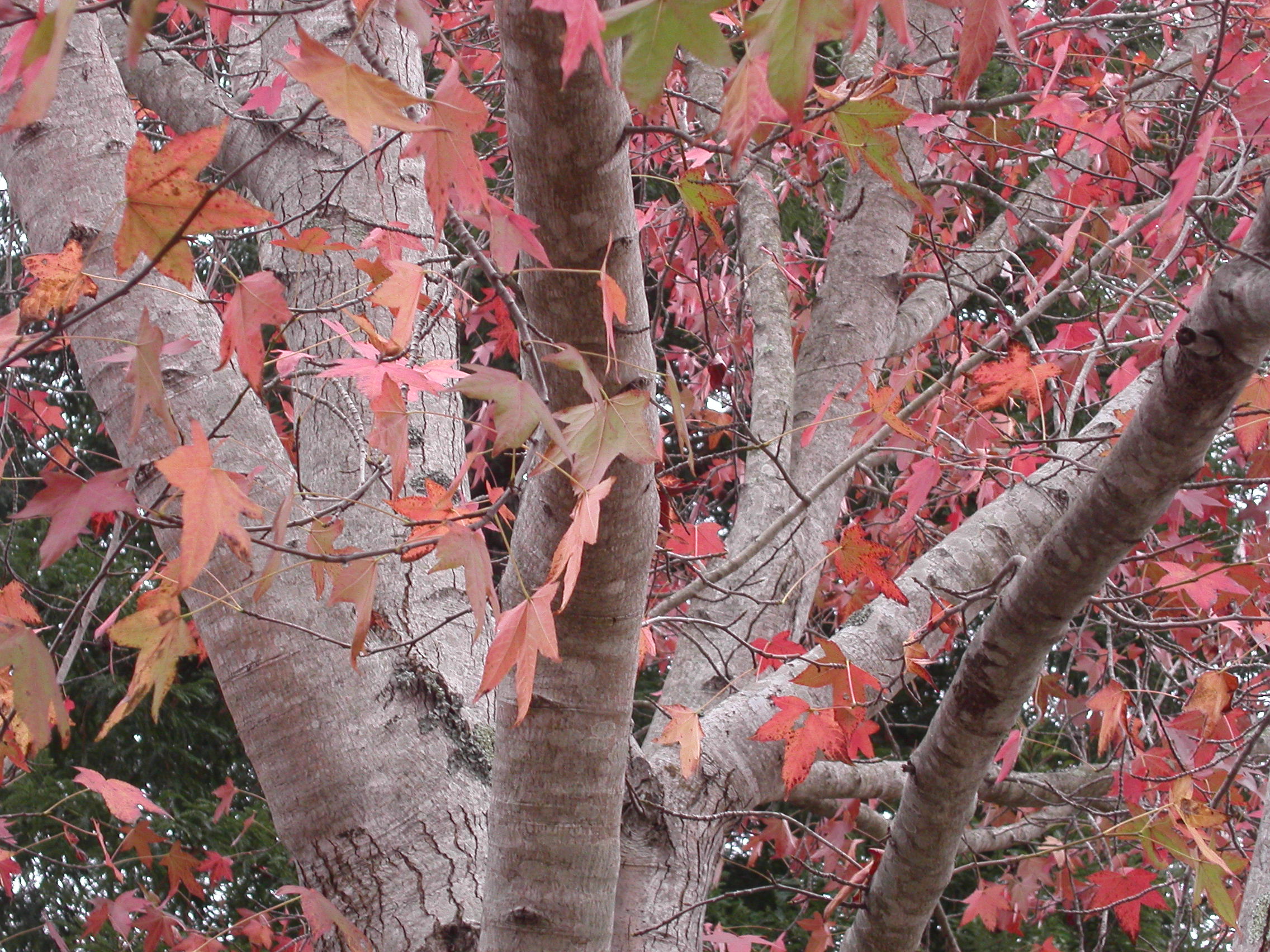
One of my favorite trees in Santa Cruz

Kesem Farewell Speech

Delivered at Kesem Senior Luncheon, 2014

Oh Hey Camp Kesem! I’m Heather, or “Autumn,” and I have been the director for Camp Kesem at Stanford for the last four years. That means that I get to work on Camp Kesem year-round with a group of the most amazing students I’ve ever known, and it means I get to watch Camp Kesem change and grow over time. It also means that at senior luncheon, I get to take a few moments to thank the seniors and co-terms who are part of our Kesem family.

This is my fourth senior luncheon speech, and this time, unlike previous years, I am joining you in saying goodbye to Camp Kesem. I went back and read my previous speeches, which were filled with positive and hopefully inspiring advice to graduating seniors and co-terms. As with most advice, I found it far easier to share with others than to heed myself. Bring Kesem with you, I told them. You are the reason this community is so special. Kesem is what it is, for campers, counselors, and parents, because of what YOU bring to it. You can create caring communities wherever you go because you know what it means to be part of something like Kesem. The world needs more people like you and more communities like this one – more openness, more generosity, more compassion.

While I still believe this to be good advice, I also want to acknowledge that what we have at Kesem is special. As I’ve tried to imagine bringing Kesem into the rest of my life, I’ve realized that deep down, I know there really is no place like Kesem. We all understand that Kesem is so much more than a week long summer camp. It’s the way a camper smiles when he sees a group of his counselors who showed up to cheer him on at his middle school musical. It’s when a camper’s face lights up when she sees 15 of us at her dad’s funeral. It’s the comforting comment one parent offers to another who tells his story at New Family Orientation, while his son is outside playing his first round of Gaga. It’s the silence that falls on the room after the common ground activity at counselor training, when we understand for the first time just how much we share. The magic of Kesem is the community, and this community is a blessing to those it serves, but also for those who participate in building it.  As much as I’d like to think we can bring that community out into the rest of the world, there’s also magic in knowing that it exists in sacred space, and that nothing else can replace it.

So with this in mind, I turn to one more lesson I’ve learned from Kesem and our campers, perhaps the most important lesson of all – that letting go, like holding on, can be an act of love. Letting go does not mean forgetting. It means that our hearts surge with gratitude in moments of grief because we are so lucky, so deeply fortunate to have been part of this community. Four years ago, I chose Autumn as my camp name because change and transition are challenging for many of us, myself included. The trees are going through an immense change in the autumn season and they respond to this change with beauty – with vibrant oranges and deep reds and golden yellows. It’s a reminder that change can be a beautiful thing, and that at some point, we all must let go of our branches and catch the next gust of wind.

Seniors and co-terms, I’m so grateful that you’ve been on this journey with me, and I’m so excited for our last week of camp together. Thank you for holding on and letting go with me. I can’t wait to see what happens next.

Edited to add/explain: I have been promoted within Hillel at Stanford. I will be supervising and supporting the new Camp Kesem director, who has been involved in Kesem for three years and is perfect for the job. I will stay involved in Kesem as a member of the advisory committee and I will provide support in any way that I can while empowering the new camp director, who deserves to have the amazing experience that I had. I will miss my direct and daily involvement with Kesem with all of my heart but I know that wonderful things are ahead and that I can support Kesem in other ways by supporting the new camp director. 

Bearing the Weight of my History

This is an “oldie-but-goodie.” I wrote this in fall 2005. I have performed it on stage and on live radio and I find that its message keeps coming back to me because I work with young women and I am always considering the way we talk about our bodies. Enjoy!

My body looks like Russia. It is immense. It spans a hearty portion of the Eastern Hemisphere. There is very little room for neighboring start-up republics on its borders, and when I was younger, I feared I was doomed to live like a frozen wasteland forever. Everything about me kept getting bigger. In fourth grade, my breasts resembled onion domes. By sixth grade, they were the size of St. Petersburg. These days, I think my breasts may be out to take over the world. You could hide nuclear missiles in there! I don’t recommend it though. You may not be able to find them again.

On the map of my body, stretch marks climb over my hips like rivers trying to reach both the Pacific and the Atlantic Oceans. The space between my legs, though not as barren as I feared it would be, seems to get lost between the snow-crested mountains of my thighs.

I inherited this Russian body from my foremothers. They handed it down with their recipes for matzo-ball soup and knish. I can still see my weight-conscious family members frowning around the table, examining my expanding waistline as they examined their own, while my great-grandmother, who sat on the other side of the table, encouraged me to take another helping. What, you should want to deny your heritage? This recipe was my grandmother’s! Eat! Enjoy! We are a zaftig (full-figured) people, that’s how we survived hard winters in Russia, and now, ha! We use food as a way to survive everything! We kvetch (complain) about how big we are, and then we eat more because we’re upset. Nu (so), it’s in our blood. What can we do about it but thank God that we have hearty appetites and big hearts to match.

I tried to listen to my great-grandmother’s words, but it’s awkward to be the largest country. I don’t mean to take up most of the space in Europe, but at least I’m nice about it. I only occupy the spaces no one else wants, the cold, lonely places where the nights are white and the darkness envelops the day. I’m clumsy about government too. My immensity gets in the way, and I seem to trip over everything.

You’d think I would do something about this. I’ve tried. I stopped eating for awhile, in hopes that I could slim down to the size of Italy, or maybe even Chile. It worked at first, but my heritage stuck out in strange places. My waist and hips lost their gargantuan dimensions, and my face took on that sexy angular look, complete with the hollow eyes and sunken cheeks that many people associate with third-world starvation. My breasts, however, never shrank down to normal size. Russia evacuated most of my body and the entire population took refuge in my chest. They threatened to secede and become countries of their own.

Eventually, I grew tired of trying to be the size of Switzerland. I could squeeze into smaller spaces, and at last I was pleased with the country staring back at me in the mirror. But the truth is, I never really fit into that shrunken frame. I was sick all the time, dizzy from my efforts to battle off sinister invaders like bread, cheese, potatoes, and even carrots, those dangerously carb-laden vegetables. I’d wanted to train for a marathon, but my body couldn’t seem to handle it. When I started to pass out after running too many miles without enough fuel, I decided that I couldn’t avoid my Russian heritage any longer.

I gently allowed my body the time it needed to grow again. At first, it was kind of fun – I enjoyed all the food I’d denied myself for so long, though I consumed a hearty serving of Jewish guilt with every bite. But after awhile, as my body regained its Russian proportions, I began to wish that there was anything I could do to abandon my genes – or squeeze into smaller ones.

My great-grandmother’s age finally crept up on her in the fall of my freshman year of college. She died at the age of 98, and I wrote poetry for her all morning, this woman who represented my past. She was one of my few family members who could tell me about Russia as she remembered it – a legacy far bigger than my body snuggled between the bodies of my foremothers and the daughters of our future.

These days, I still kvetch about my size. Having a Russian body means that shopping is devastating, my breasts hurt when the car goes over speed bumps, and every time I eat, I know that I’m feeding the Russian peasants who live in my thighs. Some days, I still look in the mirror and bemoan my figure, even though it is part of my past.

But other days, when I look at the curves of my breasts and hips, I can hear my ancestors laugh with full-figured good nature as they sit together over elaborate meals, passing the kugel and the stories across the table. This is where we enjoy old recipes cooked up and often exaggerated for flavor, this is where my own experiences collide with my history, and this is where my future will be –   served up with a sizeable portion of memories, and shared with my zaftig, loving, Russian family.

Close Up: Memory, Confrontation, and the Days of Awe – High Holiday Sermon, 5774

“On Rosh Hashanah it is written and on Yom Kippur is sealed; who will live and who will die.” This text from our High Holiday liturgy flooded my mind as I entered the gas chamber at Dachau Concentration Camp. The guide had explained that the word “Brausebad,” painted in black above the doorway, is no longer the German word for “shower.” After the Holocaust, the Germans started using a different term because “Brausebad” was the last word that so many millions of people saw before their deaths. When the year begins, we don’t know who will live and who will die. The victims of the gas chamber did not know either. I walked in, I saw the false shower heads, murmured the Mourners Kaddish in the middle of tiled room. And then, thanks to the timing of my birth, I walked out. 70 years ago, the only way out was through the chimney, and here I was, in July 2013, just walking through, processing the moment through my camera lens, like I always do – breathing, living, remembering. I visited Dachau this summer after spending a week in Berlin with Germany Close Up, a program designed to introduce young American Jews to modern Germany, heavily subsidized by the German government. A Holocaust survivor I know told me that if the German government was paying to bring young American Jews to Germany, it was for one reason only. But she was wrong. I returned. I am safe. I went to two concentration camps, and felt a surge of elated energy as I passed through the gates on the way out, overwhelmed with gratitude for my continued liberation.

I went to Germany with questions, and like any good Jew, I returned with more questions. I returned on the cusp of the month of Elul, the month when Jews, as Rabbi Alan Lew (z”l) says, look at the window instead of looking through the window: “When the shofar blows on the first day of Elul,” he says, “and every morning thereafter, it reminds us to turn our gaze inward, and to place judgment at the gates of our consciousness, to shift our focus from the outside world to the considerable activity taking place in the window through which we view it.”1 In this prelude to the High Holidays, Jews deepen our awareness, apologize to those we have wronged, and make plans to grow as human beings over the year to come. We have the opportunity to look back, to remember, and to learn how we can move forward in the new year.

Stolperstein - Stumbling Stones Berlin taught me a lot about looking back. For the first time, I had the opportunity to ask non-Jewish Germans, outright: What did your family do in the war? Most of them had no idea. It wasn’t something you talked about, their families said. It was something you remembered. You can’t walk anywhere in Berlin without remembering something. The city itself seems to have PTSD. Look down at the cobbled sidewalks and you see gold stumbling stones inscribed with the name of a Jew who lived in that spot, noting the date of deportation and the place of their death. Look up and there’s the Memorial to the Murdered Jews of Europe, tremendous and dominating, so much a part of the landscape that children have snowball fights amid the giant blocks during the winter. Turn the corner and there’s another memorial, in Hebrew, English, and German. Everywhere, the memory of someone we lost and the culture that went with them.

I don’t think anyone in Berlin has the chance to forget, even for a minute. It was like a tour through my own psyche. Yes, my psyche – I’m an American Jew, three generations removed from the Holocaust. I grew up reading too many books about the Holocaust, and had nightmares in which Dr. Mengele shot my mother while I had to watch. I was 10. I’d never been to a concentration camp and I did not know my own family’s Holocaust story, but somehow, these memories became my own. My favorite author, Jonathan Safran Foer, says “Jews have six senses: Touch, taste, sight, smell, hearing … memory. While Gentiles experience and process the world through the traditional senses, and use memory only as a second-order means of interpreting events, for Jews memory is no less primary than the prick of a pin, or its silver glimmer, or the taste of the blood it pulls from the finger. The Jew is pricked by a pin and remembers other pins. It is only by tracing the pinprick back to other pinpricks – when his mother tried to fix his sleeve while his arm was still in it, when his grandfather’s fingers fell asleep from stroking his great-grandfather’s damp forehead, when Abraham tested the knife point to be sure Isaac would feel no pain – that the Jew is able to know why it hurts. When a Jew encounters a pin, he asks: What does it remember like?”2

Memorial for the Murdered Jews of Europe

Visiiting Berlin, I got the sense that the city itself remembers the way Jews remember, with a sixth sense. Young German non-Jews who have no connection to the Holocaust still feel guilty when they meet someone Jewish. Holocaust education in the schools is extensive. Most highschool classes visit a concentration camp. All are required to visit a memorial.By the time they get through school, they are tired of hearing about it, tired of feeling guilty, tired of questions that don’t have answers: What did our family do in the war? What can we do about it? How can I live with this history? The trauma of the Holocaust has been passed down, l’dor v’dor, from generation to generation, among Jews and non-Jewish Germans alike.

The psychology of trauma teaches us that exposure is the only way to heal. Talking about it. Recognizing the pain. Being with it. Germany Close Up provided an opportunity for us to do that together. I don’t know if a r’fuah shlemah – a complete healing – is possible. But I do know that confronting the issue through compassionate conversation, sitting with the pain together, was itself a healing experience. As Rabbi Lew says of our sins, “What’s done cannot be undone— but it can be healed; it can even become the instrument of our healing.”3

We are good at remembering, but confronting trauma is much harder, and there comes a time when “never forget” just isn’t enough. For me, that time was this summer. I went to Germany because I was ready to explore some of the deeper issues in my own memory and in our collective Jewish memory. I engaged directly with the site of the trauma, with contemporary Germans, and shared a Shabbat dinner with the new Jewish community in Berlin. I also learned that Israelis love to visit Berlin and that Germans love to visit Israel. It’s harder for American Jews, and I’m not sure why. We remember. We’re not ignoring the trauma. But many of us are not coping with it either.

This is just one example of an evaded issue – the largest unresolved trauma of the 20th cenIMG_2441tury, and part of our collective Jewish memory. I know that some are not yet ready to get on a plane and fly to Berlin to cope with it. But I wonder if each of you can take this opportunity over the next ten Days of Awe to consider other evaded issues in your personal experience. What other traumas have you been ignoring? What is it that you are remembering, but not facing? What would it be like for you to engage directly with a painful experience in your personal memory – perhaps the death of a loved one, a challenge to your identity, a moment when you were unkind to someone who reminded you of something you fear in yourself? Can you acknowledge your failings and traumas without allowing them to consume you?

On Rosh Hashanah, we read the story of the Akedah, the binding of Isaac, another traumatic story in our collective history. I have often wondered what it was like for Isaac, who lived the rest of his life knowing that his father was seconds away from sacrificing him. How did Isaac walk through the world carrying this trauma? Did he relive that slow walk up the mountain in his nightmares? Did he wake up relieved that he could move his arms and legs, that he was not bound after all, to the memory of the wood, the knife, and the imminence of fire? I’m sure Isaac never forgot the terrifying moment Abraham stood above him with the knife. What traumatic moments do you replay in your own memory over and over again? And are you hiding behind the memory itself, instead of engaging in the more painful but rewarding task of confrontation?

It is not for me to say that you need to enter your personal gas chamber so that you can walk out. Only you can decide when you’re ready to confront your own trauma, and you get to decide what that means for you. All I’m asking is that you take this time during the Days of Awe to notice the window you’re looking through. Then, when you’re ready, you can open it.

Note: Hillel at Stanford is now partnering with Germany Close Up, so I will be staffing this trip over spring break 2014. If you are a Jewish student at Stanford and you want to know more about how to get involved, email me at hpaul@stanford.edu.

If you are not a Hillel at Stanford student and you would like to do this program, check out the Germany Close Up website to learn more! 


1. Lew, Alan (2003-08-01). This Is Real and You Are Completely Unprepared: The Days of Awe as a Journey of Transformation (p. 78). Hachette Book Group. Kindle Edition.

2. Foer, Jonathan Safran. Everything is Illuminated (p. 193). Harper Perennial; 1st Perennial Edition/6th Printing edition (April 1, 2003)

3. Lew, Alan (2003-08-01). This Is Real and You Are Completely Unprepared: The Days of Awe as a Journey of Transformation (p. 29). Hachette Book Group. Kindle Edition.


We Are All Educators

Originally published on hillel.org on 1/2/13.

I’ll never forget the first time I heard the term “experiential education.” Dr. Gabe Goldman explained the concept as part of a program at the Western Hillel Organization conference. Goldman taught that all experiences have the potential to be educative. The educator can make the experience engaging and interactive by creating the right setting, and asking questions that encourage and empower students to construct their own ideas based on the experience. As Goldman, who is the Director of Experiential Education at American Jewish University, began to explain this concept, my first thought was, “My work has a name!” My second thought was, “I want to learn everything I can from this guy before the conference is over.” Imagine my thrill when I discovered that “Principles of Experiential Education” was on the course list for my HUC-JIR program. This was my chance to discover the language and theories that support the work we do at Hillel every day.

When I say “we,” I am not only referring to rabbis or Senior Jewish Educators. One of the most powerful concepts I have come to understand throughout this course is that program and engagement professionals truly are educators. When we staff an alternative break or a Taglit-Birthright Israel: Hillel trip and facilitate follow-through programs, when we hang out with students at a social barbecue, or when we take a freshman out for coffee, we are – or can be – doing the work of educators. Seeing programming and engagement in the context of some of the theories we learned in class has inspired me to seek teachable moments in each of those settings. You don’t have to have “educator” in your title to organize programming and leadership opportunities that inspire learners to grow, to ask questions, or to change their perspectives.

Each of the experiential education theories had plenty to offer, and in this post, I’m going to focus on two in particular. The first is a set of learning steps for an experiential model, developed by Stephan Carlson and Sue Maxa, in their article, “Pedagogy Applied to Nonformal Education.” Although this article was published in a journal dedicated to the 4H program, the concepts apply to experiential education in a much broader sense. According to Carlson and Maxa, “Experiential learning requires both active cooperation of the learner and guidance from the leader…Experiences lead to learning if the individual understands what happened, sees the patterns of observation emerge, draws generalizations from these observations, and understands how to use the generalizations again in a new situation.”

Through the experiential model, learners:

  1. Do the activity (before being told or shown how)
  2. Share results and observations
  3. Process – analyze and reflect on the experience
  4. Generalize – relate the experience to a real-world example
  5. Apply – use what was learned in a similar of different situation.

Carlson and Maxa emphasize the importance of questioning in the process and generalizing steps. This is where a Hillel professional can facilitate meaningful discussion by asking questions that make the experience educational.

I also found Joseph Reimer and David Bryfman’s chapter in What We Now Know About Jewish Education to be particularly helpful in a Hillel context. Reimer and Bryfman state that, “experiential Jewish learning involves three distinct initiatives, each with its own set of goals: recreation, socialization, and challenge.” In recreation, they explain, “experiential Jewish education aims to provide its participants with social comfort, fun and belonging in a Jewish context.” Socialization “aims to provide the knowledge, skills, and attitudes to be an active member of the Jewish community.” Jewish educators also “aim to encourage participants to undertake the challenge of stretching themselves and growing towards a more complex participation in one’s Jewish life.” In short, experiential Jewish education programs should be fun and enjoyable, should encourage connection to Judaism and Jewish identity, and should challenge learners to get outside their comfort zones, “so they feel they are on a Jewish journey and not simply a member of a Jewish club.”

I can imagine that for some Hillel professionals, these theories may feel superfluous: “I already program this way intuitively; why should I name the process?” I propose that shared educational language provides us with a better way to communicate and learn from each other, and to learn from educators outside of Hillel.

At Hillel at Stanford, I enjoy using these and other theories to evaluate and to set educational goals for programs and engagement. I have Carlson and Maxa’s chart and Reimer and Bryfman’s initiatives tacked to my bulletin board so I remember to ask myself the right questions:

  • Does this reflection activity involve opportunities for generalization, so students connect the experience to the rest of their lives?
  • Does this experience offer enough balance between recreation, socialization, and challenge?
  • Do my questions invite students to construct their own learning?

Drawing on these resources, Hillel professionals can learn to seek and employ the teachable moments in each experience, whether it’s an alternative break orientation, a barbecue, or a coffee date. We are all educators; we just have to recognize the opportunities to educate.


Pluralism, Dissonance, and Jewish Identity Formation

Originally published on hillel.org: 9/12/2012 

My introduction to Hebrew Union College – Jewish Institute of Religion (HUC-JIR) opened in a very Jewish way: with a question. “How can we, as Jews, be a part of and apart from American culture? That’s a rhetorical question right now, but I want you to start today, and then work on answering it for the rest of your life.” We laughed, but the asker, Rabbi Tali Zelkowicz, Ph.D., was right. As Jewish professionals, the questions we ask ourselves come with answers that change over time. This is because identities, communities, and ideals are anything but static. Rabbi Zelkowicz taught us to stop saying “Jewish identity” but rather to say “Jewish Identity Formation,” because identity develops throughout our lives. We need to recognize the moments of change, and meet people where they’re at. “Identity works as a process, not a product, and educators do not ‘make’ Jews,” she said, (and quoting Hillel the elder) “The rest is commentary.”

I’m one of sixteen students in HUC-JIR’s graduate education certificate program, which focuses on teens and emerging adults. This one-year “hybrid” learning program combines online and in-person learning, and began with a three-day intensive that included the Jewish Identity Formation course. While I’m starting my fifth year as a Hillel professional and my third at Hillel at Stanford, the other students in my cohort all work with teens. At first, I was concerned that much of what we learned might be a stretch to apply to Hillel. I was also concerned that the Reform focus would not address the issues of pluralism that Hillel professionals face in our daily work, where our community members are all over the religious spectrum. At times, varying views on diverse topics like taking pictures on Shabbat or women’s prayer at the Western Wall can create acute conflict that contributes to an underlying tension within the Hillel community. However, I was pleased to find that I’ve already gained tools that are very applicable to these challenges.

The Jewish Identity Formation class provided an interesting perspective on the “dissonance,” or conflict, between American and Jewish cultures. In conversations about our personal identity formation, we quickly noticed that moments of dissonance often strengthened or deepened our understanding of our Jewish identities. While the conflict is painful in the moment, dissonance is necessary because it moves us to take action to discover our Jewish identity formation.

For example, one student had endured a painful conversation about intermarriage with her rabbi, who refused to officiate at her wedding to a patrilineal Jew. She decided that inclusivity was an important part of her Jewish life – more important than having a specific rabbi officiate her wedding – and she found another rabbi whose beliefs about intermarriage were more in line with her own. That student learned something about herself from this moment of dissonance: that what really mattered to her was raising a Jewish family with her partner’s support. As it turns out, internal dissonance can be a wonderful opportunity for Jewish identity formation and personal growth.

Identity formation intensifies during emerging adulthood. Our students are trying to define themselves on a personal level and on a community level. They have their first opportunities to design their own Jewish experience, away from their families’ Judaism. They get to decide how much they want to be apart from and a part of American culture, as American Jews. That instability can be terrifying for emerging adults, and Hillel professionals can help to support the students as they navigate this uncertainty. We can support our students in a way that validates every variation of their practice, but more importantly, we can create a safe space to challenge those variations, and to provoke those moments of dissonance and transition that lead to further identity formation and growth. For example, a Jewish student who wants a Star of David tattoo would benefit from discussing the decisions with a Hillel professional beforehand. We can provide this student with perspective about Halacha (Jewish law) and tattoos, and we can ask the student why they want to get a Jewish tattoo in the first place. It’s not up to us to persuade the student one way or the other, but Hillel professionals can ensure that the student is making an informed, intentional choice.

I always try to come back from conferences, institutes, and other learning opportunities with a few nuggets of wisdom or new ideas, and with a question for further discussion. This week, my question was inspired by our conversation about dissonance, as it applies to pluralism. We know now that personal dissonance is necessary for individual growth, but what about dissonance within the community? A student’s internal struggle about what it means to be Jewish often becomes an external conflict with another student who has a different perspective. Statements like “you’re not really Jewish” or “your Judaism is outdated and sexist” are incredibly hurtful to a student who is just beginning to develop his or her own Jewish practice. If we can help our students navigate their personal moments of dissonance, perhaps they will have more compassion toward each other when they externalize the conflict.

Furthermore, if internal dissonance fuels identity formation, is it possible that external conflict also provides an opportunity for growth? When conflicts arise between students who celebrate Judaism in different ways, how can we help our students see the positive learning opportunities within the nodes of dissonance? And although we may or may not work on answering this question for the rest of our lives, this time, it’s not rhetorical. Please share your thoughts, answers, and further questions by posting a comment below. I look forward to continuing this conversation with you!