Wisdom from the Wilderness

There’s a name for what we’re experiencing . That feeling of having our hearts broken so repeatedly by the news cycle. Flash floods, fires, mass shootings, wars within us, wars between us, and wars in the world. Wars that make us question who we really are as a people. One day you’re worrying about climate change, the next it’s a group project, AI taking over, what you’re going to do with your life, the next pandemic, your situationship, economic collapse, or drama within your friendgroup. There’s never enough time to process one crisis before another begins. Even when the crisis is no longer acute, there’s a pit in our collective stomach, and it’s not just because we’re Jews with stomach problems. There’s anxiety pulsing through our communities as we wonder what will happen next. The feeling is called “existential whiplash.”  An instagram post from a mental health service called Spring Health says that “existential whiplash” is the emotional strain of trying to keep up with daily life while everything around us feels uncertain or overwhelming. 

Our ancestors knew a thing or two about this feeling, and what it’s like to yearn for stability, while knowing that change is going to keep coming. They survived slavery, escaped Egypt, and crossed the Red Sea. They had a dramatic experience at Mt. Sinai. They reached the Promised Land.  In between these major events, they wandered in the desert – trying to live amid existential whiplash, just like us. The Hebrew word for desert is “midbar.” It also means “wilderness.” The word  midbar appears approximately 270 times in the Torah. It represents uncertainty, wandering, a feeling of lostness in a world churning  with change. 

We’ve spent a lot of time here too, bamidbar – in our own spiritual wilderness. Believe it or not, 2020 was only five years ago. It’s been a long five years, and it’s been utterly exhausting. But all that intergenerational trauma we’ve acquired – going all the way back to our ancestors in the midbar – comes with intergenerational resilience. We are still here.  Still moving forward. We’re even still complaining about it, much like our ancestors in the desert.  

Tonight, I’m going to share 7 lessons for our spiritual wilderness based on our ancestral experience, as well as a few lessons based on the literal wilderness. Some of our most powerful spiritual technologies mirror the interdependent systems of the natural world. In the wilderness, we have an opportunity to learn from that which is wild, around and within us. We will see what our ancestors and the natural world can teach us about the resilience we have right now – and the ways we can build it for the future.  

7 Lessons from the Wilderness 

Lesson 1: Build sanctuaries. “V’asu li mikdash, v’shohanti b’tocham” – God says. “Make for Me a sanctuary, that I may dwell within them.” The mishkan – the communal, portable sanctuary in the desert – was elaborate. Five Torah portions in Exodus discuss the building of this space, sometimes in excruciating detail. The mishkan teaches us that at times of uncertainty, we should build something beautiful. We should pour our energy into creating, especially co-creating something that will serve the community. 

What sanctuaries have you built in our wilderness? What does your mishkan look like? Your mishkan might be your dorm room, a friend’s car, or your favorite coffee shop. It might be the arboretum or another outdoor space where you feel at peace. When you can’t change the whole world, you can still create something beautiful. Something safe. Something meaningful to you and those around you. 

The commentators point out that “v’shohanti b’tocham,” means “that I may dwell within them.” Yes, we must build physical sanctuaries, and we do – and on another level, the text may be referring to the people themselves. “Make for Me a sanctuary that I may dwell within them,” the people. The mishkan, the dwelling place for the Divine – is within every one of us.  

This means you can both build and be a sanctuary – for yourself and others. When have you been a sanctuary for someone you care about this year? When have you been your own? What does it look like to know there is a safe and sacred space within you, one you can always return to? The ultimate mishkan – traveling temple – goes wherever you go, and is there for you no matter what. This is the first lesson of the wilderness: In times of existential whiplash, build sanctuaries. 

There are many examples of collaborative building in the wild that can be instructive for us. Bees build hives and make honey through a process called festooning.. These “festoons” create structural support and regulate the temperature of the hive. Within the hive, there are worker bees who build honeycomb, nurse bees caring for the young, and scout bees who search for optimal hive collections. Each bee contributes to the structure that enables the hive to thrive. 

This leads me to lessons 2 and 3. Lesson 2 is Everyone has something to offer. God instructed every person to bring gifts to the sanctuary, telling Moses, “You shall accept gifts for Me from every person whose heart is so moved.”  Everyone was asked to give from their heart, and every gift was accepted.  

What can you do to sustain yourself and your community?  Are you an expert problem solver? Someone with powerful listening skills? Are you creative? Are you the person who can always make your friends laugh? Think about what you can give, and give it with love. It might be exactly what your community needs. Lesson 2. Everyone has something to offer. 

Like bees, when we contribute our skills and strengths to our community, we also benefit from the skills of others. This creates a more capable community that allows people to flourish – even or especially in the wilderness. This is where lesson three comes in. Ask for help. In the mishkan, Kohanim were the priests, who made sacrifices on behalf of themselves and their communities. The Levi’im played music and managed the practical aspects of Temple worship. There were also specific roles for individuals. Miriam was the one who could always find water. Betzalel was an artist who designed that first mishkan. 

Lessons 2 and 3 are connected. If everyone has something to offer, you can help others – and others are here to help you, like the bees in their hive. We all have different skills to share. Who, in your wilderness, can you turn to for help? Who can you reach out to when you experience existential whiplash?  When your well has run dry, find a Miriam who can help you locate a new source of lifegiving water. If you can’t serve God by leading song, find yourself some Levites who can. 

Hasidic master Sefat Emet wrote, “Each one gave their own offering,  but they were all joined together by the Mishkan, and became one. Only then did they merit the Divine Presence.” Each person had something unique and precious to offer – but they could not experience the Divine Presence until they shared these offerings. We became a people united not by what we took, what we achieved, or what we conquered. We became a people united by what we gave to one another.

Ecosystems are interdependent. Beavers create habitats, and those habitats are shared with other life forms. Recent research suggests that trees of the same species are communal, and will form alliances with trees of other species. Some claim that forest trees live in cooperative, interdependent relationships, maintained by communication similar to an insect colony. We are both of and in the wilderness. No one can make it through the wilderness alone and fortunately, we don’t have to. Third lesson from the wilderness: Ask for help. 

One Jewish practice that speaks to lessons 2 and 3 is the act of praying with a minyan – ten people. Mourner’s Kaddish is one prayer we only say when we have a minyan. We show up to support the mourners so they can say this prayer during their time of vulnerability and grief. In my prayer services, we count the Jews who are in the building, not just the ones who are in our service, because we are here together for the same reason. We are here because we know we are interdependent, because it strengthens the community, and because we believe in showing up. 

In April, there was a 5.2 magnitude earthquake in Southern California. A livecam from the San Diego Zoo showed all the adult elephants making a protective circle around the two youngest elephants. This behavior is a natural instinct to protect the most vulnerable. An elephant minyan. I think about it when we pray Mourner’s Kaddish together. We can’t protect anyone from grief. But there is so much power in showing up, like the elephants – it makes the grief just a little more bearable, a little less lonely. 

When there’s existential whiplash, make the minyan.  When others ask for help, it’s ok to not always have the right words. Sometimes, showing up is the help. When people are vulnerable, when things are uncertain, when the ground itself feels shaky – count your people, leave no one behind, show up, and be counted yourself. 

Lesson 4: Practice mindful awareness – be present and look around. Our ancestors often found what they needed in the wilderness when they least expected it.

Jacob ran into the wilderness after deceiving his brother and his father. He fell asleep with his head on a rock, and he dreamed of a ladder with angels ascending and descending. Jacob awakened, saying “Mah norah hamokom hazeh!” God was in this place, and I didn’t know it. 

Moses was also bamidar when he saw a bush, burning, but not consumed in the fire. He had run away from Pharaoh’s land, struggling with his conflicting identities as a master in Pharaoh’s palace and a Hebrew, like those Pharaoh enslaved. God spoke to Moses from the burning bush, saying, “Take off your shoes. The place where you are standing is holy ground.”  It was existential whiplash. 

Moses and Jacob were in the wilderness – physically, emotionally, and spiritually – when they received these messages. The Israelites were in the wilderness when we received the Torah at Mt. Sinai. Midrash Rabbah Numbers 1:1 teaches that this was because the Israelites had to be “free and ownerless like the desert” in order to receive it.  The lesson is to be aware of your surroundings. God was in that place. The ground itself was vibrating with holiness. That which appears empty is full of potential. Make yourself free and ownerless like the desert. That which appears mundane may actually be sacred.  Lesson 4.  When facing existential whiplash, practice mindful awareness.  You never know what the wilderness of our moment might reveal.  

Lesson 5 is to forgive. Yom Kippur is the anniversary of the day God forgave the Israelites for one of the greatest sins of all-time – building and worshipping a golden calf. Moses went up Mt. Sinai to receive the Torah from God. The Israelites were afraid and uncertain as they waited. We’ve all been there. We turn to unhealthy coping mechanisms in the wilderness of the unknown, just like our ancestors did.  Even Aaron, Moses’s brother, a leader in the community, took part, inciting the group to not just build, but worship the false idol. 

We have all worshipped false idols in the last year. We have doomscrolled through the desert, worshipping headlines, statements, and trends, arguing in comments instead of taking responsibility for our errors. Your leaders, like Aaron, have also committed this sin. But the story of the golden calf and God’s forgiveness of our ancestors remind us how important it is to forgive, even if it means forgiving idolatry. 

Individuals can’t be perfect, communities can’t be perfect, and the world can’t be perfect.  Ecosystems can’t be perfect either –  even a slight shift in one element can create significant and damaging change across the system. Without grace for the flaws of individuals, communities, or the world, we lose interest in showing up to help each other. We instead cut ourselves and others out. Our communities suffer as a result, much like our ecosystems when something is missing. 

On Yom Kippur, we pray for God to forgive us, as God forgave us for the golden calf. But the only thing we can really do is forgive each other and ourselves. Adonai, Adonai, El Rachum v’Chanun, we chant, listing God’s 13 attributes of mercy – God, God, compassionate and merciful. Can we be compassionate with one another? Can we have mercy on ourselves? Can you forgive yourself for your own idolatry? Can you forgive your community? The world? Can you forgive God? It’s a tall ask. It’s not always possible and it’s not even always the right thing to do. But most of the time, it is – and we must try. Lesson 5. Forgiveness. 

Lesson 6 is to make space for grief. Miriam, Aaron, and Moses – all great leaders – eventually die in the wilderness, before the Promised Land. We’ll focus on Moses and Aaron first. Regarding Aaron’s death, the Torah says “All the house of Israel bewailed Aaron thirty days.” Regarding Moses’s death, we read, “The Israelites bewailed Moses in the steppes of Moab for thirty days.”  To this day, shloshim – 30 days – is one of the mourning periods after a death in Jewish tradition.  With their deaths, Aaron and Moses taught us how to grieve. 

Elephants revisit the remains of deceased herd members, touching and examining the bones, or standing vigil for extended periods. Some cry and refuse to eat after losing a companion. Dolphin mothers may carry their dead calves for periods of time, and other pod members may assist in carrying the body or guarding it. 

Loss happens in the wilderness. In ours, it may seem like everyone is grieving, all the time. But announcements of anguish for suffering communities does not reflect a full grieving process. Existential whiplash leads to “statement culture.” Everyone feels the need to say something about the most recent bad news. It’s often necessary, but it keeps real grief itself at a distance. We need to pause. We need to wail, like the Israelites cried for Moses and Aaron. We need to reflect and remember, like elephants revisiting their herd members’ bones. Make space to mourn. That’s lesson 6.  

Lesson 7 is to practice trust. God appeared to the Israelites as a pillar of cloud by day and a pillar of fire by night. The pillars  were with them at all times, reminding the Israelites that they were safe. That’s right. They had an emotional support pillar-of-cloud.  Still, as a people traumatized by a history of enslavement, it took them a long time to trust their safety, their leaders, and God. Even when the Israelites were on the verge of the Promised Land, they believed false risk reports, and acted out from a place of fear. They had to wait another 40 years before going into the land as a result.  Nonetheless, the pillars of cloud and  fire stayed with them; a Divine Presence. A reminder that they could learn to trust. 

When you are hypervigilant, or overly attuned to risk – what is your pillar? What shows you that you are safe, that you can trust the process, that you will be cared for, no matter how the future unfolds? Can you trust yourself? Your leaders? Your community? Lesson 7 is to “practice trust” because in times of emotional whiplash, it really does take practice. But our ancestors learned how. And so can we. 

I want to share one case study from the wilderness that shows what happens when we miss the mark in each of these lessons.  When Miriam died in the wilderness, “The community was without water, and they joined against Moses and Aaron. The people quarreled with Moses, saying, “Why have you brought God’s congregation into this wilderness for us and our livestock to die there? Why did you make us leave Egypt to bring us to this wretched place, a place with no grain or figs or vines or pomegranates? There is not even water to drink!”

Miriam was the one who made wells of water appear in the desert, so their concern about water was understandable – but by now, they had been bamidbar for a long time. God had provided what they needed, from manna to eat, to the Torah herself.  By whining for the Egypt they left behind, the Israelites abandoned the sanctuaries they built together.  With mindful awareness, the Israelites might have made space for Moses and Aaron to grieve for their sister. Instead, they panicked, quarreled, and cried for water. Ultimately, God told Moses to speak to a rock, and water would pour from it. In Moses’s rage, he hit the rock instead. 

It’s so relatable. The communal experience of water anxiety. The personal loss. The competing needs, everyone yelling over everyone else. And all of it happening all at once. It was existential whiplash. Instead of grieving, he had to make it stop. He had to fix it. Can anyone relate? Me too. With awareness, Moses might have said “I hear your concern for water. God will provide. Give me a few minutes to myself before I ask God for help.” Instead, he lashed out, hitting the rock in his rage. 

We are living in a wilderness, experiencing profound existential whiplash. The Israel / Palestine crisis, the climate catastrophe, rising antisemitism, lack of access to health care – the list goes on.  While the issues themselves may be new to us, the experience of wilderness is, for lack of a better term – precedented. We have been afraid and uncertain before. We know what happens when we act from a place of fear, building false idols that don’t really protect us. We know what happens when we jump into fixer-mode, without first making space for grief.  We are interdependent, like so many animals in the wilderness. When just a couple of wolves can’t trust the others, it threatens the health of the whole pack. 

We also know what it’s like to build and to be a sanctuary, for each other and for ourselves. We know how to make a minyan, how to lean on each other, and we know how to make offerings that come from the heart.  We know that every bee’s role is urgently needed for the health of the hive. We know how to see the sacred where we least expect it to find it. We can lessen the pain of existential whiplash by looking to the midbar – the wildernesses of our past, the wild world around us, and the wildernesses within, to discover what we need to thrive.  

To recap: 

Lesson 1. Build Sanctuaries. 

Lesson 2. Everyone has something to offer. 

Lesson 3. Ask for help. 

Lesson 4. Practice mindful awareness.

Lesson 5. Forgive. 

Lesson 6. Grieve. 

Lesson 7. Trust. 


A midrash teaches that midbar, wilderness, is linked to the word “midaber,” which means speech. We can use our speech, our words, to teach one another these lessons when we’ve forgotten. We can use them to write down our stories, so we can return to them in the next wilderness. We can use them to remind ourselves that our ancestors passed down their grit (along with all that anxiety and the stomach problems), and that we are stronger for it. We are always in the wilderness and there are always sanctuaries and we keep trying and learning and becoming. There are words for what we are experiencing – existential whiplash. And there’s a term for the antidote – it’s what happens when we learn from everything behind us, around us, and within us. It’s resilience.
Witnessing: Yom Kippur Sermon, 5785

When I was regularly facilitating children’s grief groups and volunteering at grief and cancer camps, I had a recurring dream. In the dream, I was facilitating a grief group, much like the ones I led in waking life. The crucial difference is that the dream grief group was a grief group for the dead. My job in that dream was two-fold: to witness the dead as they grieved the lives and loved ones they left behind, and to support the dead through this transition, to help them integrate their new reality. These dreams were never scary. They were tender. Loving. We even laughed together, just like we did in my grief groups for the living.

Almost always, the deceased parents of the children I worked with in waking life showed up in my dream grief groups. I recognized them immediately when they walked in, because their living children had shown me pictures of them at candlelight memorials and in popsicle stick photo frame activities. I’d heard so many stories about these deceased parents from their living children, whose grief I witnessed in waking life. One teen described her late mother as feisty and smart. She was a brilliant scientist who always wore bright red lipstick. When that deceased mother came to my dream grief group, she appeared just as her daughter described her, red lipstick and all. 

My unconscious mind fabricated grief groups for the dead based entirely on stories shared by their living children – memories, quirks, inside jokes, and even the tough moments – the ones that emerged late at night at grief camp. “My last conversation with her was an argument. It was so stupid.” “I was so angry at him for the drug use. What if he didn’t know I loved him?” In my dream grief groups, the deceased parents and I fondly remembered their children together. Their parents were always so proud of them. 

The dream groups were intimate. Personal. Powerful. It was my mind’s gentle way to witness my own witnessing – to make sense of the countless stories of loss I carried with me over my decade working with these children. 

Grief group facilitation taught me a lot about the power of witnessing – or, as my friend Rabbi Irwin Keller says – “with-nessing.” With grief, there is no problem-solving, no solution. Nothing can be done to change the situation. Witnessing and being-with are the greatest gifts we can offer. 

The Shema, the most central statement in Jewish liturgy, is a proclamation of our witnessing. In the Torah, the last letters of the word “Shema,” which means “Hear,” and the word “Echad,” which means “One,” are written in larger script than the rest of the text. These letters are Ayin and Dalet. Together, they spell “witness.” The Shema is a call to witness the Oneness of the Divine Presence as it unfolds in the world. In other words, even God needs to feel seen. 

For a number of reasons, I stopped facilitating children’s grief groups after I moved to Champaign-Urbana. The dreams stopped coming at regular intervals, and then they stopped entirely. I was focused on life in a different way, so I stopped dreaming about the dead.

After October 7, 2023, I was sure the dreams would return. I was grief counseling full time, even when we didn’t call it grief counseling. I facilitated groups. I witnessed the pain of countless students, friends, and colleagues. But the dreams didn’t come.

Until September 1st. Since that night when six hostages were murdered, those hostages and others who died on and after October 7th have been visiting my dream grief groups. Like the parents of the children I used to work with, I know the faces and stories of the dead from the living people who loved them. I’ve met musicians, tattoo artist, Shani Louk (z’l), and children who were murdered in their kibbutz bedrooms. I met Carmel Gat (z’l), who was a mindfulness meditation and yoga instructor. In my dream grief groups, she leads some gentle movement for the group each time we meet. The murder of those six unlocked the part of my dream life that processes my grief, and the grief of those I witness – by helping the dead process theirs.

Yom Kippur has a lot to teach us about death, grief, and witnessing. Jewish tradition considers Yom Kippur to be a “dress rehearsal” for our own deaths: We refrain from eating and drinking, washing and pleasure, and some people wear white, evoking the image of shrouds. I’ll talk about that tomorrow morning. Yom Kippur invites us to witness the grief of others, as we experience our own grief at the Yizkor – memorial – service. 

There’s also a Yom Kippur afternoon service that is not often included in Reform spaces, but its message is an important one for this year. It’s called Eyleh Ezkerah – “These I remember,” based on lines that we repeat throughout the service: “Eyleh Ezkerah v’nafshi alai eshp’khah, al koroteinu ha-marot einai zoglot dimah” – “These I remember, and nafshi – my soul – melts with sorrow. For the bitter course of our history, tears pour from my eyes.” The service tells the stories of generations of Jews who were murdered for being Jewish – from Rome to Mainz during the First Crusade to the Spanish Inquisition. “These we remember,” we say again, and again. None of us personally knew rabbinic greats like Rabbi Akiva and Rabbi Shimon ben Gamliel – but we remember them based on the stories of others. The Eyleh Ezkerah service offers a way for us to use ritual and memory to witness the dead, and to create meaning for the living.   

Earlier this week, on the anniversary of the October 7th massacre, students and staff worked together to implement a student vision – a memorial museum. Far from a static walk-through museum with statistics and political analysis, the experience lifted up the stories of actual people – soldiers, people who lived and died in the kibbutzim, and people who witnessed the murder of their loved ones at the Nova festival. First-person testimonials were the fabric of this experience. We felt the presence of those who died on the 7th through the powerful stories and memories of those who loved them. 

And each of us who walked through the museum was a witness. A witness to the stories. A witness to others walking beside us. A witness to our own grief – grief we may have forgotten during an intense year of political argument and analysis. Eyleh Ezkerah. These we remember. Late at night on October 8th, when we cleaned up and put away the museum pieces, it felt like uncovering the mirrors in a home after shiva. That night, more of the dead from October 7th and beyond attended my dream grief group than ever before. 

In my Erev Rosh Hashanah sermon, just 10 days ago, I said that I don’t know what to say about October 7th, and it’s still true. But that’s because there’s nothing we can say that will change what happened. 

It turns out that, once again, it’s not about saying something

Listening is greater than speaking.
Presence is greater than power.
Witnessing is sometimes the most precious gift we can offer.

Surrounded by death, witnessing says “I am here. We are alive. We are together. You are not alone.” 

In my dreams, no one, living or dead, is grieving alone. 

We are all witnessing each other. 

And we are comforted.

Lag B’Omer 5784

Today is Lag B’Omer, the 33rd day of the 49 between Passover (liberation) and Shavuot (revelation) on the Jewish calendar. The Omer is a time of mourning for the deaths of 24,000 of Rabbi Akiva’s students, possibly due to a plague, or due to the Bar Kokhba revolt. On Lag B’Omer, we learn, the plague lifted, or perhaps there was a pause in the fighting. Either way, the deaths stopped.

Lag B’Omer is also the yahrzeit (anniversary of death) for the great mystic, Rabbi Shimon Bar Yochai. Before he died on this day, he told his students that today should be a “day of joy” for them – a day of happy remembering, of lifting up the sparks of his teachings.

Today, in recognition of these historical events, Lag B’Omer is a day when the mourning practices of the Omer period either pause, or stops completely, depending on communal tradition. It interrupts our grief. Lag b’Omer is a day that is often celebrated with bonfires, music, friends and family, and time spent outside.

For the last eight months, my communities and many others have been mourning. Without going into specifics, I will share that nothing has been the same for any of us since 10/7. I’ve been a Jewish communal professional for 15 years, and have spent 10 of those years on campus. This was by far the most challenging. My colleagues and I have been grief-tending, listening, supporting, and teaching students how to be in community with those whose opinions are different from their own. It’s been important work…and it’s been exhausting work. It has been all-consuming.

But today is Lag B’Omer, and so we interrupt our grieving. We emerge from the caves of our pain, as Rabbi Shimon Bar Yochai and his son emerged from their cave after 12 years. We remember that celebration is holy. We remember that we can hold multiple truths, multiple feelings, exploring the paradox of joy and sorrow, love and loss. We gather at bonfires. We sing if we can. We try to lift up the sparks.

I am in Los Angeles to officiate a wedding today. The marriage canopy is open – it has no walls, so the love of the couple can spread throughout the world. According to mystical traditions, the love and marriage of the couple has the power to change the very fabric of the cosmos.

So, today, wherever you are, whatever you believe, I hope you can feel it. I hope you feel the love that is pulsing through universe. I hope you stop even if it’s just for a moment, and allow that love to interrupt your grief. It has been hard for a long time and the hard times are not over. But just for today, join me. Go outside if you can. Build a bonfire in your heart. Take a deep breath, close your eyes, and say “thank you.”

Happy Lag B’Omer, beloveds. May we all find a way today to celebrate the love that surrounds us.

The Narrows and the Expanse

Min ha’meitzar karati Yah
Anani ba’merchav Yah

From the narrow place I cried out to God;
God answered me with an open expanse.

These words from Psalm 118 have been on my heart this year as I’ve prepared for Passover. Every year, we relive the Exodus, saying that we ourselves were slaves in Mitzrayim – a Hebrew word that means both “Egypt” and “Narrow Place.”  This year, we are all trying to make sense of slavery and freedom in a post October 7th world. Each of us has our own meitzar (narrow place) to escape, and our own merchav (expanse) to explore. We have our individual enslavements, our personal Pharaohs and seas to be crossed. But like the Exodus, the war in Israel is being experienced collectively as well as individually.  We all need to find our way from our communal meitzar to the merchav, and we need to do it together. 

For the Hebrew slaves, the narrowness – the meitzar – was Egypt under Pharaoh. The Haggadah tells us that Pharaoh forced the slaves into hard labor. But the subjugation went far beyond the physical. When Moses told the Hebrews that God would free them from slavery, they could not hear Moses in their suffering – literally, according to the text, due to kotzer ruach, shortness of breath, or spirit.  Their spirit had shrunken until they couldn’t grasp the idea of freedom. Netivot Shalom, a 20th century Hasidic rabbi, wrote that “Israel was subjugated in total. They had no independence, even in thought.” The Hebrews “became like breath caught in the throat, subsumed in Pharaoh completely, body and spirit.”  In the narrowness, they could not hear, think or speak for themselves. A numbing silence came from deep trauma, their thoughts swallowed on the inside before they could name them, even to themselves or each other. The Zohar calls this a “galut ha’dibbur,” an exile of speech. 

The path to freedom opened when the Hebrews opened their own mouths and spoke. Exodus 2:23-24 lists four types of outcry: The Hebrews anach, (sighed), za’ak (called out), shav’ah (cried for help),and n’akah (groaned). The beginning of redemption was their own awareness. After generations of feeling and thinking only what Pharaoh told them to, the Hebrews recognized their own suffering. The next step was to call out. At first, they groaned before they could speak. It may have been unintelligible, but the pain and their voices were their own. “When they left Egypt, they went from subjugation to everlasting redemption and received anew the aspect of speech,” writes Netivot Shalom. “Peh-Sach can be interpreted as shorthand for peh (mouth) that sach (speaks). This is the essence of the holiday of Pesach.” They went from slaves that couldn’t think, feel, or speak for themselves, to human beings with awareness of their own pain, and voices that could tell their story. 

After the Hebrews crossed the Sea of Reeds, they found themselves in their merchav – the wilderness.  And they were terrified. We joke about it, but it’s true – after singing at the Sea, the Hebrews immediately used their newfound voices to complain. They complained in Egypt they’d had cucumbers, onions, and melons. Would they starve to death in the desert? What would become of them in this wasteland? These complaints were about physical needs, but they spoke to an underlying spiritual question. Enslaved in Egypt, they’d known what to expect. The Hebrews knew who they were, understood their roles, knew where their meals would come from, and when. There was security in the structure. 

Today, sometimes our structures confine and define us as strongly as Pharaoh. Our polarized political discourse is the most constrictive structure I’ve witnessed and experienced since October 7th. This meitzar is one of certainty, and obsession with our own correctness. In this suffocating narrowness, we categorize people, things, and actions into good or bad, right or wrong. People are forced to be on the side of Israel or Palestine, the side of peace or war. We are enslaved to the echo chambers we created, narrow spaces that limit our perspectives. Students who don’t fall clearly on one “side” or the other have shared that they, like our ancestors under Pharaoh’s rule, can’t speak. They don’t want to ask questions because they are afraid they will be alienated from friends and communities they hold dear. The Passover seder is all about asking questions, but we have become experts at silencing voices that question the Pharaoh. It’s so easy to unfollow or unfriend, to curate a meitzar where we feel secure – and sometimes we may need to! Like the narrow place that enslaved our ancestors, this meitzar has its benefits – it’s predictable, expected, understood. But at what cost?

If our meitzar is a place where we are constricted by certainty, the merchav – the expanse – is uncertainty, a wilderness of not-knowing. We are free when it is safe to be unsure of our stance, and we are open to engaging with different viewpoints. In the merchav, Pharaoh no longer dictates what we believe. Once again, the beginning of our redemption is our own awareness – an awareness that there’s something outside the narrow confines of our own perspectives. We have learned to speak – this time, with people outside the echo chamber. And perhaps more importantly, we’ve learned to listen.  In this expanse, we can be expansive. We can hear one another, acknowledge complexities, and hold multiple truths. 

No longer trapped in the narrowness of what iswe are able to imagine what could be. In this merchav, students who are unsure about their views on Israel and Palestine are welcome to voice their questions without being forced to choose a side. In this merchav that we create, two students who completely disagree with each other sit down for coffee, hear each other’s stories, and learn why each of them cares so deeply about this cause. Neither one convinces the other – and neither one expects to change the other’s mind. They leave the conversation richer because they understand one another better than before they entered this merchav together. 

The possibilities are exciting and terrifying, much like the merchav the Hebrews encountered. It’s scary to hear the voices of those who disagree, when our beliefs feel fundamental to who we are. Will we lose ourselves in the process? Will we forget where we came from? No we will not, because, as the seder reminds us: Avadim hayinu, ata b’nei chorin. Once we were slaves, now we are free. 

As we approach Passover this year, I invite you to use the seder as an opportunity to truly reflect on the meitzar and the merchav. Throughout the week, consider: Have you made a Pharaoh of your opinions? Are you 100% correct, or is that Pharaoh telling you what to think? When you feel the urge to retreat to the security of the meitzar, remind yourself of the consequences. Passover is an opportunity to reflect on what we believe, how we formed our beliefs, and how those beliefs may be forming us. This year, the Peh – Sach, the mouth that speaks, must be one that asks questions, as we always have in our seders. The Haggadah reminds us that we cannot return to Pharaoh. We must free each other, and we must do it together.

The Soil and the Seeds: On Openness, Vulnerability, and Leadership

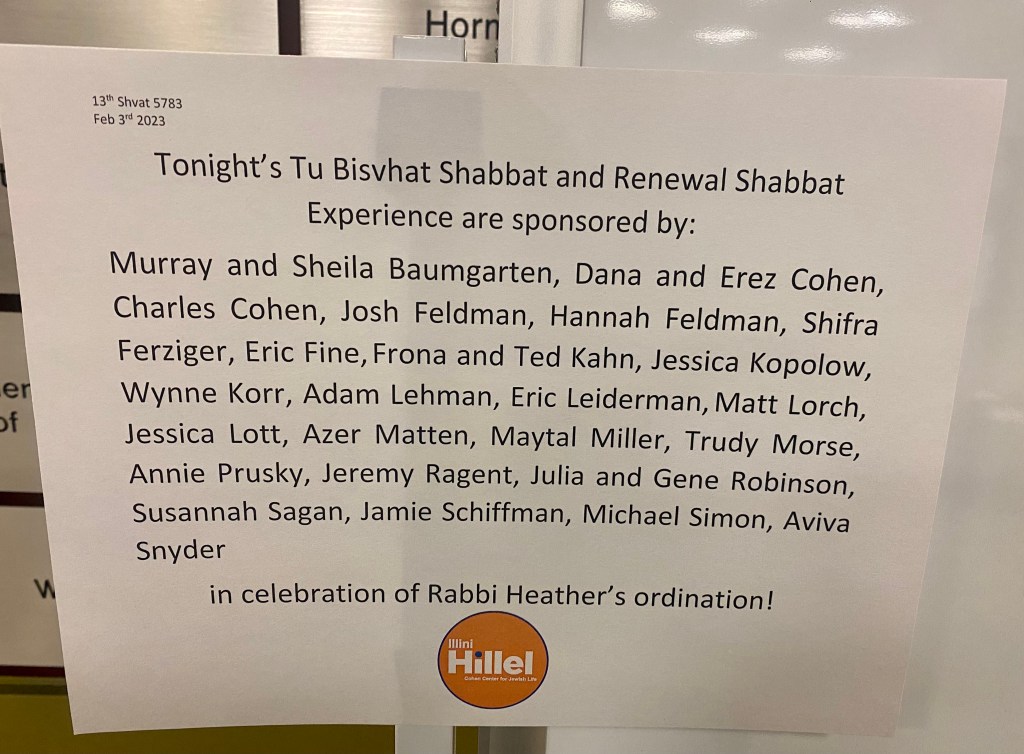
I gave this d’var at Illini Hillel on February 3rd, 2023 at a Renewal Shabbat experience in honor of my January 8th rabbinic ordination. I wanted to share something I learned about leadership during my rabbinical program with my community. This d’var was given on Shabbat Beshelach, two nights before Tu B’Shevat, the new year of the trees.

Where do untold stories go?
Do we bury them like sacred texts?
Do the stories turn into seeds underground?
If the seed splits like the Red Sea,
and a stem starts to grow, where does it go
if it can’t burst through the soil, if it can’t rise up singing,
if it never blooms?

Where do untold stories go? I’ve been asking this question for years in various leadership roles. We talked about it at Davvenen Leadership Training Institute, DLTI – the most formative training program I experienced in rabbinical school. Sometimes leading means we “tell the stories communities need to hear, instead of the stories we want to tell.” The best leaders know how to “hold space instead of taking up space.” As a leader, when I open up, it’s to create openings for others to grow. I am the soil, not the seeds. It’s an honor to bear witness, to share just enough that others are inspired to stretch, crack, and split through the shells of their seeds. It’s a blessing to empower others to grow. 

I built a life out of soil and I like to think I’m good at it. I am soil when I train and empower students to lead, when I facilitate grief groups, and when I serve as a mentor. Until DLTI, I thought I made great soil because I am comfortable with the seeds of my own stories – I am comfortable with my vulnerability. However, over time I learned that while I’m open, that doesn’t mean I’m willing to be vulnerable. The stories I share are curated and crafted. I’ve written the stories before sharing them, or I’ve considered the role they play in others’ stories. I share when it’s something a mentee needs to hear, instead of a story I need to tell. That’s a way of being a leader, but it’s not vulnerability.

At DLTI, we took turns leading and then “labbing” prayer services. In labs, our teachers offered feedback on how to make the prayer service more powerful. Transformation occurred every time a prayer leader cracked open their shell, showing a hint of their own stem. We learned to lean into vulnerability in just the right way, to draw on our stories and lead from the heart. Leaders are the soil, but we are also in the soil. And we lead best when we let it show – not a lot, but more than I had in the past.

In a conversation with one of my DLTI teachers, I set a kavanah (intention) that I was going to try this vulnerability thing. I planned to tell a story that had been longing for soil at a Saturday night open mic, a story that truly made me feel vulnerable.

Saturday night arrived, and every presenter who came before me told their own hard story. They split their shells in the soil of our kahal (community) and beautiful, vulnerable stories bloomed all over the sanctuary.  However, I noticed that the kahal was worn out from all the emotion – a few people left, and those left in the room were drained. It was time to tell the story the community needed to hear, instead of the story I wanted to tell. So when it was my turn, I shared a story that never fails to make me (and others) laugh. It felt good to lift people up. The tone was right on. Afterward, my teacher congratulated me, knowing I made the decision to share something lighter in lieu of vulnerability: “That was davvenen leadership,” he said. It was, and I was proud.

…until I was sad. Devastated. I figured I was just tired at the end of a long day and a long week. But where do untold stories go? The question was tugging at me.  When I felt tears well up during a song circle later that night, I realized that 1am was not the best time to analyze my feelings, and I went to bed. Besides, I thought, these are the kinds of decisions I make all the time as a leader. Surely I’d be fine the next day.

But I wasn’t. A friend noticed, and we walked to a private space where I explained everything. My friend acknowledged that I made the right choice the night before, and then pointed out that this moment was different. She invited me to share the story I needed to tell. I hesitated, but she meant it. I let the seed crack open.

When I finished, I felt lighter. I learned an important lesson about vulnerability that day. I learned I could plan ahead and ask a friend in advance: “If I cannot tell this story tonight, can I tell you another time?” Or as an alternative, I learned to notice my need to share in moments when I can’t, and to honor that need by sharing with a friend later. 

This question came up for me again at Hillel last fall. When a friend was in the ICU after an overdose, I wanted a morning prayer minyan for my friend’s healing. Progressive in-person minyanim aren’t regularly accessible here, so I figured I’d find a random one online. When Carly suggested I invite students I am close with to pray with me the next day, I was nervous. Should I be that vulnerable? Was this a story I needed to tell or a story the kahal needed to hear? When is it ok to ask the community I’m leading to show up for me, the leader? I decided to try it, I’m glad I did, and I’m grateful to those who joined me in prayer that day. Leaders need to both support and be supported. Sometimes leaders have to find support outside the community or outside the moment, like I did at DLTI. Other times it’s good to be vulnerable with those you are leading, like I was last fall. It’s hard to know the difference, but I’m learning every day. 

We celebrate the leadership of Moses in this parsha – a reluctant leader whose brother Aaron had to help him share his story. Tu b’Shevat is on Monday, celebrating not only trees above ground, but seeds buried in soil, a generative darkness that encourages growth. In honor of this parsha and holiday, I invite you to notice your own opportunities to lead, grow, and lean into vulnerability this week. Every seed wants a chance to grow, and, as I continue to learn, even soil needs soil sometimes. Shabbat Shalom.

“Can I Take the Place of God?” Parashat Vayehi

Dvar Torah presented at ALEPH’s ordination weekend Shabbaton on January 7, 2023

“Can I take the place of God?” Joseph surveyed his pleading brothers. His brothers, who threw him into a pit and sold him into slavery all those years ago. Their father, Jacob, was dead now, and his brothers were worried he would pay them back for what they had done. 

Joseph said to them, “Al-tirah, ki hatachat Elohim ani?” “Don’t be afraid, for can I take the place of God? Although you intended me harm, God intended it for good, so as to bring about the present result – the survival of many people.” As a leader in Egypt, Joseph saved his people from terrible famine, and he saw God redirect the evil his brothers intended toward this positive outcome. Joseph refused to respond to his brothers’ hateful acts with his own.“And so, don’t fear,” he repeated. “I will sustain you and your children.” The text says he comforted them, and spoke to their hearts. 

A flashback: Joseph’s parents, Jacob and Rachel were facing infertility, long before Joseph was born. Rachel, envious of her sister, Leah, who had children, said to Jacob, “Give me children, or I shall die.” Jacob became angry. Vayomer, “Hatachat Elohim anochi asher-mana mimech peri-baten?” He said, “Can I take the place of God, who has denied the fruit of your belly?”

“Can I take the place of God?” The same phrase – hatachat Elohim – in the voices of father and son. While Jacob lashed out, using this phrase in anger, Joseph softened it. 

When Jacob said “Can I take the place of God,” he didn’t speak to Rachel. The text de-emphasizes their relationship, saying “Jacob said,” not “Jacob said to Rachel.” We can imagine Jacob throwing up his hands in rage, spitting out the phrase “Can I take the place of God?!” He couldn’t be present in relationship with Rachel. He couldn’t respond to her pain because he was exploding with his own, blaming God for denying fruit in baten, her belly. Notice that he does not use the word rechem, womb, which shares a root with rachamim, compassion, because there was no compassion in his reaction. After this, Rachel gave him her handmaid, Bilhah, who bore two children on Rachel’s behalf. The first child, Dan, means judgment. The second, named Naftali, means struggle. Anger and jealousy begat judgment and struggle. When Rachel finally gave birth, she named her son Yosef, Joseph, meaning “increased.”

After Jacob’s death, Joseph said the same words to his brothers.“Can I take the place of God?” But the text says Vayomer Yosef aleihem  Joseph spoke to them. Unlike Jacob and Rachel, the text emphasizes the relationship. Further, Joseph addressed their feelings first: “Do not be afraid. After all, can I take the place of God?” He comforted them, and spoke to their hearts. He brought in the compassion that was missing from his father’s exclamation. 

Like his father, Joseph believed this was all part of God’s plan. In Jacob’s situation, “Can I take the place of God” meant “I’m not God. I don’t decide who can give birth.” In Joseph’s situation, “Can I take the place of God” meant “God sent me here, not you.” Both Joseph and Jacob believed God was responsible for their experience, but Joseph had the advantage of hindsight, and understood the reason.

It is so much easier to make meaning out of trauma once the reason has been revealed and you’ve moved beyond it! Jacob and Rachel were facing infertility when Jacob lashed out in anger – yes, at Rachel, but perhaps also at God and himself. Not knowing how things would turn out, Jacob only knew he could do nothing about his wife’s suffering. I get it. Sometimes I’m angry I can’t change my situation, and sometimes I’m too upset to be compassionate toward myself or others. I’m sure you can think of moments like that too. Maybe you blamed a loved one, God, or yourself. We’ve all been there. 

Joseph was in a significant leadership role, like many of us. He rose from the pit to the palace, and made meaning from his pain by acknowledging the blessings that came from it. He was in a position not only to support his family financially, but to see and speak to them with compassion. I’ve found that sometimes, after growing through trauma, we are better able to make space for others in their suffering, and to appreciate the blessings that appeared along the way.

This brings me to one difference in the words Joseph and Jacob used to say the same thing: “Can I take the place of God?” Joseph said “Hatachat Elohim Ani?” Jacob said “Hatachat Elohim Anochi?” Both “Ani” and “Anochi” mean “I.” The Zohar teaches that Anochi is associated with Binah, one of God’s upper sefirot, a part of God that is transcendent and hidden from the world. Ani is associated with Shekhina, the Divine Presence, the aspect of God that is most accessible to us on earth. Jacob used the word Anochi. For him, God was responsible for the infertility – but God and the reason were hidden. Jacob was unable to find meaning in his wife’s pain or his own. For Joseph, who used the world Ani, the Divine and the plan were revealed; Joseph was able to make meaning from it, and could respond to his brothers with kindness. 

We can’t expect ourselves – or anyone else – to find meaning, or to find God, in the midst of trauma. But that doesn’t mean we can’t pray or seek the Divine at those times. Some of our favorite Hasidic masters taught us how! 

None of us are in the place of God. We have limited control over our outcomes. Sometimes that’s frustrating and sometimes it’s a relief – who wants that responsibility? Either way, when it feels like God or meaning are distant or hidden, we can learn from Jacob’s outrage, and we can remember to treat ourselves and others with compassion instead. And when we have come through our trauma, when we’ve emerged from the pit to find ourselves in the palace, like Joseph, we can remember to appreciate the Divine blessings in our lives. We can speak to the hearts of those who fear, and act in the world from a place of love and compassion.

Contagious Hope: Yom Kippur 5782

Collecting hopes at the University of Illinois

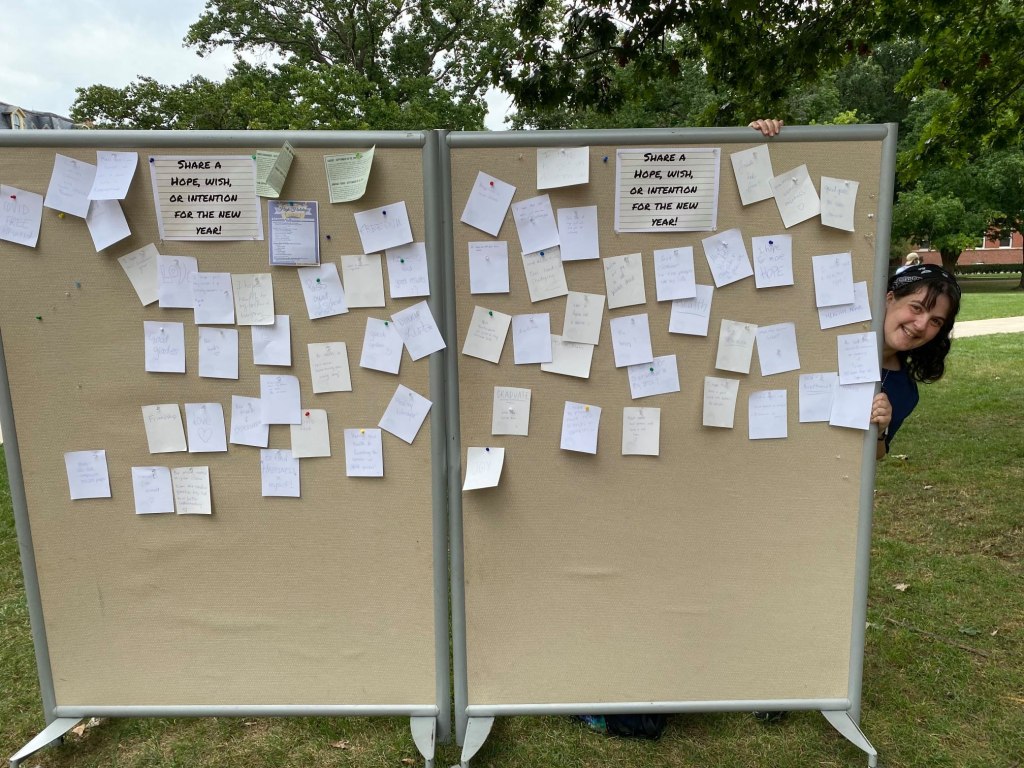
On the Thursday before Rosh Hashana, I invited random people to share their hopes with me for two hours as I stood in the quad. I had two giant rolling corkboards with me, each with an invitation tacked to the top: Share a hope, wish, or intention for the new year. The school year just started, and the Jewish new year was about to begin. Anyone could participate in a way that was meaningful for them. 

“Do you have any hopes to share?” I called out. 

Many people did. Some people wrote specific hopes –  such as passing pre-calc. Others were more general. Some hoped for good grades, better sleep, better work life balance. An end to COVID. Health. Happiness. Self-acceptance. One person wrote “Make life-long friends and live a great life to remember.” Two people took pictures of their hopes after they wrote them down. One man wrote that he wanted health for his brother – and the world. I don’t know this man or his brother, but we prayed together for his brother’s health, right there in the quad. I hope his brother is feeling better now.

Even those who couldn’t stop to answer my question smiled as they rushed by. Some people laughed as they were on their way to class, saying “No! I’ve got none left.” “Don’t worry about it,” I called after them. “You’re not the only one!” After awhile, I began including an additional offer: “If you don’t have any hope left, come absorb some of ours!” Hope, it turns out, can be contagious.

Like just about everyone else, I’ve been thinking a lot lately about contagion. In the last 18 months, many of us have learned far more about contagious diseases than we’d ever planned to. We know how vulnerable we are. We know how easy it is to transmit, carry, and catch a disease that quite literally takes your breath away. We understand, in a way that we’ve never understood before, that what’s inside of me touches what’s inside of you. That the health of one person can change the health of the world. We truly are all inter-breathing. And while that’s terrifying in the face of a pandemic, it also reminds me how intimately connected we are – by our breath, by our bodies, by the Oneness of the world.

This intimacy means we have the power to infect one another, to spread both physical and spiritual diseases. But that’s not the only option. My friend and mentor, Lee Kravetz, who is a marriage and family therapist, science journalist, and author in the Bay Area, wrote a book about social contagion, the spreading of behaviors, thoughts and emotions: “Whether it’s mirroring someone’s posture or mimicking someone else’s speech patterns, we are all driven by unconscious motivations triggered by our environment.” 

Social contagion theory teaches us that behaviors are infectious. Emotions are viral. Even thoughts are catch-able.  How we interact with individuals impacts not only how they interact with us – but also how they interact with others, with themselves, and with the world around them. We have the ability to influence others with something as minor as a smile, or eye contact, the colors we wear, the tone of our voice, the images we post on social media. And the most remarkable thing about them? Social contagion, like physical contagion, is often completely unconscious. We pick up on cues from the world around us all the time without even noticing what it was that shifted our mood or colored our experience. More important, I find, is that we are inadvertently influencing others’ thoughts, feelings, and behaviors, as well — and that includes positive cues, like hope, happiness, laughter, and benevolence. As we enter a new year – one in which we continue to fight another kind of contagion, I wonder what it would look like if we leaned into that power. How might we learn to spread the opposite of disease? Can we spread resilience instead? Or wonder? What would it look like to dedicate this year to spreading hope? 

Jewish sources include many examples of social contagion. Perhaps unsurprisingly, a lot of them are stories in which social contagion spreads for the worst – even in biblical times, bad ideas quickly went viral. Consider the story of the golden calf in the book of Exodus. The Israelites arrived at Mt. Sinai after many years of wandering in the desert, after God freed them from slavery. Moses went up the mountain to receive the Torah from God, and said that he would return in 40 days. The first emotion to spread was uncertainty. According to medieval commentator, Rashi, there was some confusion about the timing – would Moses come back on the sixteenth of Tammuz or the seventeenth? Did those 40 days include the day that Moses went up the mountain? When would Moses return? The next emotion that went viral was fear. Commentators disagree about who started spreading it, but soon, just about everyone was terrified that Moses would not return, believing instead that that God abandoned them to die in the desert. Some commentators say that Satan – yes, contrary to popular belief, Satan does appear in Jewish texts, but that’s a dvar for another day – Satan exacerbated the situation by showing the people an image of Moses, dead on the mountain, that was so real, the Israelites could reach out and touch it. 

Have you ever fallen into an anxiety spiral where the story in your head is more real than what’s in front of you? Did your fear come from a seed sewn by someone else? Many of us know what that feels like. 

You know what happens next – even Aaron, Moses’s brother, participated in building and worshipping a golden calf, a false idol. When social contagion spreads, it’s hard not to get swept up in the current. But not everyone does. Even in the story of the golden calf, the Torah noted that women refused to give their jewelry to Aaron to be melted down for the calf’s construction. And according to a midrash (a story about the Torah, which I like to call “Torah fanfiction”), the tribe of Levites also did not give in. The midrash also says that Miriam’s son, Chur, denounced those who were spreading fear – and he paid for it with his life. The angry and terrified crowd murdered him for standing up for what he believed in. It’s hard and sometimes dangerous to share a dissenting view when a social contagion is spreading. 

What about positive examples of social contagion from our tradition? Two took place at the Sea of Reeds, more commonly known as the Red Sea. A midrash teaches that when the Israelites stood before the Red Sea, with Pharaoh’s army behind them, one man took the first steps into the water. The man was given the name Nachshon, which comes from nachshol, “of the sea.” Nachshon faced the water, and the future, with bravery, and his courage was contagious. The others followed, and the sea split. 

After the Israelites made it to the other side and the army drowned in the waters behind them, Moses and Miriam each began to sing the song of the sea. Rashi says that Miriam thought to pack her timbrel as they were leaving Egypt because she believed so strongly in the coming redemption. When they began to sing, others joined Moses and Miriam in this joyful prayer of thanks to God.This is an example of a social contagion that started with one voice, and spread to many. And it’s a contagion of gratitude that spans the generations. This prayer is among the oldest lines of poetic verse in the Torah and they’re part of our daily liturgy. Mi Chamocha, ba’eilim Adonai? Who is like You, among the mighty, Adonai? 

A final moment to share, also from Exodus, takes place in the Torah portion we read the week after the incident with the golden calf. In Parshat Vayakhel, God tells the Israelites to build a mishkan, a sanctuary for God. “Everyone whose heart so moves him shall bring gifts for the Lord – gold, or silver, wool or linen, wood or oil, spices or stones, anything to make the Sanctuary more glorious for God,” said Moses. The Israelites, moved by their hearts, brought all kinds of golden objects, colorful wools, silver, copper, and acacia wood. They worked together to make the Sanctuary sacred for God. They eventually brought so many gifts that Moses had to ask them to stop. I love this contagion of giving. And I love the Israelites for how human they were. Of course they yearned deeply to give to the Holy One, to give so much that they had to be asked to stop – right after so many of them spread and gave in to the contagion of fear that led to the building of the golden calf. 

I’m sure many of us can think of contemporary social contagions, both negative and positive. Today I’m going to consider just one example from this summer. When celebrated Olympic gymnast, Simone Biles, decided to withdraw from the 2021 individual all-around competition to protect her mental health, her decision set a wave in motion. “I say put mental health first,” Biles said. “Because if you don’t, then you’re not going to enjoy your sport and you’re not going to succeed as much as you want to. So it’s OK sometimes to even sit out the big competitions to focus on yourself, because it shows how strong of a competitor and person that you really are — rather than just battle through it.” We’re just going to sit with that for a moment. Such a powerful statement about what matters most. Afterward, although a few commentators accused Biles of being a “quitter,” Biles’ decision to prioritize her mental health was generally widely praised and credited with starting a wider conversation about the role of mental health in sports. Other gymnasts relayed their own stories of struggle as a result of her sharing. Biles sent a message to all of us about the power of prioritizing health over performance. Before she withdrew from the competition, Twitter celebrated the gymnast’s excellence in her sport by creating a Simone Biles emoji that appeared whenever someone used the #SimoneBiles. After she withdrew, people continued to use that emoji, along with another hashtag: #mentalhealthfirst. Simone Biles taught us all that this is what excellence looks like. 

The ideas we share, the emotions we express, the stories we tell ourselves and others, all have the power to spread. Will we spread fear and distrust this year, building more false idols? Or will we spread something different, building a sanctuary of healing with our words, our hopes, and our actions? 

I want to clarify that I’m not encouraging anyone to spread toxic positivity – to “just be positive” in the face of suffering. Pretending that things are ok, when they’re not, is another form of idol worship at a time when the truth demands to be seen. Let’s be honest about the threats of our world, but let’s think about how we respond to them. One of my other mentors, Josh Feldman, says that “Our daily experiences are a laboratory for the invention of the future.” When we are in a lab, trying to create the next great invention, sometimes the experiment goes wrong. The data we collect from each experiment, even the failed ones, help us decide what to try next. We are not here to deny the darkness. We are not here to ignore the facts. We are here to decide what to do with them. 

What if the Israelites had approached their fear with curiosity and honesty while Moses was on the mountain? “Wow,” one might have said to the other. “I’m really scared right now. I’m not sure when Moses is coming back and I’m having a hard time trusting that we will be safe in the future.” That’s a truth worth sharing. “I’m afraid too,” the other might have responded. “Thank you for telling me. I’m grateful to know I’m not alone.” Vulnerable sharing, supporting one another, and speaking from your own experience, are also contagious behaviors. That might have been a better response to the facts of their fear.

The new year has begun and there’s still a lot of darkness around us. From the ongoing uncertainty of the coronavirus contagion to the horrific effects of climate change, gun violence, and systemic oppression.The pandemic taught us that the health of one person can change the health of the world. Social contagion theory teaches, and our Torah shows us, that the hope, courage, voice, and generosity of one person can change the world too. 

So I return to the question I posed at the beginning: What will you spread this year? How will you respond to the darkness? And how will you model what you want to see in your community when you show up as part of it? 

Anne Lammott writes, “Sometimes hope is a radical act, sometimes a quietly merciful response, sometimes a second wind, or just an increased awareness of goodness and beauty.” This year, spreading hope, wonder, or resilience may be a small act of bravery for you, an attempt to plot a better course, even when you feel the current pulling in another direction. Maybe it feels like a radical act, taking a bold step into the sea of your uncertainty, like Nachshon, or bringing the timbrel with you, like Miriam, because some part of you believes redemption is possible. Maybe you’ll put your mental health first and inspire others to do the same, like Simone Biles. Maybe yours will be the voice that encourages others to join the song. 

Two weeks ago, I stood on the quad and invited strangers to share their hopes with me. I’m going to conclude this part of our service by inviting you to do the same. What do you hope for this year? For yourself, for your community, and for the world – call it out. 

Thank you everyone. May we carry these hopes in our hearts and into the world, and may we be blessed with the courage to bring them to life. 

I ended this sermon with the song, “One Voice,” by the Wailin’ Jennys. I encourage you to listen to it now.

Voice from the Void: 30 Scatteredleaves Creations from 2020

Sometimes words bang on the doors of me, begging to be let out. Is it a striving desperation to make meaning out of madness? To tame an untamable experience by shaping it with narrative?

Several weeks ago, my classmates and I encountered Rebbe Nahman’s texts about The Void – and the silence within it. For many of my classmates, facing that silence led to more silence. But for me, it just made the words louder. I write constantly. Sometimes the words rush from my fingers faster than I can type them, an unstoppable flood pouring from the rock Moshe hit with his stick, when he couldn’t find words himself. It seems the harder it is to find the words, the more the words find me.

Chaim Bialik writes, “It is that very eternal darkness that is so fearsome – that darkness from the time of Creation…Every man is afraid of it and every man is drawn to it. With our very lips we construct barriers, words upon words and systems upon systems, and place them in front of the darkness to conceal it; but then our nails immediately begin to dig at those barriers, in an attempt to open the smallest of windows, the tiniest of cracks, through which we may gaze for a single moment at that which is on the other side.”
Perhaps writing is one of my attempts to create a penimi from a maqqif (something I can grasp within that wish is ungraspable). A way to crack a hole in the darkness of the void. A way of finding God in a place that appears empty, so that I can chase the next void, and the one after that.

With that in mind, I share a list of things I created within the void of 2020 – rituals, poems, prayers, and videos. This is not a comprehensive list. I only included the creations I felt I could publish or name in this space or elsewhere. The list doesn’t include all of my school writing (one of my classes had weekly reflection assignments) and it doesn’t include every private ritual I created for people who needed them. It also doesn’t include the virtual programs I built. But it’s a start.

I’m grateful for all the words that found me in the emptiness, but I pray for a 2021 that is full – full of inspiration, full of healing, and full of hope. Blessings on your journey, beloveds. See you on the other side.

Published on Ritualwell:

  1. Prayer Before Starting IVF
  2. Postponement Prayer (also published in When the World Turned Inward, Vol. 2)
  3. Virtual Memory Circle
  4. Hearing in our Hearts
  5. God’s Lament: A Letter to Daughter Zion (from Reb Shulamit’s class)

Videos:

  1. What Have We Lost?
  2. History of Loneliness
  3. History of Languages
  4. Looking Behind: A Monologue from Lot’s Wife
  5. Light and Darkness

Published in the Forward:

  1. ‘In the Torah, name changes signify moments of transformation.’ In the lives of transgender Jews, they are just as powerful

On my blog

  1. Nahman’s Dancing Circle, Chayei Sarah, and Pixar’s Inside Out (reflection assignment for Reb Elliot’s class)
  2. Get In, Get Real, and Grow (reflection assignment for Reb Elliot’s class)
  3. Letter to Rebbe Nahman (reflection assignment for Reb Elliot’s class)
  4. Shelters (in Place): A Pandemic Sukkot
  5. Holding the Shattered Pieces
  6. Grief in the Book of Ruth: Ruth’s Letter to Mahlon (from Reb Shulamit’s class)
  7. Silent and Sacred: Parshat Shmini for 2020
  8. Letter from God to the Ones Who Struggle: A Reinterpretation of Song of Songs (from Reb Shulamit’s Class)
  9. Alone Together: Parshat Vayikra
  10. Where Are You?

Publishing in 2021, but written in 2020

  1. Letter from Vashti to the New Queen of Shushan (publication set for February, I hope) 
  2. Prayer for the Covid-19 Vaccine
  3. Havdalah for Letting Go 
  4. Mezuzah Ritual for Moving into a New Home

Papers for Biblical Civilizations class

  1. A Tale of Two Floods 
  2. “To Teach and Enlighten:” The Book of Joshua and the Book of Judges
  3. Three Contemporary Prophecies written in the style of the prophet, Ezekiel
  4. A Contemporary Apocalypse in the style of the Book of Daniel
  5. Bringing Biblical Life and History to Hillel 

Holding the Shattered Pieces

“Suffering breaks our hearts. But there are two quite different ways for the heart to break. There’s the brittle heart that breaks apart into a thousand shards, a heart that takes us down as it explodes and is sometimes thrown like a grenade at the source of its pain. Then there’s the supple heart, the one that breaks open, not apart, growing into greater capacity for the many forms of love. Only the supple heart can hold suffering in a way that opens to new life.” 

I’ve been thinking about this teaching from Parker Palmer a lot lately. Yesterday was the 17th of Tammuz. Traditionally, this is a Jewish fast day commemorating the breach of the walls of Jerusalem before the destruction of the Second Temple.  It also marks the beginning of the three-week mourning period leading up to Tisha b’Av, the day when the first and second Temples were destroyed. These three weeks are known as Bein ha’Metzarim, between the narrows. No Jewish marriages or other celebrations are allowed at this time, since the joy of these occasions conflicts with the mood of mourning.

The 17th of Tammuz also arrives 40 days after Shavuot. This is the day when Moses came down from Mt. Sinai and found that the Israelites had built a golden calf while he was receiving the Torah. Moses was furious and he shattered the tablets. He went back up the mountain, and the Israelites went back to…waiting. Waiting with their grief, their fear, and their brokenness, the shattered tablets laying before them. 

We have been sitting in our own waiting place, Bein ha’Metzarim. By my count, it’s been 120 days since the quarantine started. Even if you are numb at this point, the emotions that surfaced at the start of COVID are still there, exacerbated by losses due to racial violence. Some days it might feel like you’re moving through molasses – there’s a fatigue you just can’t sleep off. Maybe you’ve snapped recently at someone who did nothing wrong, or there was a moment when a minor stumble felt like a disaster. All of it is grief – for the 135,000 who have died from COVID-19 in the US alone, for racial violence, for the special moments we’ve had to share on Zoom instead of in-person, and for all the plans we can’t fulfill. In progressive Jewish communities, we don’t often observe the three weeks or Tisha b’Av. However, as we wait at the foot of the mountain, sitting in our collective brokenness, and unsure of what comes next, it may be necessary to engage with this part of our tradition. And we should engage with it, as Parker Palmer has said, with a broken and supple heart. 

The Talmud teaches that when Moses came down from Mt. Sinai the second time, with new tablets, the Israelites kept the broken ones. They placed them, along with the new tablets, in the holy ark. Why? Because our ancestors knew brokenness and wholeness live side by side, in the ark and in our hearts. Some even taught that brokenness is not only natural – it’s necessary. The Kotzker Rebbe taught that “There is nothing so whole as a broken heart.” And in a Hasidic folk tale, a disciple asked a rebbe: “Why does Torah tell us to place the words of the V’ahavta upon our hearts instead of in our hearts?” The rebbe answered: “It is because our hearts are closed. So we place them on top of our hearts. And there they stay until, one day, the heart breaks and the words fall in.” The Lurianic kabbalists taught that brokenness itself is holy: When God created the world, God tried to contain God’s light in vessels that shattered into millions of pieces. We each contain a spark of this Divine light, this symbol of God’s own brokenness. 

The message from our tradition is clear: Our hearts have to break. We have to feel our grief. And we do not to have experience our brokenness alone. These three weeks are a time when we can grieve with community. When we are Bein ha-Metzarim, we are like the tablets in the holy ark. We are held in our brokenness, we are whole in our holiness, and we are healed when we hold the shattered pieces for those around us.

As we sit with the shattered tablets, as we wait in our brokenness, I want to bless each each of us with a heart that is supple – one that is open to our own suffering and to the suffering of others, so that the words of our prayers fall in, and so that we may we renewed again. 

Alone Together: Parshat Vayikra

How can we draw near in a moment when we are so far away from each other? In this week’s parsha, God shared a list of sacrifices for the Israelites to bring to the Mishkan, the holy sanctuary. Two weeks ago, when many of us began the quarantine, the Israelites built and worshiped a golden calf. Moses was up on Mt. Sinai, and they didn’t know when – or if – he was going to come back. In their fear, they built an idol they could touch, something they could connect with, physically. Something they thought they could trust to be there. Now, two weeks later, the Israelites have built a Mishkan instead. They were finally ready to sacrifice, ready to connect with the God they could not touch. The word for sacrifice in Hebrew is “Korban,” which means “to draw near.” They Israelites drew near to the God Who could not be seen, but could be deeply felt.

In the last two weeks, we, too, have been building sanctuaries. Sanctuaries in our homes, sanctuaries online, sanctuaries with our voices raised in song and prayer. We have been alone, afraid, and uncertain. We cannot reach out to touch one another. But we, too, have drawn near in ways that can be be felt.

One of my teachers, Reb Eli Cohen, pointed out that one of the names for God is HaMakom, which means The Place. Maybe while we have been sheltering-in-place, we have also been sheltering-in-The Place, embraced by the nurturing Source that holds us all. In our evening liturgy, we sing Ufros Aleinu Sukkat Shlomecha – asking God to spread over us a shelter of peace. Throughout these last two weeks, I’ve envisioned the lights from our screens, shining in our hands and on our desks all over the world. We cannot touch, but we have found ways to draw near to each other, to create sanctuaries, and to face our fears, embracing the Oneness that connects us all.

Shabbat Shalom, l’kulam. May it be a Shabbat of peace, wholeness, and healing, as we who are far away from one another draw near in every way we can.