Telling Our Stories: Parsha Vayigash

What do our hidden stories reveal, when we reveal ourselves to others? When we tell the truth, to whom do we tell it, and what do we learn from the telling? In this week’s Torah portion, Yosef revealed his identity to his brothers, who came before him in Egypt to ask for help in the midst of famine. For context, we recall that in previous chapters, Yosef’s jealous brothers cast him into a pit and sold him into slavery. Yosef’s brothers then lied to their father, Yaakov, saying that a wild beast killed Yosef, and they had not seen their brother since then. After a series of additional twists and turns, which included dreams, false accusations, imprisonment, and more (this is quite a dramatic story), Yosef eventually rose to a position of significant power in Egypt. When his brothers approached him in this Torah portion, Yosef was the governor of Egypt, second only to Pharaoh himself, and Pharaoh had given him a new name: Tzofnat Paneach. According to some translations, Yosef’s new name meant “revealer of mysteries.”

This Yosef, this Tzofnat Paneach, whom the brothers entreated on his throne, was quite different from the Yosef who was their father’s favorite son, the Yosef they threw into the pit, and sold into slavery. This Yosef was even different from the Yosef who lived in the Egyptian prison. It’s no surprise that, although Yosef recognized them, his brother’s did not see Yosef on the face of Tzofnat Paneach, the Egyptian governor.

Yosef tricked and tested his brothers, accusing the youngest, Benyamin, of stealing a silver cup that Yosef planted in Benyamin’s sack. Upon “discovering” this silver cup, Yosef threatened to enslave Benyamin. Fortunately, the brothers passed the test: Older brother, Yehuda, offered himself in Benyamin’s place, so that their aging father, Yaakov, would not have to grieve the loss of yet another favored child.

When he learned that his father was alive, the Torah says, v’lo yachol Yosef l’hitapek” – Yosef could not afak – contain – the secret of his identity. He asked everyone to leave besides the brothers, and he began to cry. “Ani Yosef,” “I am Yosef,” he told them. “Ha’od avi chai?”: “Does my father still live?” When he heard about his father, Yosef remembered where he came from  – he was not only Tzofnat Paneach, governor of Egypt. He was also Yosef, the Jewish son of Yaakov and Rachel, the boy from the pit and the prison, the interpreter of dreams. When he asked “Does my father still live,” “Ha’od avi chai,” the word “od” means still, continuing, again, iteration. If his father continued, then so did Yosef. He was still, after all, himself.

His brothers were frightened and could not answer him, worried that their brother would exact revenge. But Yosef was not angry – they passed the test and showed that they had changed. Come near me, I pray you, Ani Yosef,” he said again. “I am Yosef, your brother, whom you sold into Egypt.” He explained that they should not worry, saying that God sent him to Egypt to ensure their safety during these years of famine. He told his brothers everything that had happened since they sold him into slavery, and Yosef sent them back home with food and other provisions, so that the brothers could return with their father and the rest of the family.

“Ani Yosef,” “I am Yosef,” appeared twice within a few lines of this story. Why did he say his name more than once? Maybe the brothers were disbelieving, and Yosef wanted to prove his identity, explaining that he was, in fact, their brother, whom they sold into Egypt. Or maybe it was because Yosef was reclaiming his own identity. It’s significant that Yosef could not afak, he could not contain Yosef, once he learned that his father was alive, even though he rose to power under a new name, Tzofnat Paneach.

It’s also significant that Yosef told his story as one of triumph, in which God had sent him to Egypt to save his family, instead of a story of victimhood, in which his abusive brothers sold him into slavery. Both of these things were parts of Yosef’s truth. Sometimes, trauma doesn’t have a purpose – it just sucks. And part of me wants Yosef to be really angry about what happened to him. And maybe he was. But in telling his story, Yosef had a triple revelation. First, he revealed his identity to his brothers, then he revealed that everything that happened was part of God’s plan, and the resulting third revelation was the most powerful of all: Yosef revealed his own truth to himself. After everything that happened, his father was still alive, and he was still Yosef.

What do our hidden stories reveal, when we reveal ourselves to others? When we tell the truth, to whom do we tell it, and what do we learn from the telling? What does Yosef’s story teach us about our own stories, about our own hidden traumas, our own pits and prisons?

Yosef tried to keep his identity a secret, but eventually, he remembered who he was, and he could not contain it any longer. By revealing himself, the story Yosef told became something that happened through him, instead of something that happened to him; the trauma of the pit and the prison became part of a larger narrative that led to Yosef’s ultimate success. When he remembered where he came from, Yosef and Tzofnat Paneach, the boy from the pit and the governor of Egypt, became one, so that Yosef could reunite with his father once again.

There are many lessons we can pull from this Torah portion, but in the week to come, I challenge you to reveal one part of yourself that’s hidden, to reclaim just one part of your story by sharing it. Shape your narrative. Define your own meaning. You might be surprised to find what’s been inside of you all along.

Becoming Ourselves: Parsha Vayishlach

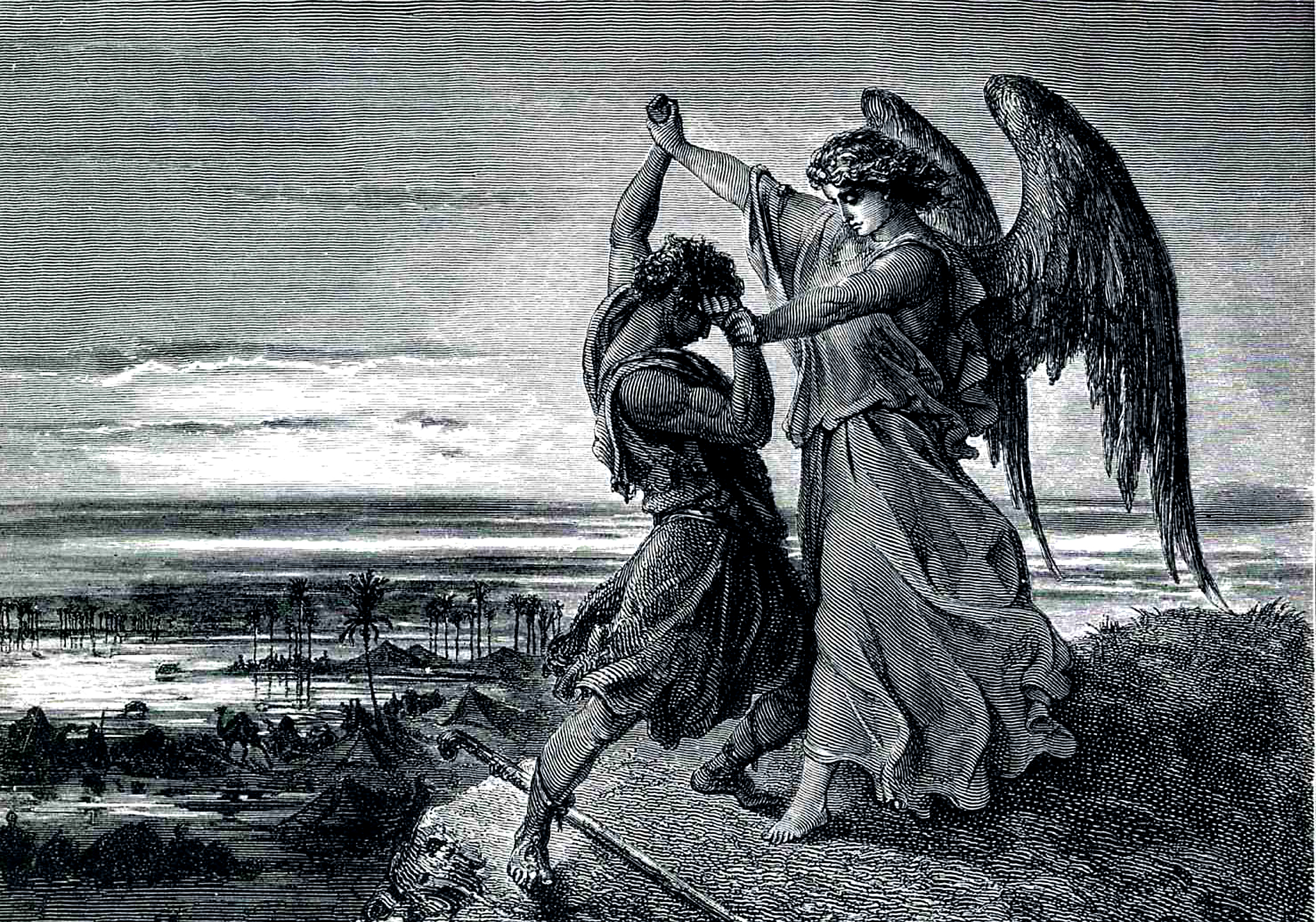
In this week’s Torah portion, an angel comes to Jacob at night, and they wrestle until daybreak, dislocating Jacob’s hip in the fight. When the angel says “Let me go, for dawn is breaking,” Jacob says “I will not let you go until you have blessed me.” The angel asks “What is your name?” “Jacob.” The angel says “Your name shall no longer be called Jacob, but Israel, because you have power with God, and with men, and you have prevailed.” This is where Jews get one of our names – Israel, in Hebrew, Yis-ra-el – which means “wrestlers with God.”

I’ve always loved this idea that Jews are wrestlers-with-God – that we are encouraged to question, to wonder, disrupt, and struggle with all things human and Divine. But I also can’t help noticing that Jacob – and the Jews – aren’t renamed “prevails over God.” The angel says Jacob will have a new name because he has prevailed, and then renames Jacob – and all future Jews – for the wrestling. We are, from that moment forward, called strugglers-with-God.

The word that is most often translated as “you have prevailed” is “tuchal,” from the root “yachal,” which means “to prevail over, overcome, endure,” to “have power,” “be able to gain or accomplish, to have strength.” The story of overcoming struggle is wrapped in the story of the struggle itself, and in the wrestling, we become the ones who can endure.

When has one of your own struggles come to define you? Have you ever wanted to release this part of your story and redefine yourself based on something else? What about a struggle where you ultimately prevailed, as Jacob did? After you prevailed, was the struggle still part of your identity?
As we enter Shabbat, I invite us to question the personal narratives behind each identity we hold dear. Have we been shaped by our struggles, our triumphs, or both? How does your perception of the struggle change when you see it as a sacred part of who you are?
Shabbat Shalom, Everyone. May the struggles we face reveal the strength in each of us as we learn to become ourselves.

The Dancing Circle: Parsha Chayei Sarah

“Sometimes a group of people happily dancing together take hold of someone who is standing miserable and depressed on the outside. They pull him into the dance circle despite himself, forcing him to rejoice with them. Similarly, when a person is happy, his pain and sadness may move to the sidelines. But a higher level is to pursue the sadness itself and pull it into the dance circle.”

– Rebbe Nachman of Breslov, on bringing your sadness with you 
In this week’s Torah portion, Sarah dies and her son Isaac marries Rebecca. Abraham, Sarah’s husband, marries a new wife named Keturah, and Abraham dies at the end of the chapter. This is a story that includes two weddings and two burials. Isn’t it always this way? Isaac takes Rebecca to his mother’s tent and she comforts him in his grief.
 
In December 2015, I officiated my grandmother’s funeral the day before I officiated my brother’s wedding. Loss and love, celebration and grief, crammed up beside one another in Torah, and in life. We can try to compartmentalize; we can pretend to leave the losses behind before we jump into joyful celebration. But at the wedding it felt like she should have been there, and we danced with her memory, grateful and grieving all at once, as the night turned to morning, and a new day began.
 
The shooting last weekend took place on Shabbat, a day of rest, joy, and gratitude. A family at the synagogue had also planned a brit milah for that day, a celebration welcoming a child into the community. Trauma rends the fabric of our narrative and tells us that things are not as they seemed. Our story is disrupted, we are not as safe as we believed, we are no longer immune or invincible. We are supposed to be celebrating, but we’re grieving instead. Suddenly, we have nothing to ground us, nothing we can trust.
 
And yet, since Saturday, I’ve seen so many people congregate, bringing their sadness and joy, their anger and love, their fear, their compassion, and their hope. It’s not supposed to be like this, but here we are, with all of these raw emotions colliding, just like they did in the dancing circle at my brother’s wedding almost three years ago. And just like they did for our ancestors, Abraham, Sarah, Isaac, and Rebecca, in this week’s Torah portion.
 
As we enter another Shabbat, the first since the tragic massacre that tore our stories apart, I invite you to fully experience and honor each of these emotions, with all of their complexity and their contradictions. And when joy and sorrow collide in the dancing circle, may your memories and community be a source of strength and healing, and may you be comforted, like Isaac, by the love that surrounds you.
 
Shabbat Shalom, Beloveds. May be it truly be a Shabbat of peace, love, and wholeness.

Looking Behind: Parsha Vayeira

I knew I shouldn’t have done it. I know I’m supposed to live into my uncertainty, trusting that God will meet me there. Others seem to be able to do this – they experience time as a straight line, a narrative as cool and clean as an autumn breeze. My bones have always known that time is a circle, or a spiral. We are not the wind, we are the leaves as they spin, in an endless pursuit of beginnings chasing endings.

I am Lot’s Wife. You don’t know my name because they never asked my husband. People wonder now, reading my story. Back then, they didn’t think it mattered. And even now, I’m not sure it does. I’m one line in your Bible story – “And his wife looked behind him, and she became a pillar of salt.” One look back. That was all it took.

You know what happened. Avraham argued with God, saying that God should spare us all if there were even 10 good people in Sodom and Gomorrah. We were judged to be the righteous few, and they told us to flee. So we did.

As it says, “God rained fire and brimstone on Sodom and Gomorrah, and God turned over these cities and the entire plain, and all the inhabitants of the cities, and the vegetation of the ground.”   

We were running forward but I had to look back. It was my last chance. What else could I have done? It wasn’t perfect, but it was home, and it was burning. I wasn’t perfect, but I’m only human – or was, until I became salt. Ramban wrote that I was looking to see if my daughters were following. He’s not wrong. But that’s not the whole truth either. I wanted to make sure they were with us – but I also had to say goodbye.

No one ever gets to say goodbye in the beginning. Adam and Eve are cast out of Eden. Noah and his family got on the boat as the world they knew was swallowed by water. God told Avraham to leave his father’s house and his native land, to go, God says, “to a land that I will show you, to a place you do not know.” The stories of our people are marked by loss. All of them left something or someone. And yet, no one ever asks if Adam and Eve were homesick, if Avraham yearned for his father, or for the culture and religion he left behind. Did Noah dream of the people who drowned? Maybe he did…maybe not. But he trusted God. I’ve never understood it. The past is so knowable and the future, intangible. How does anyone learn to trust?

I knew I shouldn’t have done it. But time is a circle, and the leaves on the wind are torn from their limbs before they’re ready to die. This is why I needed one last glimpse of what we left behind, even as we ran forward, away from our lives, our homes, and our stories. I couldn’t leave without saying goodbye to everything I knew. Noah’s world was lost to the salty sea, but I’m the one who is made of salt now, dissolving at the mere touch of water.  

That My Mouth May Declare Your Praise

Sometimes, rabbinical study feels like pulling back the curtain. Today I learned the horrifying history behind a blessing I have enjoyed for many years – one that Jews sing before entering the silent, standing prayer (amidah) in our prayer services.

hebtfilah1

God, open my lips,
that my mouth may declare Your praise.

This line from Psalm 51 serves as an entry point, often chanted many times out loud before we retreat into personal, silent meditation. I’ve always appreciated this prayer because it invites us to be present, centered, and focused, to clean out the remains of the week and to approach our prayers with gratitude. Open my lips so that I may praise. Open my heart to all that is praiseworthy within me and around me. This is the space I want to occupy before I enter the silent amidah. 

Today, I learned from Midrash Tehillim (commentary on the psalms) that Psalm 51 was spoken by King David. This is not surprising, as many of our psalms are attributed to him. However, given the intentions I bring to this blessing, I was surprised to learn of its moment of origin. This is a prayer offered to God in a moment of shame. King David has raped and impregnated BatSheva, the wife of his best friend, Uriah. He has sent Uriah to war, placing him at the head of charge, knowing that Uriah will be killed. Rather than facing Uriah, David murders him – not with his own hands, but with his decision to place him directly in danger. David murders Uriah in a way that renders him, from an outsider’s perspective, blameless.

But Nathan, a prophet who serves King David, sees exactly what has happened, and is not afraid to face him. In 2 Samuel, Nathan approaches David with a parable. The story says:

“When [Nathan] came to David, he said, “There were two men in a certain town, one rich and the other poor. The rich man had a very large number of sheep and cattle, but the poor man had nothing except one little ewe lamb he had bought. He raised it, and it grew up with him and his children. It shared his food, drank from his cup and even slept in his arms. It was like a daughter to him.

“Now a traveler came to the rich man, but the rich man refrained from taking one of his own sheep or cattle to prepare a meal for the traveler who had come to him. Instead, he took the ewe lamb that belonged to the poor man and prepared it for the one who had come to him.”

David burned with anger against the man and said to Nathan, “As surely as God lives, the man who did this must die! He must pay for that lamb four times over, because he did such a thing and had no pity.”

Then Nathan said to David, “You are the man!”

Nathan tells David that God will punish David and his family for these evil actions – for taking BatSheva and murdering Uriah, even though David has more wealth and power than he will ever need. Hearing this, David is horrified and he composes and sings Psalm 51, a prayer that begs God for mercy. The statement that opens our silent meditation, “God, open my lips that my mouth may declare your glory” is line 15 of Psalm 51.

All my praying life, I have been approaching silent communion with the Divine with this line, sung by a rapist and murderer who has just realized that he is a monster. It’s even possible that David is only begging for mercy because he knows that God will punish him, instead of praying from a place of true remorse. What does this mean about the placement of this line in our daily liturgy?

I’ll admit that my first instinct was to drop the blessing entirely from my own practice. How can I echo David’s words knowing the context in which he spoke them? I reminded myself that as clergy, my job will be to support others in discovering how these and other verses are applicable to our lives today, but I was still frustrated that I’ve been singing these lines for so many years without knowing why.

Then I remembered how powerful this prayer has been for me – when I sing this line, it grounds me in the present, preparing me to praise, instead of losing myself in frustration about what might have been, and anxiety about what might come next. Grounding in the present is a lesson in humility – we can acknowledge the past, but we can’t change it, and we have limited control over the future. All we really have is this moment.

David prays Psalm 51 in a moment of humility as well. Realizing what he has done, he approaches God and says “For I know my transgressions, and my sin is ever before me.” He acknowledges his actions, and asks God for help anyways. “God, open up my lips so that I may declare Your praise,” says “God, I really screwed up. I know I can’t change what I’ve done, but I can ask You to open my lips to praise You.”

It is really hard to face the truth when we have screwed up. If I dig beneath the surface, I realize that my urge to cut this blessing from my own practice comes from a place of fear. “Well I’m not a rapist and a murderer, so why should I pray like one?” I don’t have to pray like David, but I do have to pray like me. And I don’t want to face my flaws any more than David wanted to face his. Maybe that’s the reason for this line’s placement in our liturgy. It’s a reminder to acknowledge how human we are when we approach That which is Larger than Us.

Sometimes, rabbinical study feels like pulling back the curtain. And if I’m afraid of what I’ll find there, there’s a good chance it’s something I need to face after all. “Adonai, s’fa tai tiftach” is  a reminder to recognize our flaws and to pray from a place of honesty – Yes, we have made mistakes. Yes, we are human. And yes, we still need reminders that the world is worthy of praise.


unRevelation

On Shavuot 2016, 49 people were murdered at Pulse Nightclub in Orlando, Florida. Shavuot is the holiday that celebrates the receiving of Torah at Mt. Sinai. It’s the end of one long journey and the start of another. We observe our years of wandering in the desert by counting the Omer, the 49 days between Passover and Shavuot. After our freedom from slavery, after all of the wandering, we are finally able to own that freedom at Mt. Sinai, becoming a people at last.

The day after Shavuot 2016, and the day after the Pulse Nightclub shooting, I was driving to work, stuck in traffic as always, crying as I listened to the story of the massacre on NPR. It was Virginia Tech, it was Sandy Hook, it was every other communal tragedy that affected me on a personal level. A voice inside rose like smoke from a flame: I want to be a rabbi. I tried to shrug it off. I have to be a rabbi. While this may not have been an answer for the world, at the very least, in the moment, it felt like an answer for me.

It’s hard to articulate why the Pulse Nightclub shooting inspired this epiphany. Maybe I felt like I had to do something, anything to heal this shattered world. Even though I know it’s impossible, I also knew I had to try, and this was the best I could offer. Maybe this was my Shavuot becoming, my revelation at the foot of the great mountain. Maybe it was just a feeling, a sudden knowing, and I don’t need to find words, or reasons, for everything.

Today, we enter the Shabbat before Shavuot in the wake of another mass shooting, this time in Santa Fe, Texas, where 10 children were murdered. We received 10 commandments at Mt. Sinai, including the injunction, “You shall not murder.” The Hebrew word ratzach, which means to murder or slay, shares a root with the word retzach, which means shattering. Moses shattered the tablets when he found that the Israelites had created a Golden Calf, an idol, while he was at the top of the mountain receiving Torah for the first time. How many lives are shattered when one is lost? How many commandments are broken when 10 children are murdered at school? The numbers pound in my head with my broken heart: 49 lives lost in Orlando, following the 49 days of the Omer. 10 children killed before we celebrate the 10 commandments. Mishnah Sanhedrin says whoever destroys a soul destroys a whole world. So many worlds, days, stone tablets, lives: all gone forever.

I have two semesters of rabbinical school behind me, and many more ahead. I still don’t know how to respond to violence. I can dissect the Hebrew word that means “to murder,” and I can connect the number of children killed with the number of commandments on the tablets. But in the days following this horrific tragedy, I doubt the smoke from a flame will again rise within me, that voice that urged me to follow another path in the aftermath of Orlando. I never did find an answer for myself, even though others in the world turn to me in moments of crisis. I teach them to sit with the unanswered questions. If there is a voice in the aftermath, it will not have an answer. It will be a sob, or perhaps a wailing, a recognition that the shattering never stopped, that we are still, after all, in the wilderness. We are here, waiting for a leader to descend the mountain. We are scrambling to hide the Golden Calf we built out of fear. We are still grieving the first set of stone tablets, the broken ones, searching for their message in the silence that follows the gun shots. We do not know if revelation is coming, only that the broken commandments cannot be reforged. If we want to bring about revelation, we must build new tablets together.

Parshat Shemot

You’re walking through the desert and you’ve been walking forever. You are walking away from something you’re trying to forget. You’re not sure what you should be walking toward, but you do know you have to walk. There is sand between your toes and there’s a pebble in your sandal that’s just large enough to be an annoyance, digging into your heel. You don’t stop to remove it because you are compelled, with a focus you’ve never felt before, to just keep walking. Nothing will stop you. Until you see the light. The light of a thornbush on fire, burning but not consumed. Where is all the smoke?

Parsha Shemot is the beginning of the story of Exodus, and it includes Moses’s first encounter with God, through the burning bush. When Moses moves toward the strange burning, God calls out to him. “Moses, Moses!” And Moses said, Hineini, “Here I am.” Hineini is a statement of focused presence. I am here. I am listening. I am ready.

“Do not come near; take your sandals off your feet, for the place on which you are standing holy ground. I am the God of your father, the God of Abraham, the God of Isaac, and the God of Jacob.”

You have removed your shoes, the pebble lost in the sand now. Your heart is pounding in your head and the voice is pounding with it. I am, I am, I am, it says.  Hineini, you respond. I am, too.

“I have surely seen the affliction of my people who are in Egypt,” says God. “I have heard their cry. I know their sufferings.”

Their cry and their sufferings have enslaved you too. You tried to leave them behind, but somehow they came with you – their voices, their faces twisted in sorrow. You tried to escape it, but memory makes escape impossible.

God was not enslaved by the Egyptians, and yet, God knows the sufferings of the Israelites just by seeing the affliction and hearing their sufferings. This is empathy: to know the suffering of others, whether or not you can personally relate. According to Rashi, God demonstrates that God is with the Israelites in their affliction by appearing in a thornbush, instead of a more innocuous plant or tree.

“The cry of the people of Israel has come to me, and I have also seen how the Egyptians oppress them,” God says. “Come, I will send you to Pharaoh that you may bring my people, the children of Israel, out of Egypt.”

“Who am I that I should go to Pharaoh and bring the children of Israel out of Egypt?”

 God, the God of my Ancestors, I am Here, but Who am I? I am the pebble in my sandal, I am trying to escape, I have been walking because I am afraid.

“I will be with you,” God says. “I will be with you.” God doesn’t say “It will all be ok,” or “Don’t be ridiculous; of course you can do it.” God doesn’t tell Moses “This is your job – now deal with it.” I will be with you is validating and honest. God never tries to convince Moses that the exodus will be easy. Instead, God shows Moses that he will not be on this journey alone.

People often feel isolated when they face personal challenges, alone in our personal deserts, waiting for a bush to burn. I can talk with multiple students in the same week who are facing similar challenges, but they all think that they are the only one. It’s tough to combat feelings of loneliness because vulnerability is scary – our own and the vulnerability of others. Of course we are compelled to walk away from it all, to face the suffering of others by suffering alone.

This is why God’s promise, “I will be with you” is such a powerful and healing response. When we don’t actually know the outcome of a situation, “It’s all going to be ok” is a hard to swallow, and “just stay positive” can feel like blame. Validation and acceptance create a safe space for real growth and change. “Yes, this is really hard. It feels impossible. And yet, here I am with you, and I will stay.” My friend Donnovan likes to say “Your presence is the medicine.” When there’s not much to say to someone who is suffering, being present is enough. Presence means you’re not walking away. Presence says “Your pain is not taboo.” Presence says “You have not lost me, even if you feel like you have lost everything.” Presence says “Hineini,” Here I Am. I am listening. I am with you. Like Moses, most of us just need to know that we are not alone.

In honor of this parsha and at the start of our secular new year, I encourage you to really listen to your friends and loved ones, to seek an understanding of their suffering, even if you can’t personally relate. Listen to what your loved ones are saying and not saying, and check your assumptions when you’re about to offer advice. A simple “I will be with you,” may be more than enough. Suffering is hard, and isolation makes it harder. Your presence is the medicine. Only together can we do the work of healing.

Close Up: Memory, Confrontation, and the Days of Awe – High Holiday Sermon, 5774

“On Rosh Hashanah it is written and on Yom Kippur is sealed; who will live and who will die.” This text from our High Holiday liturgy flooded my mind as I entered the gas chamber at Dachau Concentration Camp. The guide had explained that the word “Brausebad,” painted in black above the doorway, is no longer the German word for “shower.” After the Holocaust, the Germans started using a different term because “Brausebad” was the last word that so many millions of people saw before their deaths. When the year begins, we don’t know who will live and who will die. The victims of the gas chamber did not know either. I walked in, I saw the false shower heads, murmured the Mourners Kaddish in the middle of tiled room. And then, thanks to the timing of my birth, I walked out. 70 years ago, the only way out was through the chimney, and here I was, in July 2013, just walking through, processing the moment through my camera lens, like I always do – breathing, living, remembering. I visited Dachau this summer after spending a week in Berlin with Germany Close Up, a program designed to introduce young American Jews to modern Germany, heavily subsidized by the German government. A Holocaust survivor I know told me that if the German government was paying to bring young American Jews to Germany, it was for one reason only. But she was wrong. I returned. I am safe. I went to two concentration camps, and felt a surge of elated energy as I passed through the gates on the way out, overwhelmed with gratitude for my continued liberation.

I went to Germany with questions, and like any good Jew, I returned with more questions. I returned on the cusp of the month of Elul, the month when Jews, as Rabbi Alan Lew (z”l) says, look at the window instead of looking through the window: “When the shofar blows on the first day of Elul,” he says, “and every morning thereafter, it reminds us to turn our gaze inward, and to place judgment at the gates of our consciousness, to shift our focus from the outside world to the considerable activity taking place in the window through which we view it.”1 In this prelude to the High Holidays, Jews deepen our awareness, apologize to those we have wronged, and make plans to grow as human beings over the year to come. We have the opportunity to look back, to remember, and to learn how we can move forward in the new year.

Stolperstein - Stumbling Stones Berlin taught me a lot about looking back. For the first time, I had the opportunity to ask non-Jewish Germans, outright: What did your family do in the war? Most of them had no idea. It wasn’t something you talked about, their families said. It was something you remembered. You can’t walk anywhere in Berlin without remembering something. The city itself seems to have PTSD. Look down at the cobbled sidewalks and you see gold stumbling stones inscribed with the name of a Jew who lived in that spot, noting the date of deportation and the place of their death. Look up and there’s the Memorial to the Murdered Jews of Europe, tremendous and dominating, so much a part of the landscape that children have snowball fights amid the giant blocks during the winter. Turn the corner and there’s another memorial, in Hebrew, English, and German. Everywhere, the memory of someone we lost and the culture that went with them.

I don’t think anyone in Berlin has the chance to forget, even for a minute. It was like a tour through my own psyche. Yes, my psyche – I’m an American Jew, three generations removed from the Holocaust. I grew up reading too many books about the Holocaust, and had nightmares in which Dr. Mengele shot my mother while I had to watch. I was 10. I’d never been to a concentration camp and I did not know my own family’s Holocaust story, but somehow, these memories became my own. My favorite author, Jonathan Safran Foer, says “Jews have six senses: Touch, taste, sight, smell, hearing … memory. While Gentiles experience and process the world through the traditional senses, and use memory only as a second-order means of interpreting events, for Jews memory is no less primary than the prick of a pin, or its silver glimmer, or the taste of the blood it pulls from the finger. The Jew is pricked by a pin and remembers other pins. It is only by tracing the pinprick back to other pinpricks – when his mother tried to fix his sleeve while his arm was still in it, when his grandfather’s fingers fell asleep from stroking his great-grandfather’s damp forehead, when Abraham tested the knife point to be sure Isaac would feel no pain – that the Jew is able to know why it hurts. When a Jew encounters a pin, he asks: What does it remember like?”2

Memorial for the Murdered Jews of Europe

Visiiting Berlin, I got the sense that the city itself remembers the way Jews remember, with a sixth sense. Young German non-Jews who have no connection to the Holocaust still feel guilty when they meet someone Jewish. Holocaust education in the schools is extensive. Most highschool classes visit a concentration camp. All are required to visit a memorial.By the time they get through school, they are tired of hearing about it, tired of feeling guilty, tired of questions that don’t have answers: What did our family do in the war? What can we do about it? How can I live with this history? The trauma of the Holocaust has been passed down, l’dor v’dor, from generation to generation, among Jews and non-Jewish Germans alike.

The psychology of trauma teaches us that exposure is the only way to heal. Talking about it. Recognizing the pain. Being with it. Germany Close Up provided an opportunity for us to do that together. I don’t know if a r’fuah shlemah – a complete healing – is possible. But I do know that confronting the issue through compassionate conversation, sitting with the pain together, was itself a healing experience. As Rabbi Lew says of our sins, “What’s done cannot be undone— but it can be healed; it can even become the instrument of our healing.”3

We are good at remembering, but confronting trauma is much harder, and there comes a time when “never forget” just isn’t enough. For me, that time was this summer. I went to Germany because I was ready to explore some of the deeper issues in my own memory and in our collective Jewish memory. I engaged directly with the site of the trauma, with contemporary Germans, and shared a Shabbat dinner with the new Jewish community in Berlin. I also learned that Israelis love to visit Berlin and that Germans love to visit Israel. It’s harder for American Jews, and I’m not sure why. We remember. We’re not ignoring the trauma. But many of us are not coping with it either.

This is just one example of an evaded issue – the largest unresolved trauma of the 20th cenIMG_2441tury, and part of our collective Jewish memory. I know that some are not yet ready to get on a plane and fly to Berlin to cope with it. But I wonder if each of you can take this opportunity over the next ten Days of Awe to consider other evaded issues in your personal experience. What other traumas have you been ignoring? What is it that you are remembering, but not facing? What would it be like for you to engage directly with a painful experience in your personal memory – perhaps the death of a loved one, a challenge to your identity, a moment when you were unkind to someone who reminded you of something you fear in yourself? Can you acknowledge your failings and traumas without allowing them to consume you?

On Rosh Hashanah, we read the story of the Akedah, the binding of Isaac, another traumatic story in our collective history. I have often wondered what it was like for Isaac, who lived the rest of his life knowing that his father was seconds away from sacrificing him. How did Isaac walk through the world carrying this trauma? Did he relive that slow walk up the mountain in his nightmares? Did he wake up relieved that he could move his arms and legs, that he was not bound after all, to the memory of the wood, the knife, and the imminence of fire? I’m sure Isaac never forgot the terrifying moment Abraham stood above him with the knife. What traumatic moments do you replay in your own memory over and over again? And are you hiding behind the memory itself, instead of engaging in the more painful but rewarding task of confrontation?

It is not for me to say that you need to enter your personal gas chamber so that you can walk out. Only you can decide when you’re ready to confront your own trauma, and you get to decide what that means for you. All I’m asking is that you take this time during the Days of Awe to notice the window you’re looking through. Then, when you’re ready, you can open it.

Note: Hillel at Stanford is now partnering with Germany Close Up, so I will be staffing this trip over spring break 2014. If you are a Jewish student at Stanford and you want to know more about how to get involved, email me at hpaul@stanford.edu.

If you are not a Hillel at Stanford student and you would like to do this program, check out the Germany Close Up website to learn more! 


1. Lew, Alan (2003-08-01). This Is Real and You Are Completely Unprepared: The Days of Awe as a Journey of Transformation (p. 78). Hachette Book Group. Kindle Edition.

2. Foer, Jonathan Safran. Everything is Illuminated (p. 193). Harper Perennial; 1st Perennial Edition/6th Printing edition (April 1, 2003)

3. Lew, Alan (2003-08-01). This Is Real and You Are Completely Unprepared: The Days of Awe as a Journey of Transformation (p. 29). Hachette Book Group. Kindle Edition.