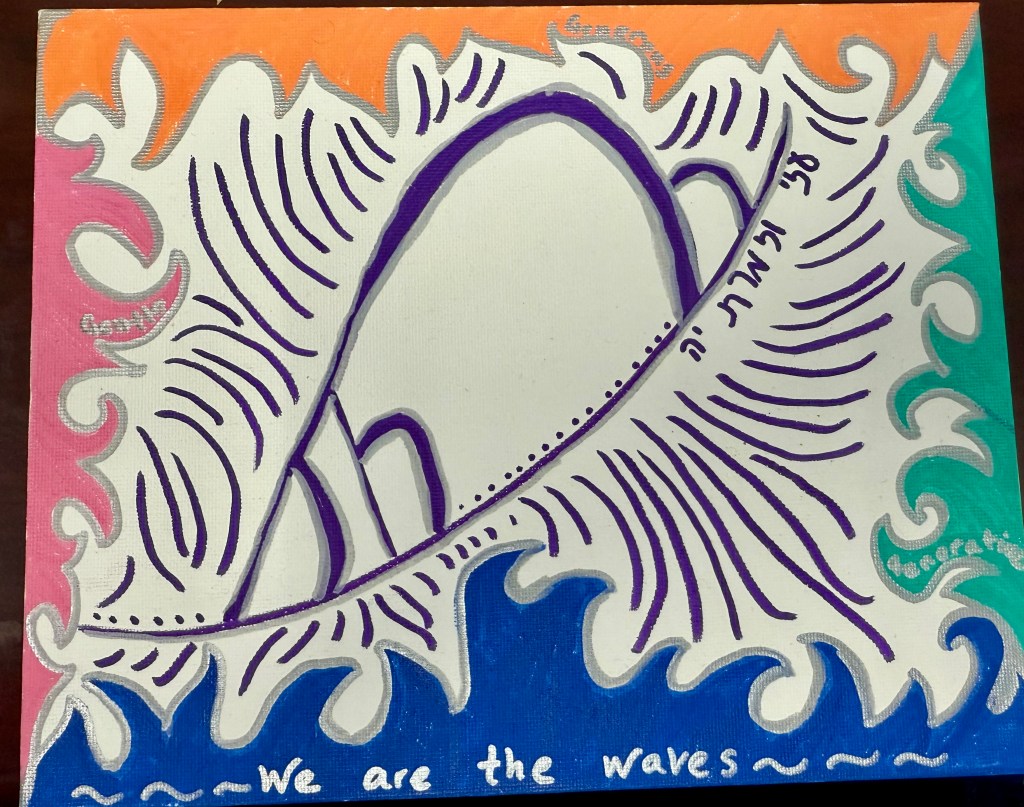
A sigil made out of the Hebrew letters for Ozi v’Zimrat Yah. I developed the sigil during a class on facilitated by Kohenet Bekah Starr,* and drew this one during the two week wait
עָזִּי וְזִמְרָת יָ וַיְהִי לִי לִישׁוּעָה Ozi v’zimrat Yah Vayehi li lishua My strength (Ozi) and God’s song (Zimrat Yah) will be my salvation.
This prayer-song was my anthem for my final embryo transfer. Offered to me as medicine from my soul sisters on the Sunday of the Ohalah Shabbaton in January, I listened to recordings of my beloved friends singing me this song as I drove to doctors appointments and before most of my injections.
Ozi v’zimrat Yah. My strength and God’s song. We never know how the song will unfold. When I surrender to its music and I focus on my own strength, the parts of my life – and the parts of IVF – that I can control, it helps ease my passage through the dissonance I encounter along the way.
IVF – really, all pregnancy and birth, but especially IVF – are part miracle, part medicine. My strength and God’s song. Hope and hormones. Prayer, practicing trust, and doing everything we possibly can to make it work.
We did everything we could to make our final embryo transfer work on February 27th. And still, on March 10th, we found out the embryo didn’t even attach this time. I was not pregnant. I’m not pregnant.
For a long time I felt guilty about even wanting or praying for another child, and I felt guilty asking my friends for support while I was trying. I leaned on community so heavily in my journey to Ella. Part of me felt like “I already got my miracle. Who am I to ask for another?” But we had always wanted two. That was our intention. Before the first miscarriage. Before infertility. Before the endo diagnosis. Before IVF. We dreamed of being a family of four. I wasn’t willing to give up on that, not while I still had remaining embryos. Even after my challenging pregnancy and birth experience with Ella, I wanted her to have a sibling. And knowing that we only had XY embryos left – we were really excited about the possibility of a baby brother.
But we miscarried the embryo we transferred in September and this final embryo didn’t attach. And we won’t be doing further medical intervention. The time for egg retrievals is behind us. It costs a fortune. My egg quality wasn’t great during all those retrievals and it’s certainly not better now. My body reacts so badly to the progesterone injections that doing this again with a donor egg isn’t an option either. After this transfer, I battled another infection at one of my injection sites. It was cellulitis – the same thing that landed me in the hospital in 2021. I caught it early this time and got antibiotics as soon as I knew. I am glad I listened to my body and went to the doctor instead of waiting longer.
While I battled the infection, Gulliver, our beloved 13-year-old labradoodle, got very sick. In just five days, we went from thinking we might gain a family member – to facing the very real possibility of losing one. I didn’t have capacity to reflect on the embryo loss while we were deciding if we should put Gulliver through the operation. Would they operate and find cancer, discovering that he had no chance at survival anyhow? Would they remove the spleen and find a benign tumor, prolonging his until-now happy and healthy life? Once again, we were standing at the crossroads of medicine and miracles. Our strength and God’s song. A doctor we trusted and an outcome we couldn’t. Just enough information to tell us we had a choice, but not enough to know if we had a decent chance. How would the song unfold this time?
We are so relieved that our sweet boy is healthy after all. We know Gulliver is a senior dog and we aren’t in denial about that. But for now, he is cancer-free, which means that he and Ella can make more happy memories together in the time he has. They shared a piece of pizza on Saturday, and it felt sacred.
It has been over seven years since my first pregnancy, and over five years since we started pursuing IVF. Seven years of trial and error. An endometriosis diagnosis. Countless ultrasounds, blood tests, laparoscopies, injections, miscarriages, tears, and everything else. At the same time – rabbinical school, a cross-country move for a rabbinic position, a child born, ordination received, and growing into my roles as rabbi and mother. Ozi. My strength. It took so much strength to get through it all. Looking back, realizing again how unlikely it was for IVF to work even once for someone like me, I’m so, so grateful that it did.
Ozi v’zimrat Yah Vayehi li lishua My strength and God’s song will be my salvation.
I have no regrets about the decisions we made. I am grateful that IVF – part medicine and part miracle – brought Ella into our lives, even while I grieve for the ones it couldn’t. We surrender what we can’t control, and do our best with what we can. We don’t know how the song will unfold, but this process has taught me that in the face of dissonance, the best thing I can do is continue, with all my strength, to sing along.
When I was regularly facilitating children’s grief groups and volunteering at grief and cancer camps, I had a recurring dream. In the dream, I was facilitating a grief group, much like the ones I led in waking life. The crucial difference is that the dream grief group was a grief group for the dead. My job in that dream was two-fold: to witness the dead as they grieved the lives and loved ones they left behind, and to support the dead through this transition, to help them integrate their new reality. These dreams were never scary. They were tender. Loving. We even laughed together, just like we did in my grief groups for the living.
Almost always, the deceased parents of the children I worked with in waking life showed up in my dream grief groups. I recognized them immediately when they walked in, because their living children had shown me pictures of them at candlelight memorials and in popsicle stick photo frame activities. I’d heard so many stories about these deceased parents from their living children, whose grief I witnessed in waking life. One teen described her late mother as feisty and smart. She was a brilliant scientist who always wore bright red lipstick. When that deceased mother came to my dream grief group, she appeared just as her daughter described her, red lipstick and all.
My unconscious mind fabricated grief groups for the dead based entirely on stories shared by their living children – memories, quirks, inside jokes, and even the tough moments – the ones that emerged late at night at grief camp. “My last conversation with her was an argument. It was so stupid.” “I was so angry at him for the drug use. What if he didn’t know I loved him?” In my dream grief groups, the deceased parents and I fondly remembered their children together. Their parents were always so proud of them.
The dream groups were intimate. Personal. Powerful. It was my mind’s gentle way to witness my own witnessing – to make sense of the countless stories of loss I carried with me over my decade working with these children.
Grief group facilitation taught me a lot about the power of witnessing – or, as my friend Rabbi Irwin Keller says – “with-nessing.” With grief, there is no problem-solving, no solution. Nothing can be done to change the situation. Witnessing and being-with are the greatest gifts we can offer.
The Shema, the most central statement in Jewish liturgy, is a proclamation of our witnessing. In the Torah, the last letters of the word “Shema,” which means “Hear,” and the word “Echad,” which means “One,” are written in larger script than the rest of the text. These letters are Ayin and Dalet. Together, they spell “witness.” The Shema is a call to witness the Oneness of the Divine Presence as it unfolds in the world. In other words, even God needs to feel seen.
For a number of reasons, I stopped facilitating children’s grief groups after I moved to Champaign-Urbana. The dreams stopped coming at regular intervals, and then they stopped entirely. I was focused on life in a different way, so I stopped dreaming about the dead.
After October 7, 2023, I was sure the dreams would return. I was grief counseling full time, even when we didn’t call it grief counseling. I facilitated groups. I witnessed the pain of countless students, friends, and colleagues. But the dreams didn’t come.
Until September 1st. Since that night when six hostages were murdered, those hostages and others who died on and after October 7th have been visiting my dream grief groups. Like the parents of the children I used to work with, I know the faces and stories of the dead from the living people who loved them. I’ve met musicians, tattoo artist, Shani Louk (z’l), and children who were murdered in their kibbutz bedrooms. I met Carmel Gat (z’l), who was a mindfulness meditation and yoga instructor. In my dream grief groups, she leads some gentle movement for the group each time we meet. The murder of those six unlocked the part of my dream life that processes my grief, and the grief of those I witness – by helping the dead process theirs.
Yom Kippur has a lot to teach us about death, grief, and witnessing. Jewish tradition considers Yom Kippur to be a “dress rehearsal” for our own deaths: We refrain from eating and drinking, washing and pleasure, and some people wear white, evoking the image of shrouds. I’ll talk about that tomorrow morning. Yom Kippur invites us to witness the grief of others, as we experience our own grief at the Yizkor – memorial – service.
There’s also a Yom Kippur afternoon service that is not often included in Reform spaces, but its message is an important one for this year. It’s called Eyleh Ezkerah – “These I remember,” based on lines that we repeat throughout the service: “Eyleh Ezkerah v’nafshi alai eshp’khah, al koroteinu ha-marot einai zoglot dimah” – “These I remember, and nafshi – my soul – melts with sorrow. For the bitter course of our history, tears pour from my eyes.” The service tells the stories of generations of Jews who were murdered for being Jewish – from Rome to Mainz during the First Crusade to the Spanish Inquisition. “These we remember,” we say again, and again. None of us personally knew rabbinic greats like Rabbi Akiva and Rabbi Shimon ben Gamliel – but we remember them based on the stories of others. The Eyleh Ezkerah service offers a way for us to use ritual and memory to witness the dead, and to create meaning for the living.
Earlier this week, on the anniversary of the October 7th massacre, students and staff worked together to implement a student vision – a memorial museum. Far from a static walk-through museum with statistics and political analysis, the experience lifted up the stories of actual people – soldiers, people who lived and died in the kibbutzim, and people who witnessed the murder of their loved ones at the Nova festival. First-person testimonials were the fabric of this experience. We felt the presence of those who died on the 7th through the powerful stories and memories of those who loved them.
And each of us who walked through the museum was a witness. A witness to the stories. A witness to others walking beside us. A witness to our own grief – grief we may have forgotten during an intense year of political argument and analysis. Eyleh Ezkerah. These we remember. Late at night on October 8th, when we cleaned up and put away the museum pieces, it felt like uncovering the mirrors in a home after shiva. That night, more of the dead from October 7th and beyond attended my dream grief group than ever before.
In my Erev Rosh Hashanah sermon, just 10 days ago, I said that I don’t know what to say about October 7th, and it’s still true. But that’s because there’s nothing we can say that will change what happened.
It turns out that, once again, it’s not about saying something.
Listening is greater than speaking. Presence is greater than power. Witnessing is sometimes the most precious gift we can offer.
Surrounded by death, witnessing says “I am here. We are alive. We are together. You are not alone.”
In my dreams, no one, living or dead, is grieving alone.
Wow. What a year. I have to be honest, friends. I don’t know what to say about it. I don’t know what to say about the year we are leaving behind. I don’t know what to say about where we are now – with rockets flying in multiple directions, slogans screaming across Instagram, countless lives lost and relationships shattered since October 7th. I don’t know what to say about where we are going in this new year when there’s no resolution in sight. We eat apples dipped in honey, illustrating our hopes for a sweet new year. But it can be really hard to think or talk about sweetness when we are tasting bitterness at the same time.
The beauty of Jewish holidays is that they are both commemorative and experiential. We are asked to remember something that happened in the past – AND we experience it in real time. At Passover we are told that we ourselves are coming out of slavery. Rosh Hashanah is a time when we both remember and experience renewal, rebirth, and creation. When God began creating the world, 5785 days ago in Jewish time, the earth was tohu vavohu, chaos and void. And choshech, darkness, was on the face of the deep. And Ruach Elohim, the spirit of God, m’rachefet, hovered on the face of the water.
What was God feeling in that moment, hovering over the darkness? Was God afraid of the void? Anxious amid the chaos? What did it take for God to find the courage to say “yehi or,” “Let there be light?”
We, too, have known darkness this year. We have also faced the depths. And right now, we, too, are hovering – m’rachefet – between darkness and whatever comes next. What is it like living in this hovering uncertainty? What will it take for us to risk looking forward at all, let alone looking forward with something like hope? I don’t know. But I do know we have examples in our tradition of other moments like this one, and we can learn from our ancestors.
Our ancestors shared an experience of darkness, chaos, and confusion at Mt. Sinai, waiting for Moses to bring Torah down from the mountaintop. When Moses ascended Mt. Sinai, the Israelites didn’t know when he would return, and they were terrified. In their fear and anxiety, hovering beneath the mountain, they turned to a destructive but familiar coping mechanism, like so many of us have in those uncertain moments – they built a golden calf, a false idol.
How many of us have turned to an unhealthy habit in moments of anxiety in the last year? Me too.
Moses came down from the mountain with the commandments on two luchot, two stone tablets, and when he saw the golden calf, he was so furious that he shattered them. Moses climbed the mountain again. Even though he was angry at the Israelites, he pleaded with God on their behalf. And God forgave them on the 10th of Tishrei – a day that we now experience and commemorate each year: Yom Kippur. Then Moses descended with new luchot.
A midrash – which is Torah fanfiction – on this Torah portion tells us how our tradition treats the brokenness we experience in times of darkness and hovering. When Moses came down from Mt. Sinai the second time, with new tablets, the Israelites kept the broken ones. They placed the broken luchot, along with the new ones, in the holy ark.
Why keep this symbol of our own fear, this casualty of rage, this set of broken laws? Because brokenness and wholeness live side by side in the world and in our hearts. Because we had to be in the wilderness, hovering, waiting, lost and afraid, worshiping a false god before we could worship our One God from a place of trust. We kept the broken tablets because learning is part of becoming. We kept them alongside the new ones, because brokenness itself is holy. The broken tablets, carried along with the whole ones in the Aron HaKodesh, the holy ark, represent the resilience that carried us through the rest of the uncertain wilderness.
Rabbi Harold Kushner (z’l) raised an important point about this story “…The saga of the golden calf, God’s anger at the people, Moses’ intervention and God’s forgiveness raise an interesting question: When something breaks, something that was precious to us, is it ever possible to put it together again so that it’s as good as new?”
So much shattering occurred over the last year. Trust was broken. Relationships ruptured. Communities crumbled. October 7th splintered us again and again. How can we repair? Is it even possible to build ourselves up again so that we and our communities are as good as new?
Rabbi Kushner continued, “It would be nice to believe that a God of second chances would make that possible, but the reality seems to be no, you can’t. If it’s broken and repaired, it will never be the same. The crack will always show. But what a God of second chances does is make it possible that you will end up with something in its place that will be even stronger and better than the original.”
What would it look like for us to build something better? And what examples can our textual tradition offer for guidance?
After God hovered in darkness, over the face of the water, God said “yehi or” “let there be light,” and went about the work of creating the world for us. When we finished hovering in the darkness at the foot of the mountain with the golden calf, we went about the work of creating a Mishkan for God, an elaborate and collaborative traveling sanctuary. Each person contributed something of their own to the creation of the Mishkan. The sages consider the golden calf incident to be one of the darkest moments of our history – despairing, leaderless, and chaotic. Our ancestors came through that darkness and said “yehi or,” “Let there be light.” And they created a mishkan.
The truth is that there is always darkness, brokenness, and loss. And – we can always say yehi or – while we hover within the tohu vavohu, within the chaos. Kohelet says “To everything there is a season, a time for joy and a time to weep.” In his poem, “Kohelet Wasn’t Right,” Israeli poet, Yehuda Amichai responds that no, these are not separate times. “In the days when each hour collides with the next,” he says, “we have no choice but to cry and to laugh with the same eyes, to mourn and dance at the same time.” We have to carry the broken tablets with the whole ones. We have to create light while the darkness swirls around us. When false idols have made us forget that we are One, we have to build a mishkan together.
Does it sound impossible? That’s ok. It won’t happen perfectly, or all at once. Creation didn’t happen just one time – creation is always unfolding, all around and within us. 40 days and nights passed before Moses came back down the mountain with the new tablets after seeing the golden calf. It took time for the Israelites to return to the mishkan. Healing is a long and by no means linear process. We may continue hovering – m’rachefet – over the depths for awhile.
In the meantime, we have ancestral tools, handed down in our hearts and in our liturgy, that can help us make incremental change. One of these tools is selichot – forgiveness. Rabbi Kushner wrote that “The crack in the first set of tablets was the loss of the dream of perfection. Now the challenge facing you is… can you replace that dream of perfection…with a more realistic one… that will make allowance for human frailty? … Can you give yourself and those around you permission to be human…? On Yom Kippur, so many years ago, God forgave the people who built the golden calf. He forgave us for being human beings, with hopes that we would learn to forgive each other as well.”
Can you forgive yourself for the moments when the darkness was unbearable, the moments when the shattered pieces of your heart cut so deeply you couldn’t see the whole ones beside you, the moments when hovering was the only option because you couldn’t find light amid the chaos? Can you forgive your community for the moments when we failed to hold you in the way you needed to be held? Can you forgive God for God’s imperfect world? 18th century Ukrainian rabbi, Rebbe Nachman of Breslov, taught that Moses was able to find the nekuda tovah – the good point, the Divine Spark – in the Israelites when he pleaded with God on their behalf on top of the mountain. Nachman teaches that this is what allowed the Israelites to move from building the golden calf to building the mishkan – all it took was one person seeing the good inside of them. Forgiveness is another way to say “yehi or.” Let there be light.
5784 had darkness, chaos, confusion, and grief. We have been at the foot of the mountain with the golden calf. At this exact moment, when we remember and experience the story of creation, we are m’rachefet – hovering – on the face of the depths. How can we say “yehi or,” like God, when God created from darkness? How can we say “yehi or,” like our ancestors who contributed to the mishkan after contributing to a golden calf? How can we build new tablets – while we hold onto the broken ones? We have looked at an ancestral tool, but we can and should draw on personal experience as well.
Take a deep breath. Think back on some of your own, personal, darkest moments from this last year. What are the qualities you already had inside you, what are the roots you returned to, what did you discover that was grounding, replenishing, and brought you a little more light? What did you try? What was helpful for you?
Even in this dark year, you were able to find “yehi or” moments. Looking back on our year at Hillel, I can also see examples of times when we said “let there be light” as a community, not in spite of, or even because of, the chaos – but because it is what we do. It’s part of who we are.
Yes, there was rupture within our community. And, over the twenty-five Bagel Brunches we shared on Sunday mornings, we ate 1,250 bagels in total. There’s an ongoing hostage crisis and war in the Middle East. There was anger, distrust, and antisemitism on campus. There was also Matzo Ball, a festive Hollywood themed semi-formal at Joe’s at the beginning of spring semester. We were anxious and uncertain, but we also celebrated Purim with 300 of our besties at the seventh annual Purim drag show. The news cycle was relentless and depressing. And we played a lot of Dungeons and Dragons. We said “yehi or” when we piloted a wellness-themed Jewish Learning Fellowship, where students shared from their hearts and deepened their relationships. We said “yehi or” when we welcomed the angels, and each other, by singing Shalom Aleichem together before each Shabbat meal. With the darkness – light. With the brokenness – creation. With the hovering – a mishkan, a gathering space for sacred community.
Contemporary scholar of kabbalah, Dr. Melila Hellner-Eshed, writes that “An envelope of bitterness encases the divine sweetness,” yet we can “reach the sweet, divine essence hidden within the layers of the world’s bitterness.” So we will dip our apples and our challah in honey for a sweet near year. We will practice forgiving ourselves and each other for our imperfections. We will rebuild relationships and repair our community. It won’t be the same as before, but it will be stronger. We will honor our brokenness and our wholeness. We will turn away from false idols and we will work together to create a better world. We will say “yehi or.” Say it with me: “Yehi or.” Let there be light.
Shared with gratitude to Rabbi Bluth and Josh Feldman for helping me figure out what to say in a year when none of us really know what to say. Your friendship and mentorship means the world to me.
From the narrow place I cried out to God; God answered me with an open expanse.
These words from Psalm 118 have been on my heart this year as I’ve prepared for Passover. Every year, we relive the Exodus, saying that we ourselves were slaves in Mitzrayim – a Hebrew word that means both “Egypt” and “Narrow Place.” This year, we are all trying to make sense of slavery and freedom in a post October 7th world. Each of us has our own meitzar (narrow place) to escape, and our own merchav (expanse)to explore. We have our individual enslavements, our personal Pharaohs and seas to be crossed. But like the Exodus, the war in Israel is being experienced collectively as well as individually. We all need to find our way from our communal meitzar to the merchav, and we need to do it together.
For the Hebrew slaves, the narrowness – the meitzar – was Egypt under Pharaoh. The Haggadah tells us that Pharaoh forced the slaves into hard labor. But the subjugation went far beyond the physical. When Moses told the Hebrews that God would free them from slavery, they could not hear Moses in their suffering – literally, according to the text, due to kotzer ruach, shortness of breath, or spirit. Their spirit had shrunken until they couldn’t grasp the idea of freedom. Netivot Shalom, a 20th century Hasidic rabbi, wrote that “Israel was subjugated in total. They had no independence, even in thought.” The Hebrews “became like breath caught in the throat, subsumed in Pharaoh completely, body and spirit.” In the narrowness, they could not hear, think or speak for themselves. A numbing silence came from deep trauma, their thoughts swallowed on the inside before they could name them, even to themselves or each other. The Zohar calls this a “galut ha’dibbur,” an exile of speech.
The path to freedomopened when the Hebrews opened their own mouths and spoke. Exodus 2:23-24 lists four types of outcry: The Hebrews anach, (sighed), za’ak (called out), shav’ah (cried for help),and n’akah (groaned). The beginning of redemption was their own awareness. After generations of feeling and thinking only what Pharaoh told them to, the Hebrews recognized their own suffering. The next step was to call out. At first, they groaned before they could speak. It may have been unintelligible, but the pain and their voices were their own. “When they left Egypt, they went from subjugation to everlasting redemption and received anew the aspect of speech,” writes Netivot Shalom. “Peh-Sach can be interpreted as shorthand for peh (mouth) that sach (speaks). This is the essence of the holiday of Pesach.” They went from slaves that couldn’t think, feel, or speak for themselves, to human beings with awareness of their own pain, and voices that could tell their story.
After the Hebrews crossed the Sea of Reeds, they found themselves in their merchav – the wilderness. And they were terrified. We joke about it, but it’s true – after singing at the Sea, the Hebrews immediately used their newfound voices to complain. They complained in Egypt they’d had cucumbers, onions, and melons. Would they starve to death in the desert? What would become of them in this wasteland? These complaints were about physical needs, but they spoke to an underlying spiritual question. Enslaved in Egypt, they’d known what to expect. The Hebrews knew who they were, understood their roles, knew where their meals would come from, and when. There was security in the structure.
Today, sometimes our structures confine and define us as strongly as Pharaoh. Our polarized political discourse is the most constrictive structure I’ve witnessed and experienced since October 7th. This meitzar is one of certainty, and obsession with our own correctness. In this suffocating narrowness, we categorize people, things, and actions into good or bad, right or wrong. People are forced to be on the side of Israel or Palestine, the side of peace or war. We are enslaved to the echo chambers we created, narrow spaces that limit our perspectives. Students who don’t fall clearly on one “side” or the other have shared that they, like our ancestors under Pharaoh’s rule, can’t speak. They don’t want to ask questions because they are afraid they will be alienated from friends and communities they hold dear. The Passover seder is all about asking questions, but we have become experts at silencing voices that question the Pharaoh. It’s so easy to unfollow or unfriend, to curate a meitzar where we feel secure – and sometimes we may need to! Like the narrow place that enslaved our ancestors, this meitzar has its benefits – it’s predictable, expected, understood. But at what cost?
If our meitzar is a place where we are constricted by certainty, the merchav – the expanse –is uncertainty, a wilderness of not-knowing. We are free when it is safe to be unsure of our stance, and we are open to engaging with different viewpoints. In the merchav, Pharaoh no longer dictates what we believe. Once again, the beginning of our redemption is our own awareness – an awareness that there’s something outside the narrow confines of our own perspectives. We have learned to speak – this time, with people outside the echo chamber. And perhaps more importantly, we’ve learned to listen. In this expanse, we can be expansive. We can hear one another, acknowledge complexities, and hold multiple truths.
No longer trapped in the narrowness of what is, we are able to imagine what could be. In this merchav, students who are unsure about their views on Israel and Palestine are welcome to voice their questions without being forced to choose a side. In this merchav that we create, two students who completely disagree with each other sit down for coffee, hear each other’s stories, and learn why each of them cares so deeply about this cause. Neither one convinces the other – and neither one expects to change the other’s mind. They leave the conversation richer because they understand one another better than before they entered this merchav together.
The possibilities are exciting and terrifying, much like the merchav the Hebrews encountered. It’s scary to hear the voices of those who disagree, when our beliefs feel fundamental to who we are. Will we lose ourselves in the process? Will we forget where we came from? No we will not, because, as the seder reminds us: Avadim hayinu, ata b’nei chorin. Once we were slaves, now we are free.
As we approach Passover this year, I invite you to use the seder as an opportunity to truly reflect on the meitzar and the merchav. Throughout the week, consider: Have you made a Pharaoh of your opinions? Are you 100% correct, or is that Pharaoh telling you what to think? When you feel the urge to retreat to the security of the meitzar, remind yourself of the consequences. Passover is an opportunity to reflect on what we believe, how we formed our beliefs, and how those beliefs may be forming us. This year, the Peh – Sach, the mouth that speaks, must be one that asks questions, as we always have in our seders. The Haggadah reminds us that we cannot return to Pharaoh. We must free each other, and we must do it together.
“Forget your perfect offering There is a crack in everything That’s how the light gets in.” – Leonard Cohen
“Can I be a rabbi if I can’t sing?” I sobbed to one of my teachers in rabbinical school. I’d struggled for years to find my voice, taking lessons, trying to force myself to make sounds that just wouldn’t come out of my mouth. I practiced relentlessly, but it never seemed to be enough. My teacher was soothing and supportive, pointing out how many strengths I had, and the many gifts I would offer my future communities as a rabbi. And prayer isn’t about having a beautiful voice, after all, she said. It’s about connection.
Similarly, many times, students have confessed to me that they don’t feel comfortable praying because they don’t know how to do it perfectly. They don’t know Hebrew, are not sure about their relationship with God, or they don’t know what they “should” be doing during the silent part of the prayer service. I’m always happy to help students build their prayer skills, but I have to wonder how many times we’ve missed the point because we’re trying to make the perfect offering. Even beyond the world of prayer services, I recognize that many of us have missed opportunities to connect with ourselves or with others in a deeper way because we are afraid to fail.
This week’s Torah portion is Parashat Tzav. Tzav means “command,” and the parsha opens with God telling Moses to command the priests to make offerings. The rest of the text details the long process of making a ritual sacrifice, and consequences for completing the ritual imperfectly. This long list of instructions may seem pedantic. But the language used in the parsha reveals additional meaning. While “tzav” צו means “command” in Hebrew, this word is also related to tzavta צוותא, which means “connect,” or “bond” in Aramaic. “Mitzvah” מצוה, which comes from the same word, means “commandment” and it means “connection.” Similarly, the Hebrew word for sacrifice is “korban,” קָרְבָּן which comes from the root, “karav,” קָרַב, meaning “to draw near.” God commanded us – tzav – to make sacrifices – korbanot – so we could tzavta – connect – and karov – draw near to the Divine Presence. It was all about connection and closeness with something bigger than ourselves.
After the Second Temple was destroyed in 70 CE, we no longer had a place to make sacrifices. The Sages had to design new ways to connect with God, drawing near to the Sacred during a period of distance and exile from everything they knew. The animals the priests offered in sacrifice at the Temple had to be unblemished, but without a Temple or priests, our ancestors understood that our offerings would no longer be perfect, or even uniform. Prayer was the innovation that came from this understanding. In the Temple’s absence, we learned to draw near to the Divine Presence that is alive in everything around us. We don’t need a Temple because our world is the temple. We don’t need priests because everyone can pray.
In Parashat Tzav, we are commanded three different times to never let the fire on the sacrificial altar go out. Without a sacrificial altar at a Temple, the fire that must be tended is an internal one – the spark of the Divine that each of us carries inside. 19th century Polish rabbi, Sefat Emet שפת אמת, wrote that any “distracting thought that enters the heart” during prayer is consumed in that inner fire. “That, in fact, is the true purpose of all those thoughts that rise up within the heart; they are there to be overpowered in the fire of worship. In this way, those distracting thoughts are purified and uplifted.”
Sefat Emet wants us to make our imperfect offerings. My distracting thoughts about my voice are there to fuel the fire inside me. The students’ feelings of uncertainty during prayer are there to do the same – to help them shed light on the reason why they pray, which is connection. I don’t have to sing perfectly in order to pray through song or lead prayer services. I can lead in different ways, using poetry and meditation, or I can partner with a strong vocalist. Most importantly, I’ve learned that I can still sing along with my community, letting the music move me into deeper connection with my community, and with the Divine. This parsha teaches us that we have to keep that light burning.
As we make our offerings on this Shabbat Tzav, if anything is holding you back, I invite you to consider the power of your imperfect praises, blessings, and prayers. Let the light of hope and connection get in. And if you are looking for a place to start, I humbly offer the prayer below – an interpretive version of a prayer we say as part of the daily and Shabbat Amidah. The original prayer asks for a restoration of the Temple, the priests, and the sacrifices. Mine asks instead for acceptance of the words we offer up – wholly imperfect and perfectly holy.
HaMakom, Our prayers are the offering and You are the Temple.
Our words rise to the sky like smoke from a flame, swirling above what is burnt, what is broken.
Holy One of Blessing, please accept them all: the words and wonder, the fear and awe.
Life is light and wood and burning. Every offering we bring before You is a way to draw near, a promise of our love.
Barukh Atah Adonai, mekabel ha’olot Blessed are You, Holy One, Who accepts our offerings.


 Scattered Leaves