Threnody (n): a song, poem, or musical piece composed as a formal lamentation or memorial for the dead
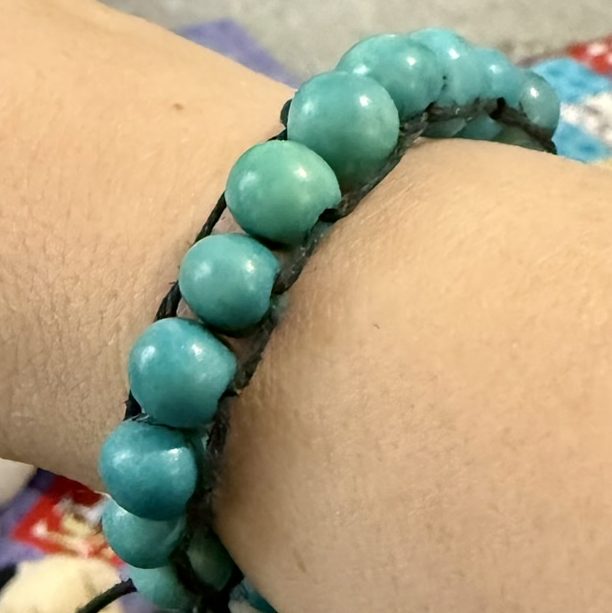
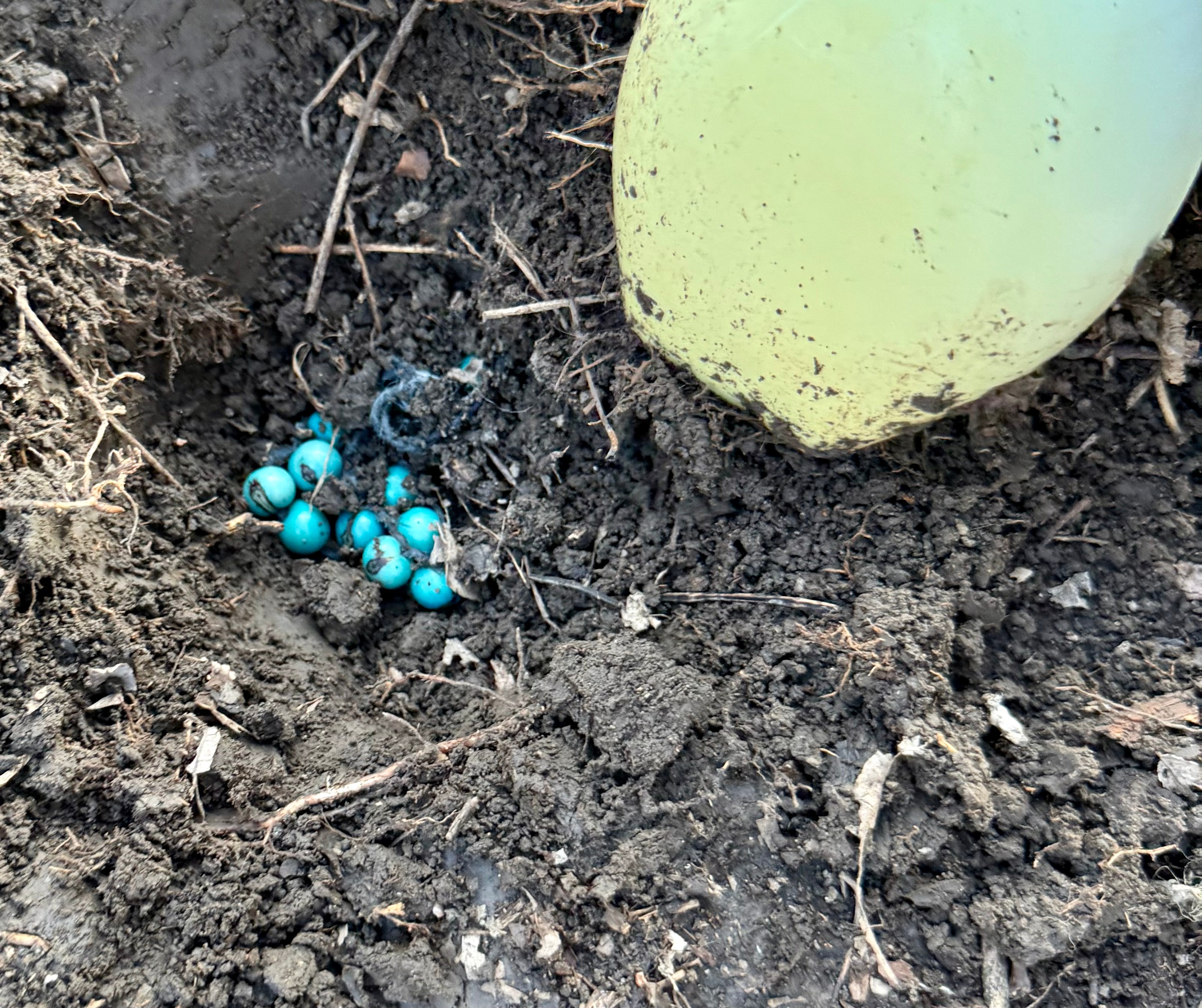
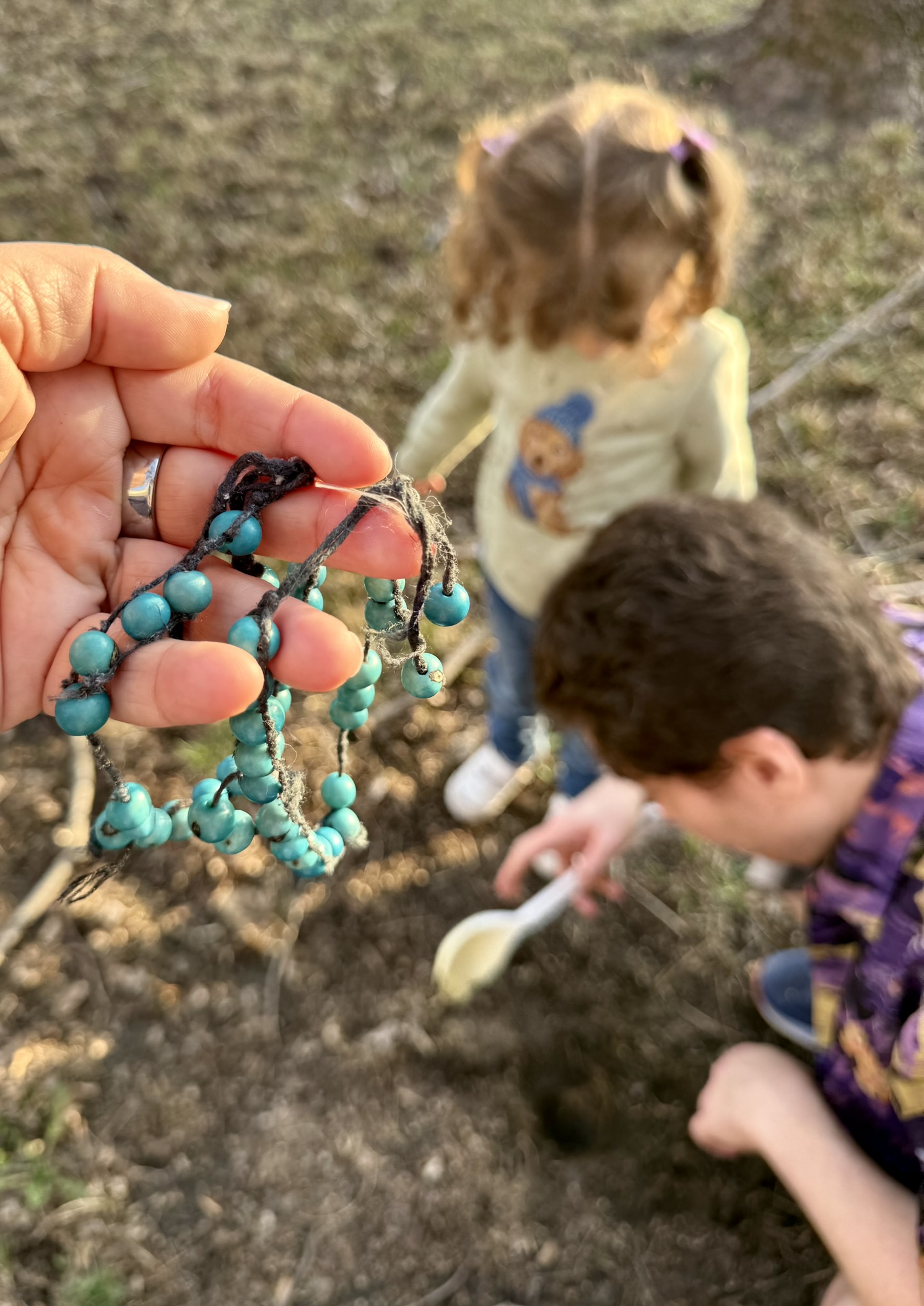
On Tuesday, Joseph, Ella and I buried this bracelet in the backyard.
The bracelet had been with me for almost a year. On my wrist. In my backpack. My purse. It came with me to Kallah in Baltimore over the summer. It came with me to California for three visits and then a fourth when I officiated my grandfather’s funeral. It went to three different states when I officiated weddings in August, October, and January.
I bought the bracelet not long after we lost our last embryo on March 10, 2025. With that embryo, we also lost our last chance to become biological parents to a second child. I was still carrying the weight of the two pregnancies we lost before our miracle Ella, as well as the two losses that followed her. Even as I delighted in Ella every day, I grieved for the future I envisioned for us as a family of four. At the same time, my parents were preparing for their move to Florida. Realizing they are aging, I grieved anew that it took us so long to have a child and that we live too far away for frequent visits. I grieved for the time we lost and the time we won’t have. I grieved the end of my childhood, young adulthood, and the vision I’d had for my future.
I had trouble speaking about this litany of grief because I also have so much to be grateful for. I know that grief does not undermine gratitude – it actually expands our capacity for it. But it was still hard for me to name this weight, padlocks dangling heavy on the gates of my heart.
If anyone else had come to me with this problem, I would have designed a ritual for them, some way to externalize the feeling, acknowledge and validate it. I would have invited them into ritual to honor the memory of what had been lost, and to support their steps into the future. But as our sages taught, in a famous Talmud passage, “A prisoner cannot free themself from prison.” In the story, Rabbi Yohanan, who had the power to heal others from sickness, could not heal himself. He needed a friend to help, and so did I (Talmud Bavli, Brachot 5). It was Reb Irwin who suggested a bracelet made of biodegradable materials. Something that I could keep for a year and then bury. I’d made similar suggestions to others coping with miscarriages – carry a rock for a week, a month, or as long as you carried the pregnancy, and then bury it. In the absence of a body, a casket, or a funeral, it’s helpful to hold a physical item, return it to the earth, and say goodbye. The loss of this embryo seemed to carry all the previous losses inside of it, a set of faceless Russian nesting dolls. With all of those layers, it felt like a year was the right amount of time to carry the bracelet.
The bracelet I selected was made of turquoise acai seeds and black cotton thread. When it arrived, I counted 22 beads. One for each letter of the Hebrew alphabet. In Jewish tradition, 22 is a number that represents creation and completion. The mystics teach that these letters were the building blocks of the universe. In Bereishit, God created 22 things within the six days of creation, and rested when the work was complete. And in gematria, Hebrew numerology, the number 22 = יחד yachad, which means “together.”
Despite my intent to wear it daily (and the mystical meaning I was rapidly assigning to acai seeds on a string), the bracelet itself was not the sturdiest. The woven structure fell apart within two weeks. I bought a second one. After all, if I wanted this item to stay with me for the duration of a year, I needed something durable, something that could hold itself together. The second one fell apart as quickly as the first, and I found myself asking my friend Bekah to help me stitch the beads back in line at ALEPH’s Kallah over the summer. Bekah is a Kohenet, artist and ritual guide; I told her why the bracelet was important to me, and asked for suggestions. How could I keep it from falling apart?
I spent a lot of time rethreading the beads in the art room during breaks at Kallah. I tied and retied them, but no matter how I tried, I couldn’t get the beads to line up as they had before. Bekah noticed, and she reflected my behavior back to me – my singular focus on stringing the beads in a specific way. And I realized that for years, I had been trying to build my life the same way. No matter how hard I try, I just can’t control the future. I can pick the colors, string the beads, line everything up, create something beautiful – but sometimes, the thread breaks, the colors fade, the last embryo fails to attach. Sometimes, I am left with something less than what I’d envisioned, and more beautiful in its authenticity. I am left with the life I have, and the best thing I can do is wrap it around my wrist, and wear it with love.
I kept both of the broken bracelets, carried them through my own wilderness, like the broken Tablets of the Covenant the Israelites carried, along with the whole ones, in their traveling sanctuary (Talmud Bavli, Bava Batra 14b). I kept one bracelet within my eyesight in my office, and kept the other in my backpack or purse. These artifacts of my grief made the losses visible, even if they were only visible to me.
This past Tuesday was March 10, 2026. One year had passed since the day we learned about our last embryo. It was time for burial. Since I had two bracelets, I decided to keep one as a reminder of what I learned in the art room at Kallah. I brought the other out to the yard behind the house we’ve been renting in Urbana for the last four years. I moved into this house mid-miscarriage, and it’s the house we brought Ella home to when she was born. It’s the last home we ever shared with Gulliver.
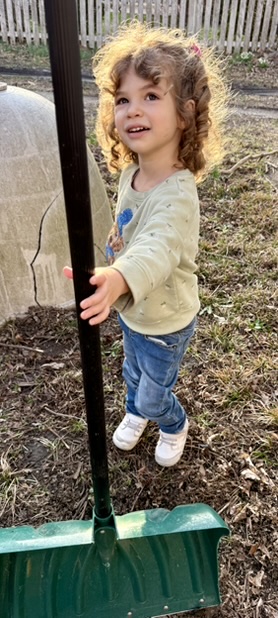
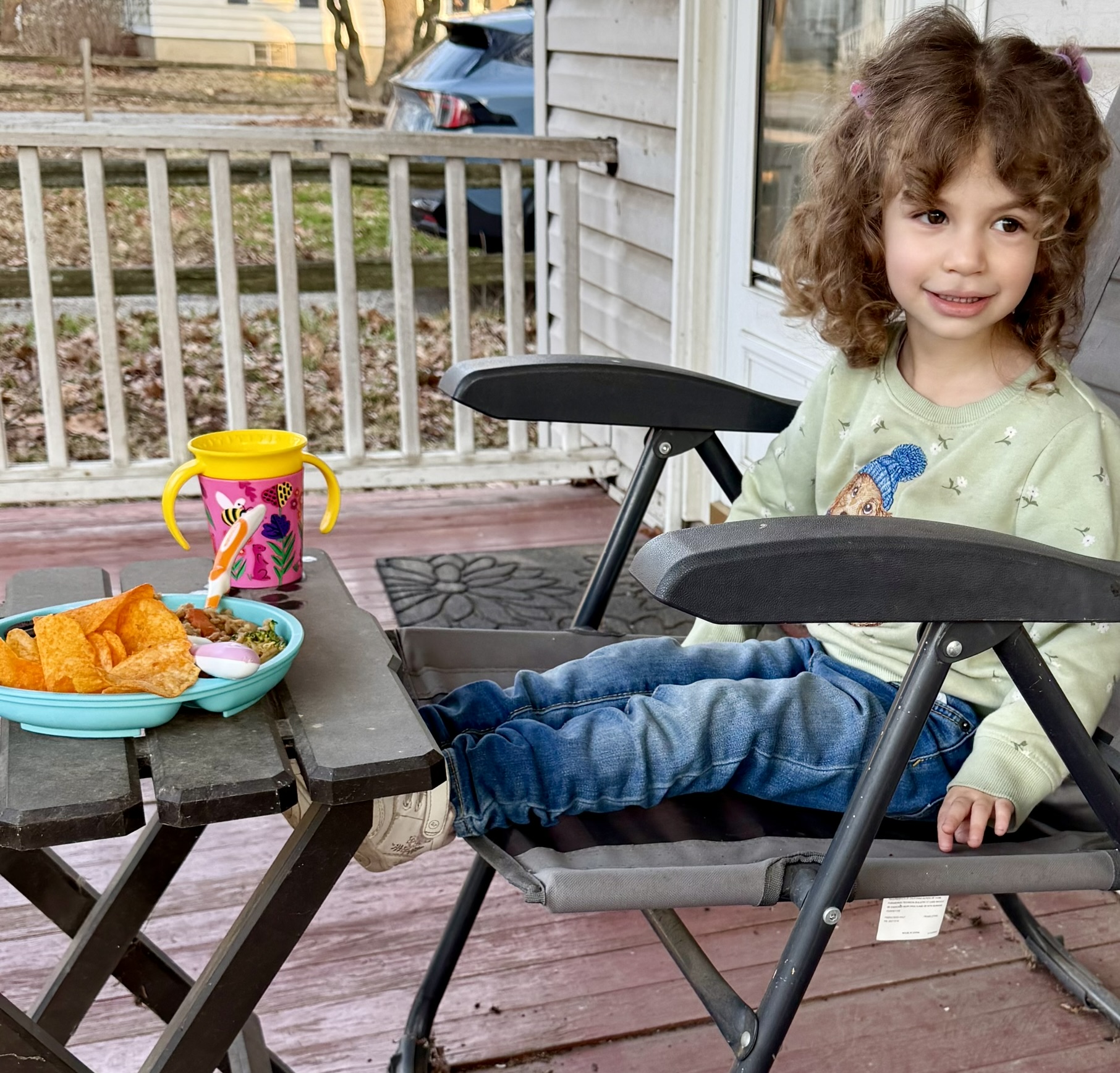
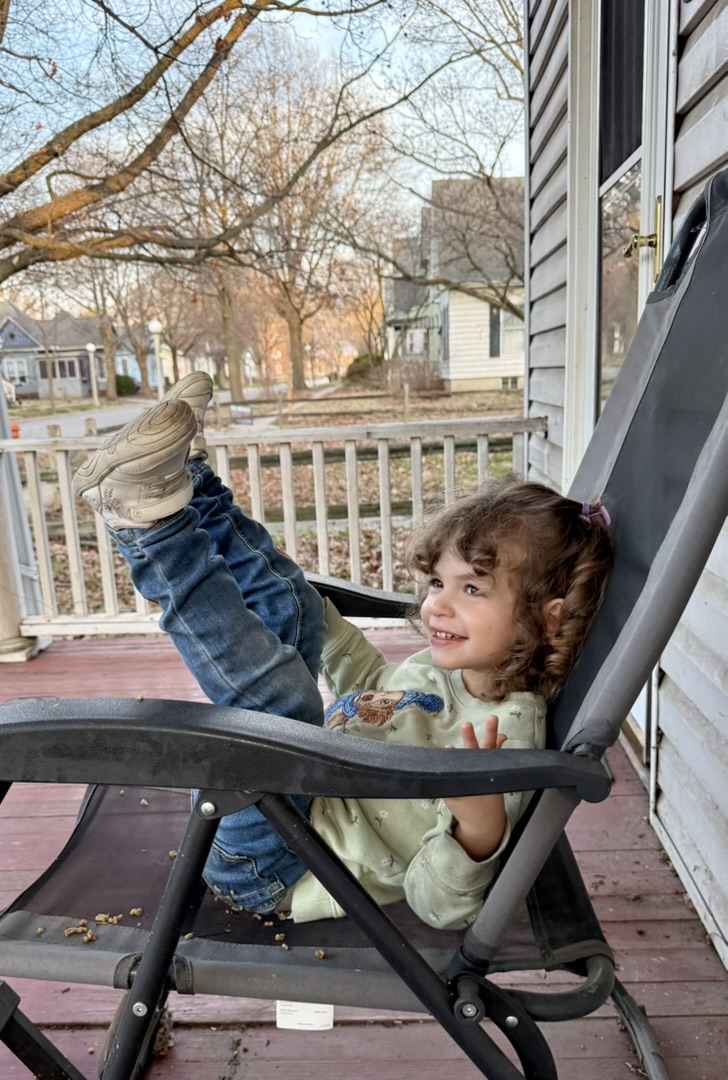
It was a beautiful spring day. Ella was wearing her favorite sweatshirt, the one my mom made for her with a dog embroidered on the front. We didn’t have a gardening trowel, but the earth was soft enough that we could dig a small hole with a snow shovel and soup ladle. “Today we are outside in the yard!” Ella chattered, telling us about the trees, the grass, and the wildflowers. She was excited to help us dig, “like a doggie!” I didn’t feel the need to say a blessing of any kind, or to name out loud what we were doing and why. It was beautiful to just be yachad – together – returning these 22 seeds to the earth. Ella asked if we could eat dinner outside afterward, so we sat together on the porch, enjoying the evening.
One year after a traditional burial, Jews do an unveiling ceremony. The headstone is covered until that time, and at a ceremony around the one year anniversary, the veil is lifted. This was a different kind of loss, and I was burying, not unveiling. But something lifted for me that night as we sat on the porch together after burying the bracelet. For a few moments, there were no veils separating the life I am living from the life I had envisioned. I tied my daughter’s laughter with string, wrapped it twice around my heart, and I knew, in that moment, that we are everything we need.
There’s a name for what we’re experiencing . That feeling of having our hearts broken so repeatedly by the news cycle. Flash floods, fires, mass shootings, wars within us, wars between us, and wars in the world. Wars that make us question who we really are as a people. One day you’re worrying about climate change, the next it’s a group project, AI taking over, what you’re going to do with your life, the next pandemic, your situationship, economic collapse, or drama within your friendgroup. There’s never enough time to process one crisis before another begins. Even when the crisis is no longer acute, there’s a pit in our collective stomach, and it’s not just because we’re Jews with stomach problems. There’s anxiety pulsing through our communities as we wonder what will happen next. The feeling is called “existential whiplash.” An instagram post from a mental health service called Spring Health says that “existential whiplash” is the emotional strain of trying to keep up with daily life while everything around us feels uncertain or overwhelming.
Our ancestors knew a thing or two about this feeling, and what it’s like to yearn for stability, while knowing that change is going to keep coming. They survived slavery, escaped Egypt, and crossed the Red Sea. They had a dramatic experience at Mt. Sinai. They reached the Promised Land. In between these major events, they wandered in the desert – trying to live amid existential whiplash, just like us. The Hebrew word for desert is “midbar.” It also means “wilderness.” The word midbar appears approximately 270 times in the Torah. It represents uncertainty, wandering, a feeling of lostness in a world churning with change.
We’ve spent a lot of time here too, bamidbar – in our own spiritual wilderness. Believe it or not, 2020 was only five years ago. It’s been a long five years, and it’s been utterly exhausting. But all that intergenerational trauma we’ve acquired – going all the way back to our ancestors in the midbar – comes with intergenerational resilience. We are still here. Still moving forward. We’re even still complaining about it, much like our ancestors in the desert.
Tonight, I’m going to share 7 lessons for our spiritual wilderness based on our ancestral experience, as well as a few lessons based on the literal wilderness. Some of our most powerful spiritual technologies mirror the interdependent systems of the natural world. In the wilderness, we have an opportunity to learn from that which is wild, around and within us. We will see what our ancestors and the natural world can teach us about the resilience we have right now – and the ways we can build it for the future.
7 Lessons from the Wilderness
Lesson 1: Build sanctuaries. “V’asu li mikdash, v’shohanti b’tocham” – God says. “Make for Me a sanctuary, that I may dwell within them.” The mishkan – the communal, portable sanctuary in the desert – was elaborate. Five Torah portions in Exodus discuss the building of this space, sometimes in excruciating detail. The mishkan teaches us that at times of uncertainty, we should build something beautiful. We should pour our energy into creating, especially co-creating something that will serve the community.
What sanctuaries have you built in our wilderness? What does your mishkan look like? Your mishkan might be your dorm room, a friend’s car, or your favorite coffee shop. It might be the arboretum or another outdoor space where you feel at peace. When you can’t change the whole world, you can still create something beautiful. Something safe. Something meaningful to you and those around you.
The commentators point out that “v’shohanti b’tocham,” means “that I may dwell within them.” Yes, we must build physical sanctuaries, and we do – and on another level, the text may be referring to the people themselves. “Make for Me a sanctuary that I may dwell within them,” the people. The mishkan, the dwelling place for the Divine – is within every one of us.
This means you can both build and be a sanctuary – for yourself and others. When have you been a sanctuary for someone you care about this year? When have you been your own? What does it look like to know there is a safe and sacred space within you, one you can always return to? The ultimate mishkan – traveling temple – goes wherever you go, and is there for you no matter what. This is the first lesson of the wilderness: In times of existential whiplash, build sanctuaries.
There are many examples of collaborative building in the wild that can be instructive for us. Bees build hives and make honey through a process called festooning.. These “festoons” create structural support and regulate the temperature of the hive. Within the hive, there are worker bees who build honeycomb, nurse bees caring for the young, and scout bees who search for optimal hive collections. Each bee contributes to the structure that enables the hive to thrive.
This leads me to lessons 2 and 3. Lesson 2 is Everyone has something to offer. God instructed every person to bring gifts to the sanctuary, telling Moses, “You shall accept gifts for Me from every person whose heart is so moved.” Everyone was asked to give from their heart, and every gift was accepted.
What can you do to sustain yourself and your community? Are you an expert problem solver? Someone with powerful listening skills? Are you creative? Are you the person who can always make your friends laugh? Think about what you can give, and give it with love. It might be exactly what your community needs. Lesson 2. Everyone has something to offer.
Like bees, when we contribute our skills and strengths to our community, we also benefit from the skills of others. This creates a more capable community that allows people to flourish – even or especially in the wilderness. This is where lesson three comes in. Ask for help. In the mishkan, Kohanim were the priests, who made sacrifices on behalf of themselves and their communities. The Levi’im played music and managed the practical aspects of Temple worship. There were also specific roles for individuals. Miriam was the one who could always find water. Betzalel was an artist who designed that first mishkan.
Lessons 2 and 3 are connected. If everyone has something to offer, you can help others – and others are here to help you, like the bees in their hive. We all have different skills to share. Who, in your wilderness, can you turn to for help? Who can you reach out to when you experience existential whiplash? When your well has run dry, find a Miriam who can help you locate a new source of lifegiving water. If you can’t serve God by leading song, find yourself some Levites who can.
Hasidic master Sefat Emet wrote, “Each one gave their own offering, but they were all joined together by the Mishkan, and became one. Only then did they merit the Divine Presence.” Each person had something unique and precious to offer – but they could not experience the Divine Presence until they shared these offerings. We became a people united not by what we took, what we achieved, or what we conquered. We became a people united by what we gave to one another.
Ecosystems are interdependent. Beavers create habitats, and those habitats are shared with other life forms. Recent research suggests that trees of the same species are communal, and will form alliances with trees of other species. Some claim that forest trees live in cooperative, interdependent relationships, maintained by communication similar to an insect colony. We are both of and in the wilderness. No one can make it through the wilderness alone and fortunately, we don’t have to. Third lesson from the wilderness: Ask for help.
One Jewish practice that speaks to lessons 2 and 3 is the act of praying with a minyan – ten people. Mourner’s Kaddish is one prayer we only say when we have a minyan. We show up to support the mourners so they can say this prayer during their time of vulnerability and grief. In my prayer services, we count the Jews who are in the building, not just the ones who are in our service, because we are here together for the same reason. We are here because we know we are interdependent, because it strengthens the community, and because we believe in showing up.
In April, there was a 5.2 magnitude earthquake in Southern California. A livecam from the San Diego Zoo showed all the adult elephants making a protective circle around the two youngest elephants. This behavior is a natural instinct to protect the most vulnerable. An elephant minyan. I think about it when we pray Mourner’s Kaddish together. We can’t protect anyone from grief. But there is so much power in showing up, like the elephants – it makes the grief just a little more bearable, a little less lonely.
When there’s existential whiplash, make the minyan. When others ask for help, it’s ok to not always have the right words. Sometimes, showing up is the help. When people are vulnerable, when things are uncertain, when the ground itself feels shaky – count your people, leave no one behind, show up, and be counted yourself.
Lesson 4: Practice mindful awareness – be present and look around. Our ancestors often found what they needed in the wilderness when they least expected it.
Jacob ran into the wilderness after deceiving his brother and his father. He fell asleep with his head on a rock, and he dreamed of a ladder with angels ascending and descending. Jacob awakened, saying “Mah norah hamokom hazeh!” God was in this place, and I didn’t know it.
Moses was also bamidar when he saw a bush, burning, but not consumed in the fire. He had run away from Pharaoh’s land, struggling with his conflicting identities as a master in Pharaoh’s palace and a Hebrew, like those Pharaoh enslaved. God spoke to Moses from the burning bush, saying, “Take off your shoes. The place where you are standing is holy ground.” It was existential whiplash.
Moses and Jacob were in the wilderness – physically, emotionally, and spiritually – when they received these messages. The Israelites were in the wilderness when we received the Torah at Mt. Sinai. Midrash Rabbah Numbers 1:1 teaches that this was because the Israelites had to be “free and ownerless like the desert” in order to receive it. The lesson is to be aware of your surroundings. God was in that place. The ground itself was vibrating with holiness. That which appears empty is full of potential. Make yourself free and ownerless like the desert. That which appears mundane may actually be sacred. Lesson 4. When facing existential whiplash, practice mindful awareness. You never know what the wilderness of our moment might reveal.
Lesson 5 is to forgive. Yom Kippur is the anniversary of the day God forgave the Israelites for one of the greatest sins of all-time – building and worshipping a golden calf. Moses went up Mt. Sinai to receive the Torah from God. The Israelites were afraid and uncertain as they waited. We’ve all been there. We turn to unhealthy coping mechanisms in the wilderness of the unknown, just like our ancestors did. Even Aaron, Moses’s brother, a leader in the community, took part, inciting the group to not just build, but worship the false idol.
We have all worshipped false idols in the last year. We have doomscrolled through the desert, worshipping headlines, statements, and trends, arguing in comments instead of taking responsibility for our errors. Your leaders, like Aaron, have also committed this sin. But the story of the golden calf and God’s forgiveness of our ancestors remind us how important it is to forgive, even if it means forgiving idolatry.
Individuals can’t be perfect, communities can’t be perfect, and the world can’t be perfect. Ecosystems can’t be perfect either – even a slight shift in one element can create significant and damaging change across the system. Without grace for the flaws of individuals, communities, or the world, we lose interest in showing up to help each other. We instead cut ourselves and others out. Our communities suffer as a result, much like our ecosystems when something is missing.
On Yom Kippur, we pray for God to forgive us, as God forgave us for the golden calf. But the only thing we can really do is forgive each other and ourselves. Adonai, Adonai, El Rachum v’Chanun, we chant, listing God’s 13 attributes of mercy – God, God, compassionate and merciful. Can we be compassionate with one another? Can we have mercy on ourselves? Can you forgive yourself for your own idolatry? Can you forgive your community? The world? Can you forgive God? It’s a tall ask. It’s not always possible and it’s not even always the right thing to do. But most of the time, it is – and we must try. Lesson 5. Forgiveness.
Lesson 6 is to make space for grief. Miriam, Aaron, and Moses – all great leaders – eventually die in the wilderness, before the Promised Land. We’ll focus on Moses and Aaron first. Regarding Aaron’s death, the Torah says “All the house of Israel bewailed Aaron thirty days.” Regarding Moses’s death, we read, “The Israelites bewailed Moses in the steppes of Moab for thirty days.” To this day, shloshim – 30 days – is one of the mourning periods after a death in Jewish tradition. With their deaths, Aaron and Moses taught us how to grieve.
Elephants revisit the remains of deceased herd members, touching and examining the bones, or standing vigil for extended periods. Some cry and refuse to eat after losing a companion. Dolphin mothers may carry their dead calves for periods of time, and other pod members may assist in carrying the body or guarding it.
Loss happens in the wilderness. In ours, it may seem like everyone is grieving, all the time. But announcements of anguish for suffering communities does not reflect a full grieving process. Existential whiplash leads to “statement culture.” Everyone feels the need to say something about the most recent bad news. It’s often necessary, but it keeps real grief itself at a distance. We need to pause. We need to wail, like the Israelites cried for Moses and Aaron. We need to reflect and remember, like elephants revisiting their herd members’ bones. Make space to mourn. That’s lesson 6.
Lesson 7 is to practice trust. God appeared to the Israelites as a pillar of cloud by day and a pillar of fire by night. The pillars were with them at all times, reminding the Israelites that they were safe. That’s right. They had an emotional support pillar-of-cloud. Still, as a people traumatized by a history of enslavement, it took them a long time to trust their safety, their leaders, and God. Even when the Israelites were on the verge of the Promised Land, they believed false risk reports, and acted out from a place of fear. They had to wait another 40 years before going into the land as a result. Nonetheless, the pillars of cloud and fire stayed with them; a Divine Presence. A reminder that they could learn to trust.
When you are hypervigilant, or overly attuned to risk – what is your pillar? What shows you that you are safe, that you can trust the process, that you will be cared for, no matter how the future unfolds? Can you trust yourself? Your leaders? Your community? Lesson 7 is to “practice trust” because in times of emotional whiplash, it really does take practice. But our ancestors learned how. And so can we.
I want to share one case study from the wilderness that shows what happens when we miss the mark in each of these lessons. When Miriam died in the wilderness, “The community was without water, and they joined against Moses and Aaron. The people quarreled with Moses, saying, “Why have you brought God’s congregation into this wilderness for us and our livestock to die there? Why did you make us leave Egypt to bring us to this wretched place, a place with no grain or figs or vines or pomegranates? There is not even water to drink!”
Miriam was the one who made wells of water appear in the desert, so their concern about water was understandable – but by now, they had been bamidbar for a long time. God had provided what they needed, from manna to eat, to the Torah herself. By whining for the Egypt they left behind, the Israelites abandoned the sanctuaries they built together. With mindful awareness, the Israelites might have made space for Moses and Aaron to grieve for their sister. Instead, they panicked, quarreled, and cried for water. Ultimately, God told Moses to speak to a rock, and water would pour from it. In Moses’s rage, he hit the rock instead.
It’s so relatable. The communal experience of water anxiety. The personal loss. The competing needs, everyone yelling over everyone else. And all of it happening all at once. It was existential whiplash. Instead of grieving, he had to make it stop. He had to fix it. Can anyone relate? Me too. With awareness, Moses might have said “I hear your concern for water. God will provide. Give me a few minutes to myself before I ask God for help.” Instead, he lashed out, hitting the rock in his rage.
We are living in a wilderness, experiencing profound existential whiplash. The Israel / Palestine crisis, the climate catastrophe, rising antisemitism, lack of access to health care – the list goes on. While the issues themselves may be new to us, the experience of wilderness is, for lack of a better term – precedented. We have been afraid and uncertain before. We know what happens when we act from a place of fear, building false idols that don’t really protect us. We know what happens when we jump into fixer-mode, without first making space for grief. We are interdependent, like so many animals in the wilderness. When just a couple of wolves can’t trust the others, it threatens the health of the whole pack.
We also know what it’s like to build and to be a sanctuary, for each other and for ourselves. We know how to make a minyan, how to lean on each other, and we know how to make offerings that come from the heart. We know that every bee’s role is urgently needed for the health of the hive. We know how to see the sacred where we least expect it to find it. We can lessen the pain of existential whiplash by looking to the midbar – the wildernesses of our past, the wild world around us, and the wildernesses within, to discover what we need to thrive.
To recap:
Lesson 1. Build Sanctuaries.
Lesson 2. Everyone has something to offer.
Lesson 3. Ask for help.
Lesson 4. Practice mindful awareness.
Lesson 5. Forgive.
Lesson 6. Grieve.
Lesson 7. Trust.
A midrash teaches that midbar, wilderness, is linked to the word “midaber,” which means speech. We can use our speech, our words, to teach one another these lessons when we’ve forgotten. We can use them to write down our stories, so we can return to them in the next wilderness. We can use them to remind ourselves that our ancestors passed down their grit (along with all that anxiety and the stomach problems), and that we are stronger for it. We are always in the wilderness and there are always sanctuaries and we keep trying and learning and becoming. There are words for what we are experiencing – existential whiplash. And there’s a term for the antidote – it’s what happens when we learn from everything behind us, around us, and within us. It’s resilience.
Oh Hey Camp Kesem! I’m Heather, or “Autumn,” and I have been the director for Camp Kesem at Stanford for the last four years. That means that I get to work on Camp Kesem year-round with a group of the most amazing students I’ve ever known, and it means I get to watch Camp Kesem change and grow over time. It also means that at senior luncheon, I get to take a few moments to thank the seniors and co-terms who are part of our Kesem family.
This is my fourth senior luncheon speech, and this time, unlike previous years, I am joining you in saying goodbye to Camp Kesem. I went back and read my previous speeches, which were filled with positive and hopefully inspiring advice to graduating seniors and co-terms. As with most advice, I found it far easier to share with others than to heed myself. Bring Kesem with you, I told them. You are the reason this community is so special. Kesem is what it is, for campers, counselors, and parents, because of what YOU bring to it. You can create caring communities wherever you go because you know what it means to be part of something like Kesem. The world needs more people like you and more communities like this one – more openness, more generosity, more compassion.
While I still believe this to be good advice, I also want to acknowledge that what we have at Kesem is special. As I’ve tried to imagine bringing Kesem into the rest of my life, I’ve realized that deep down, I know there really is no place like Kesem. We all understand that Kesem is so much more than a week long summer camp. It’s the way a camper smiles when he sees a group of his counselors who showed up to cheer him on at his middle school musical. It’s when a camper’s face lights up when she sees 15 of us at her dad’s funeral. It’s the comforting comment one parent offers to another who tells his story at New Family Orientation, while his son is outside playing his first round of Gaga. It’s the silence that falls on the room after the common ground activity at counselor training, when we understand for the first time just how much we share. The magic of Kesem is the community, and this community is a blessing to those it serves, but also for those who participate in building it. As much as I’d like to think we can bring that community out into the rest of the world, there’s also magic in knowing that it exists in sacred space, and that nothing else can replace it.
So with this in mind, I turn to one more lesson I’ve learned from Kesem and our campers, perhaps the most important lesson of all – that letting go, like holding on, can be an act of love. Letting go does not mean forgetting. It means that our hearts surge with gratitude in moments of grief because we are so lucky, so deeply fortunate to have been part of this community. Four years ago, I chose Autumn as my camp name because change and transition are challenging for many of us, myself included. The trees are going through an immense change in the autumn season and they respond to this change with beauty – with vibrant oranges and deep reds and golden yellows. It’s a reminder that change can be a beautiful thing, and that at some point, we all must let go of our branches and catch the next gust of wind.
Seniors and co-terms, I’m so grateful that you’ve been on this journey with me, and I’m so excited for our last week of camp together. Thank you for holding on and letting go with me. I can’t wait to see what happens next.
Rainbow coordinator team 2011
Camp Kesem 2011
Rainbow 2012
Camp Kesem 2012
Rainbow 2014
The best is yet to come
Edited to add/explain: I have been promoted within Hillel at Stanford. I will be supervising and supporting the new Camp Kesem director, who has been involved in Kesem for three years and is perfect for the job. I will stay involved in Kesem as a member of the advisory committee and I will provide support in any way that I can while empowering the new camp director, who deserves to have the amazing experience that I had. I will miss my direct and daily involvement with Kesem with all of my heart but I know that wonderful things are ahead and that I can support Kesem in other ways by supporting the new camp director.
This is an “oldie-but-goodie.” I wrote this in fall 2005. I have performed it on stage and on live radio and I find that its message keeps coming back to me because I work with young women and I am always considering the way we talk about our bodies. Enjoy!
My body looks like Russia. It is immense. It spans a hearty portion of the Eastern Hemisphere. There is very little room for neighboring start-up republics on its borders, and when I was younger, I feared I was doomed to live like a frozen wasteland forever. Everything about me kept getting bigger. In fourth grade, my breasts resembled onion domes. By sixth grade, they were the size of St. Petersburg. These days, I think my breasts may be out to take over the world. You could hide nuclear missiles in there! I don’t recommend it though. You may not be able to find them again.
On the map of my body, stretch marks climb over my hips like rivers trying to reach both the Pacific and the Atlantic Oceans. The space between my legs, though not as barren as I feared it would be, seems to get lost between the snow-crested mountains of my thighs.
I inherited this Russian body from my foremothers. They handed it down with their recipes for matzo-ball soup and knish. I can still see my weight-conscious family members frowning around the table, examining my expanding waistline as they examined their own, while my great-grandmother, who sat on the other side of the table, encouraged me to take another helping. What, you should want to deny your heritage? This recipe was my grandmother’s! Eat! Enjoy! We are a zaftig (full-figured) people, that’s how we survived hard winters in Russia, and now, ha! We use food as a way to survive everything! We kvetch (complain) about how big we are, and then we eat more because we’re upset. Nu (so), it’s in our blood. What can we do about it but thank God that we have hearty appetites and big hearts to match.
I tried to listen to my great-grandmother’s words, but it’s awkward to be the largest country. I don’t mean to take up most of the space in Europe, but at least I’m nice about it. I only occupy the spaces no one else wants, the cold, lonely places where the nights are white and the darkness envelops the day. I’m clumsy about government too. My immensity gets in the way, and I seem to trip over everything.
You’d think I would do something about this. I’ve tried. I stopped eating for awhile, in hopes that I could slim down to the size of Italy, or maybe even Chile. It worked at first, but my heritage stuck out in strange places. My waist and hips lost their gargantuan dimensions, and my face took on that sexy angular look, complete with the hollow eyes and sunken cheeks that many people associate with third-world starvation. My breasts, however, never shrank down to normal size. Russia evacuated most of my body and the entire population took refuge in my chest. They threatened to secede and become countries of their own.
Eventually, I grew tired of trying to be the size of Switzerland. I could squeeze into smaller spaces, and at last I was pleased with the country staring back at me in the mirror. But the truth is, I never really fit into that shrunken frame. I was sick all the time, dizzy from my efforts to battle off sinister invaders like bread, cheese, potatoes, and even carrots, those dangerously carb-laden vegetables. I’d wanted to train for a marathon, but my body couldn’t seem to handle it. When I started to pass out after running too many miles without enough fuel, I decided that I couldn’t avoid my Russian heritage any longer.
I gently allowed my body the time it needed to grow again. At first, it was kind of fun – I enjoyed all the food I’d denied myself for so long, though I consumed a hearty serving of Jewish guilt with every bite. But after awhile, as my body regained its Russian proportions, I began to wish that there was anything I could do to abandon my genes – or squeeze into smaller ones.
My great-grandmother’s age finally crept up on her in the fall of my freshman year of college. She died at the age of 98, and I wrote poetry for her all morning, this woman who represented my past. She was one of my few family members who could tell me about Russia as she remembered it – a legacy far bigger than my body snuggled between the bodies of my foremothers and the daughters of our future.
These days, I still kvetch about my size. Having a Russian body means that shopping is devastating, my breasts hurt when the car goes over speed bumps, and every time I eat, I know that I’m feeding the Russian peasants who live in my thighs. Some days, I still look in the mirror and bemoan my figure, even though it is part of my past.
But other days, when I look at the curves of my breasts and hips, I can hear my ancestors laugh with full-figured good nature as they sit together over elaborate meals, passing the kugel and the stories across the table. This is where we enjoy old recipes cooked up and often exaggerated for flavor, this is where my own experiences collide with my history, and this is where my future will be – served up with a sizeable portion of memories, and shared with my zaftig, loving, Russian family.



 Scattered Leaves