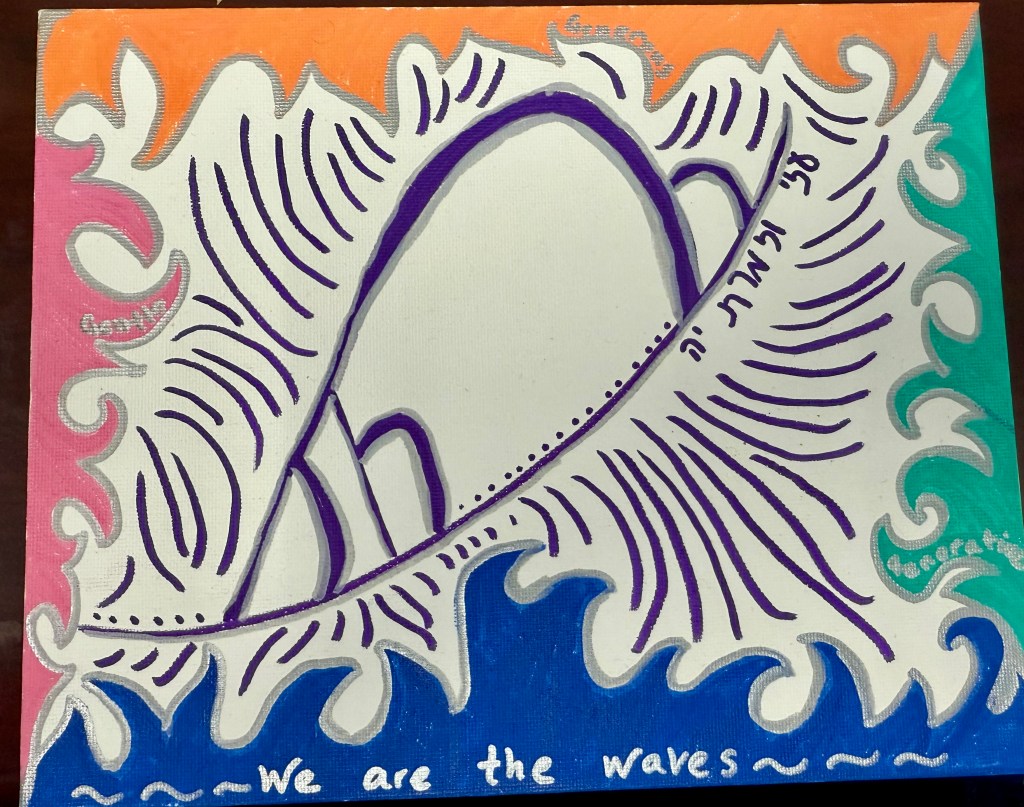
Strength and Song


עָזִּי וְזִמְרָת יָ וַיְהִי לִי לִישׁוּעָה
Ozi v’zimrat Yah
Vayehi li lishua

My strength (Ozi) and God’s song (Zimrat Yah) will be my salvation.

This prayer-song was my anthem for my final embryo transfer. Offered to me as medicine from my soul sisters on the Sunday of the Ohalah Shabbaton in January, I listened to recordings of my beloved friends singing me this song as I drove to doctors appointments and before most of my injections.

Ozi v’zimrat Yah. My strength and God’s song. We never know how the song will unfold. When I surrender to its music and I focus on my own strength, the parts of my life – and the parts of IVF – that I can control, it helps ease my passage through the dissonance I encounter along the way.

IVF – really, all pregnancy and birth, but especially IVF – are part miracle, part medicine. My strength and God’s song. Hope and hormones. Prayer, practicing trust, and doing everything we possibly can to make it work.

We did everything we could to make our final embryo transfer work on February 27th. And still, on March 10th, we found out the embryo didn’t even attach this time. I was not pregnant.
I’m not pregnant.

For a long time I felt guilty about even wanting or praying for another child, and I felt guilty asking my friends for support while I was trying. I leaned on community so heavily in my journey to Ella. Part of me felt like “I already got my miracle. Who am I to ask for another?” But we had always wanted two. That was our intention. Before the first miscarriage. Before infertility. Before the endo diagnosis. Before IVF. We dreamed of being a family of four. I wasn’t willing to give up on that, not while I still had remaining embryos. Even after my challenging pregnancy and birth experience with Ella, I wanted her to have a sibling. And knowing that we only had XY embryos left – we were really excited about the possibility of a baby brother.

But we miscarried the embryo we transferred in September and this final embryo didn’t attach. And we won’t be doing further medical intervention. The time for egg retrievals is behind us. It costs a fortune. My egg quality wasn’t great during all those retrievals and it’s certainly not better now. My body reacts so badly to the progesterone injections that doing this again with a donor egg isn’t an option either. After this transfer, I battled another infection at one of my injection sites. It was cellulitis – the same thing that landed me in the hospital in 2021. I caught it early this time and got antibiotics as soon as I knew. I am glad I listened to my body and went to the doctor instead of waiting longer.

While I battled the infection, Gulliver, our beloved 13-year-old labradoodle, got very sick. In just five days, we went from thinking we might gain a family member – to facing the very real possibility of losing one. I didn’t have capacity to reflect on the embryo loss while we were deciding if we should put Gulliver through the operation. Would they operate and find cancer, discovering that he had no chance at survival anyhow? Would they remove the spleen and find a benign tumor, prolonging his until-now happy and healthy life? Once again, we were standing at the crossroads of medicine and miracles. Our strength and God’s song. A doctor we trusted and an outcome we couldn’t. Just enough information to tell us we had a choice, but not enough to know if we had a decent chance. How would the song unfold this time?

We are so relieved that our sweet boy is healthy after all. We know Gulliver is a senior dog and we aren’t in denial about that. But for now, he is cancer-free, which means that he and Ella can make more happy memories together in the time he has. They shared a piece of pizza on Saturday, and it felt sacred.

It has been over seven years since my first pregnancy, and over five years since we started pursuing IVF. Seven years of trial and error. An endometriosis diagnosis. Countless ultrasounds, blood tests, laparoscopies, injections, miscarriages, tears, and everything else. At the same time – rabbinical school, a cross-country move for a rabbinic position, a child born, ordination received, and growing into my roles as rabbi and mother. Ozi. My strength. It took so much strength to get through it all. Looking back, realizing again how unlikely it was for IVF to work even once for someone like me, I’m so, so grateful that it did.

Ozi v’zimrat Yah
Vayehi li lishua
My strength and God’s song will be my salvation.

I have no regrets about the decisions we made. I am grateful that IVF – part medicine and part miracle – brought Ella into our lives, even while I grieve for the ones it couldn’t. We surrender what we can’t control, and do our best with what we can. We don’t know how the song will unfold, but this process has taught me that in the face of dissonance, the best thing I can do is continue, with all my strength, to sing along.

*Read more about Kohenet Bekah Starr’s art and teachings here

Our Imperfect Offerings

Sent to the Illini Hillel community on March 29, 2024

“Forget your perfect offering 
There is a crack in everything 
That’s how the light gets in.”
Leonard Cohen 

“Can I be a rabbi if I can’t sing?” I sobbed to one of my teachers in rabbinical school. I’d struggled for years to find my voice, taking lessons, trying to force myself to make sounds that just wouldn’t come out of my mouth. I practiced relentlessly, but it never seemed to be enough. My teacher was soothing and supportive, pointing out how many strengths I had, and the many gifts I would offer my future communities as a rabbi. And prayer isn’t about having a beautiful voice, after all, she said. It’s about connection. 

Similarly, many times, students have confessed to me that they don’t feel comfortable praying because they don’t know how to do it perfectly.  They don’t know Hebrew, are not sure about their relationship with God, or they don’t know what they “should” be doing during the silent part of the prayer service. I’m always happy to help students build their prayer skills, but I have to wonder how many times we’ve missed the point because we’re trying to make the perfect offering. Even beyond the world of prayer services, I recognize that many of us have missed opportunities to connect with ourselves or with others in a deeper way because we are afraid to fail.  

This week’s Torah portion is Parashat Tzav. Tzav means “command,” and the parsha opens with God telling Moses to command the priests to make offerings. The rest of the text details the long process of making a ritual sacrifice, and consequences for completing the ritual imperfectly. This long list of instructions may seem pedantic. But the language used in the parsha reveals additional meaning.  While “tzav” צו means “command” in Hebrew, this word is also related to tzavta צוותא, which means “connect,” or “bond” in Aramaic.  “Mitzvah” מצוה, which comes from the same word, means “commandment” and it means “connection.” Similarly, the Hebrew word for sacrifice is “korban,” קָרְבָּן‎ which comes from the root, “karav,”  קָרַב, meaning “to draw near.” God commanded us – tzav – to make sacrifices – korbanot – so we could tzavta – connect – and karov – draw near to the Divine Presence.  It was all about connection and closeness with something bigger than ourselves. 

After the Second Temple was destroyed in 70 CE,  we no longer had a place to make sacrifices. The Sages had to design new ways to connect with God, drawing near to the Sacred during a period of distance and exile from everything they knew.  The animals the priests offered in sacrifice at the Temple had to be unblemished, but without a Temple or priests, our ancestors understood that our offerings would no longer be perfect, or even uniform. Prayer was the innovation that came from this understanding. In the Temple’s absence, we learned to draw near to the Divine Presence that is alive in everything around us. We don’t need a Temple because our world is the temple. We don’t need priests because everyone can pray.

In Parashat Tzav, we are commanded three different times to never let the fire on the sacrificial altar go out.  Without a sacrificial altar at a Temple, the fire that must be tended is an internal one – the spark of the Divine that each of us carries inside.  19th century Polish rabbi, Sefat Emet שפת אמת‎, wrote that any “distracting thought that enters the heart” during prayer is consumed in that inner fire. “That, in fact, is the true purpose of all those thoughts that rise up within the heart; they are there to be overpowered in the fire of worship. In this way, those distracting thoughts are purified and uplifted.”  

Sefat Emet wants us to make our imperfect offerings. My distracting thoughts about my voice are there to fuel the fire inside me. The students’ feelings of uncertainty during prayer are there to do the same – to help them shed light on the reason why they pray, which is connection.  I don’t have to sing perfectly in order to pray through song or lead prayer services. I can lead in different ways, using poetry and meditation, or I can partner  with a strong vocalist. Most importantly, I’ve learned that I can still sing along with my community, letting the music move me into deeper connection with my community, and with the Divine.  This parsha teaches us that we have to keep that light burning. 

As we make our offerings on this Shabbat Tzav, if anything is holding you back, I invite you to consider the power of your imperfect praises, blessings, and prayers.  Let the light of hope and connection get in. And if you are looking for a place to start, I humbly offer the prayer below – an interpretive version of a prayer we say as part of the daily and Shabbat Amidah. The original prayer asks for a restoration of the Temple, the priests, and the sacrifices. Mine asks instead for acceptance of the words we offer up – wholly imperfect and perfectly holy. 

HaMakom,
Our prayers are the offering
and You are the Temple.

Our words rise to the sky 
like smoke from a flame,
swirling above what is burnt,
what is broken.

Holy One of Blessing,
please accept them all:
the words and wonder, 
the fear and awe.

Life is light and wood and burning.
Every offering we bring before You
is a way to draw near, a promise of our love. 

Barukh Atah Adonai, mekabel ha’olot 
Blessed are You, Holy One, Who accepts our offerings.

Rabbi Heather’s interpretive R’tzei prayer originally published on Ritualwell